Results by title
2 books match the query 'Ziegler, Edith M.'
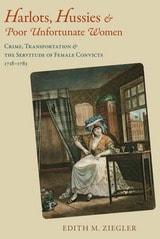
Harlots, Hussies, and Poor Unfortunate Women
Crime, Transportation, and the Servitude of Female Convicts, 1718-1783Edith M. Ziegler
University of Alabama Press, 2014
In Harlots, Hussies, and Poor Unfortunate Women, Edith M. Ziegler recounts the history of British convict women involuntarily transported to Maryland in the eighteenth century.
Great Britain’s forced transportation of convicts to colonial Australia is well known. Less widely known is Britain’s earlier program of sending convicts—including women—to North America. Many of these women were assigned as servants in Maryland. Titled using epithets that their colonial masters applied to the convicts, Edith M. Ziegler’s Harlots, Hussies, and Poor Unfortunate Women examines the lives of this intriguing subset of American immigrants.
Basing much of her powerful narrative on the experiences of actual women, Ziegler restores individual faces to women stripped of their basic freedoms. She begins by vividly invoking the social conditions of eighteenth-century Britain, which suffered high levels of criminal activity, frequently petty thievery. Contemporary readers and scholars will be fascinated by Ziegler’s explanation of how gender-influenced punishments were meted out to women and often ensnared them in Britain’s system of convict labor.
Ziegler depicts the methods and operation of the convict trade and sale procedures in colonial markets. She describes the places where convict servants were deployed and highlights the roles these women played in colonial Maryland and their contributions to the region’s society and economy. Ziegler’s research also sheds light on escape attempts and the lives that awaited those who survived servitude.
Mostly illiterate, convict women left few primary sources such as diaries or letters in their own words. Ziegler has masterfully researched the penumbra of associated documents and accounts to reconstruct the worlds of eighteenth-century Britain and colonial Maryland and the lives of these unwilling American settlers. In illuminating this little-known episode in American history, Ziegler also discusses not just the fact that these women have been largely forgotten, but why. Harlots, Hussies, and Poor Unfortunate Women makes a valuable contribution to American history, women’s studies, and labor history.
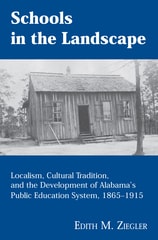
Schools in the Landscape
Localism, Cultural Tradition, and the Development of Alabama's Public Education System, 1865-1915Edith M. Ziegler
University of Alabama Press, 2010
Where culture met classroom—how Alabama’s past shaped its public schools.
Schools in the Landscape offers a richly detailed and deeply contextualized history of public education in Alabama during the transformative half-century following the Civil War. In this groundbreaking study, Edith M. Ziegler examines how localism, cultural tradition, and social conservatism shaped the development of Alabama’s public school system between 1865 and 1915—a period marked by Reconstruction, Redemption, and the entrenchment of racial segregation.
Ziegler explores how Alabama’s rural, economically challenged, and culturally conservative communities influenced the structure and function of public education. Drawing on a wide range of archival sources, she investigates the roles of teachers, schoolhouses, funding mechanisms, and community rituals in shaping educational experiences. The book also delves into the dual system of Black and white schools, highlighting the systemic inequalities and the resilience of African American communities in the face of institutionalized racism.
Through chapters on Progressive Era reforms, local festivals, and the symbolic role of schools in civic life, Ziegler reveals how education in Alabama was not merely a top-down initiative but a deeply local and contested process. Her analysis underscores the importance of understanding regional identity and cultural values in the broader narrative of American educational history.
Schools in the Landscape is essential reading for scholars of Southern history, education policy, and cultural studies, offering a nuanced portrait of how public schooling evolved in one of the nation’s most complex and tradition-bound regions.