Results by title
4 books match the query 'Zimmermann, Susan'

Divide, Provide and Rule
An Integrative History of Poverty Policy, Social Reform, and Social Policy in Hungary under the Habsburg MonarchySusan Zimmermann
Central European University Press, 2011

Silicone Survivors
Women's Experiences with Breast ImplantsSusan Zimmermann
Temple University Press, 1998
Some opted for breast implants after mastectomies, others for cosmetic reasons. Some felt empowered by the surgery: "Being a woman, I just like breasts and felt like I got ripped off. ... I did it for myself." Others were pressured by their husbands: "He used to make fun of parts of my body. .... And, he made me believe that if I was ever to leave him, no one would have anything to do with me because I was this deformed type of person."
After surgery, some women were ecstatic, while others had a sense of inner conflict about what they had done to themselves: were they "faking it"? And a few were angry: "I was really angry inside that I had had to put plastic bags filled with chemicals in my body in order for me to feel like I could do the Hoochie Koo on Saturday nights. ... I didn't wear tight clothes; I didn't want my children to find out."
Now, having faced years of medical and personal uncertainty, many have coped by reassessing their lives and their relationships, by sharing information and support with other women with implants, outreach that became a means for self-empowerment.
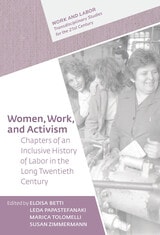
Women, Work, and Activism
Chapters of an Inclusive History of Labor in the Long Twentieth CenturyEloisa Betti
Central European University Press, 2022
The thirteen critical and well-documented chapters of Women, Work and Activism examine women’s labor struggle from late nineteenth-century Portuguese mutual societies to Yugoslav peasant women’s work in the 1930s, and from the Catalan labor movement under the Franco dictatorship to workplace democracy in the United States. The authors portray women's labor activism in a wide variety of contexts. This includes spontaneous resistance to masculinist trade unionism, the feminist engagement of women workers, the activism of communist wives of workers, and female long-distance migration, among others. The chapters address the gendered involvement of working people in multiple and often precarious and unstable labor relations and in unpaid labor, as well as the role of the state and other institutions in shaping the history of women’s labor.
The book is an innovative contribution to both the new labor history and feminist history. It fully integrates the conceptual advances made by gender historians in the study of labor activism, driving home critiques of Eurocentric historiographies of labor to Europe while simultaneously contributing to an inclusive history of women’s labor-related activism wherever to be found. Examining women’s activism in male-dominated movements and institutions, and in women’s networks and organizations, the authors make a case for a new direction in gender history.
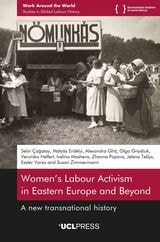
Women’s Labour Activism in Eastern Europe and Beyond
A New Transnational historySelin Çagatay, et al.
University College London, 2025
So often, theories of activism and social change neglect acts of resistance in informal, community, and domestic contexts. This collaborative investigation from a transnational team of scholars addresses two related shortcomings: the lack of class analysis in gender history and the neglect of gender dynamics in labor history. Women’s Labour Activism in Eastern Europe and Beyond highlights understudied topics in both of these fields, such as radical, grassroots, and interclass women’s labor activism on behalf of lower-income and working-class women and communities; women’s participation in trade unions on both sides of the Iron Curtain; and the heretofore neglected presence of Eastern European women in international organizations, including the cooperative movement.