Results by title
3 books match the query 'Zone'

Black Ecologies of Zone A
More-Than-Human Relations on New York's Colonial ShorelineAyasha Guerin
Duke University Press, 2027
In Black Ecologies of Zone A, Ayasha Guerin examines how the intertwined forces of colonialism, racial capitalism, and environmental transformation produced New York City’s coastal flood zones. Seen through the lens of Black ecologies, flooding is not a natural disaster, but a condition deliberately imposed through historical processes of landmaking, labor exploitation, and ecological disruption. Drawing on a range of resources like environmental and labor histories, law, archaeology, and memoir, they trace how centuries of settlement transformed wetlands, waterways, and shorelines into sites of extraction, enclosure, and vulnerability. However, Guerin also highlights waterfront spaces as sites of fugitivity, mutual aid, and abolitionist organizing where Black and Indigenous communities forge alternative relations of care and survival. Engaging contemporary artists alongside historical archives, Guerin foregrounds creative practice as a method for interpreting and reimagining socio-ecological histories, calling for relational repair grounded in ecological remediation, decolonization, and interspecies care.
[more]
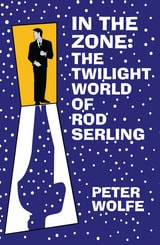
In the Zone
The Twilight World of Rod SerlingPeter Wolfe
University of Wisconsin Press, 1997
The classic television show The Twilight Zone explored the possibilities inhering in the ordinary. A Twilight Zone episode moved us by being poignant and intimate, rambunctious or thought provoking. But whether it takes place on an asteroid, in a city pool room, or in the backwoods, it will usually convey both a folklorist’s eye for detail and the born raconteur’s sense of pace. Rod Serling, the show’s originator, main scriptwriter, and artistic director, knew how much burden he could place on his rhetorical and dramatic gifts. Deservedly celebrated as a pioneer fiction writer for television, Serling always grounded his work in the human condition: he wrote movingly about history and loyalty, the grip of everyday reality, and the dangers of both forgetting about one’s ghosts and giving them the upper hand.
[more]
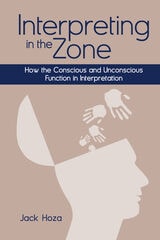
Interpreting in the Zone
How the Conscious and Unconscious Function in InterpretationJack Hoza
Gallaudet University Press, 2016
Successful interpretation can feel seamless, an intuitive and efficient translation of meaning from one signed or spoken language to another. Yet the process of interpretation is actually quite complex and relies upon myriad components ranging from preparation to experience to honed judgment. Interpreting in the zone, instinctively and confidently, is an energizing, encompassing experience that results in great satisfaction and top performance—but what does it take to get there?
Jack Hoza’s newest research examines the components that enable interpreters to perform successfully, looking at literature in interpretation, cognitive science, education, psychology, and neuroscience, as well as reviewing the results of two qualitative studies he conducted. He seeks to uncover what it means to interpret in the zone by understanding exactly how the brain works in interpretation scenarios. He explores a range of dichotomies that influence interpretation outcomes, such as:
- Intuition vs. rational thought
- Left brain vs. right brain
- Explicit vs. implicit learning
- Novice vs. master
- Spoken vs. signed languages
- Emotion vs. reasoning
Cognitive processes such as perception, short-term memory, and reflexivity are strong factors in driving successful interpretation and are explored along with habits, behaviors, and learned strategies that can help or hinder interpretation skills. Hoza also considers the importance of professional development and collaboration with other practitioners in order to continually hone expertise.
Interpreting in the Zone shows that cognitive research can help us better understand the intricacies of the interpreting process and has implications for how to approach the interpreting task. This resource will be of value to both the interpreter-in-training as well as the seasoned practitioner.
[more]