Results by title
7 books match the query 'Zorach, Rebecca'
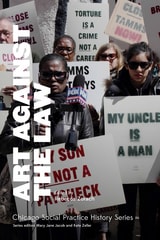
Art Against the Law
Edited by Rebecca Zorach
School of the Art Institute of Chicago, 2014
Despite the city's sometimes notorious political and social history, art practices that challenge authority have thrived in Chicago. Art Against the Law examines the creative tactics of the city’s activist artists and their ways of addressing the broad definitions of the law—from responses to excessive policing to inequities in public policy. These include creative forms of protest, rebellion against the law through illegal art practices, and using the political system itself as an art medium to alter existing laws. The essays and conversations in this volume also address the boundaries between art and creative activism and question whether lines should be drawn at all. Through these texts and interviews, Art Against the Law proves that creative imagination can be formidable in challenging the status quo.
Art Against the Law is part of the new Chicago Social Practice History series, edited by Mary Jane Jacob and Kate Zeller in the Department of Exhibitions and Exhibition Studies at the School of the Art Institute of Chicago (SAIC).
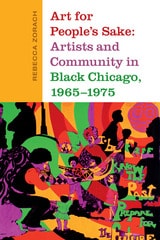
Art for People's Sake
Artists and Community in Black Chicago, 1965-1975Rebecca Zorach
Duke University Press, 2019
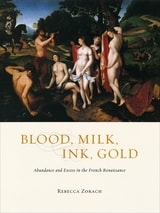
Blood, Milk, Ink, Gold
Abundance and Excess in the French RenaissanceRebecca Zorach
University of Chicago Press, 2005
Throughout the book, abundance and excess flow in liquids-blood, milk, ink, and gold-that highlight the materiality of objects and the human body, and explore the value (and values) accorded to them. The arts of the lavish royal court at Fontainebleau and in urban centers are here explored in a vibrant tableau that illuminates our own contemporary relationship to excess and desire.
From marvelous works by Francois Clouet to oversexed ornamental prints to Benvenuto Cellini's golden saltcellar fashioned for Francis I, Blood, Milk, Ink, Gold covers an astounding range of subjects with precision and panache, producing the most lucid, well-rounded portrait of the cultural politics of the French Renaissance to date.
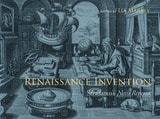
Renaissance Invention
Stradanus's Nova RepertaEdited by Lia Markey
Northwestern University Press, 2020
Renaissance Invention: Stradanus’s “Nova Reperta” seeks to understand why certain inventions or novelties were represented in the series and how that presentation reflected and fostered their adoption in the sixteenth century. What can Stradanus’s prints tell us about invention and cross-cultural encounter in the Renaissance? What was considered “new” in the era? Who created change and technological innovation?
Through images of group activities and interactions in workshops, Stradanus’s prints emphasize the importance of collaboration in the creation of new things, dispelling traditional notions of individual genius. The series also dismisses the assumption that the revival of the wonders of the ancient world in Italy was the catalyst for transformation. In fact, the Latin captions on the prints explain how contemporary inventions surpass those of the ancients. Together, word and image foreground the global nature of invention and change in the early modern period even as they promote specifically Florentine interests and activities.
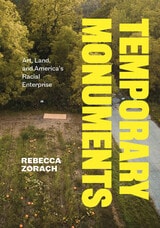
Temporary Monuments
Art, Land, and America's Racial EnterpriseRebecca Zorach
University of Chicago Press, 2024
Art has long played a key role in constructing how people understand and imagine America. Starting with contemporary controversies over public monuments in the United States, Rebecca Zorach carefully examines the place of art in the occupation of land and the upholding of White power in the US, arguing that it has been central to the design of America’s racial enterprise. Confronting closely held assumptions of art history, Zorach looks to the intersections of art, nature, race, and place, working through a series of symbolic spaces—the museum, the wild, islands, gardens, home, and walls and borders—to open and extend conversations on the political implications of art and design.
Against the backdrop of central moments in American art, from the founding of early museums to the ascendancy of abstract expressionism, Zorach shows how contemporary artists—including Dawoud Bey, Theaster Gates, Maria Gaspar, Kerry James Marshall, Alan Michelson, Dylan Miner, Postcommodity, Cauleen Smith, and Amanda Williams—have mined the relationship between environment and social justice, creating works that investigate and interrupt White supremacist, carceral, and environmentally toxic worlds. The book also draws on poetry, creative nonfiction, hip-hop videos, and Disney films to illuminate crucial topics in art history, from the racial politics of abstraction to the origins of museums and the formation of canons.
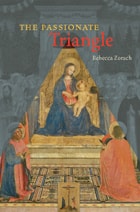
The Passionate Triangle
Rebecca Zorach
University of Chicago Press, 2011
Triangles abounded in the intellectual culture of early modern Europe—the Christian Trinity was often mapped as a triangle, for instance, and perspective, a characteristic artistic technique, is based on a triangular theory of vision. Renaissance artists, for their part, often used shapes and lines to arrange figures into a triangle on the surface of a painting—a practice modern scholars call triangular composition. But is there secret meaning in the triangular arrangements artists used, or just a pleasing symmetry? What do triangles really tell us about the European Renaissance and its most beguiling works of art?
In this book, Rebecca Zorach takes us on a lively hunt for the triangle’s embedded significance. From the leisure pursuits of Egyptian priests to Jacopo Tintoretto’s love triangles, Zorach explores how the visual and mathematical properties of triangles allowed them to express new ideas and to inspire surprisingly intense passions. Examining prints and paintings as well as literary, scientific, and philosophical texts, The Passionate Triangle opens up an array of new ideas, presenting unexpected stories of the irrational, passionate, melancholic, and often erotic potential of mathematical thinking before the Scientific Revolution.
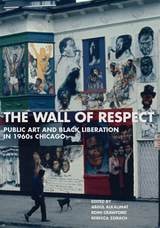
The Wall of Respect
Public Art and Black Liberation in 1960s ChicagoEdited by Abdul Alkalimat, Romi Crawford, and Rebecca Zorach
Northwestern University Press, 2017
The Wall of Respect received national critical acclaim when it was unveiled on the side of a building at Forty-Third and Langley in Chicago’s Bronzeville neighborhood. Painters and photographers worked side by side on the mural's seven themed sections, which featured portraits of Black heroes and sheroes, among them John Coltrane, Nina Simone, Billie Holiday, Malcolm X, Muhammad Ali, and W. E. B. Du Bois. The Wall became a platform for music, poetry, and political rallies. Over time it changed, reflecting painful controversies among the artists as well as broader shifts in the Civil Rights and Black Liberation Movements.
At the intersection of African American culture, politics, and Chicago art history, The Wall of Respect offers, in one keepsake-quality work, an unsurpassed collection of images and essays that illuminate a powerful monument that continues to fascinate artists, scholars, and readers in Chicago and across the United States.