Results by title

8 books match the query 'Zulu (African people)'
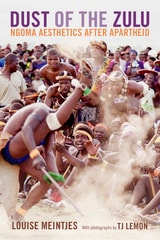
cover of Dust of the Zulu: Ngoma Aesthetics after Apartheid

Dust of the Zulu

Ngoma Aesthetics after Apartheid

Louise Meintjes

Duke University Press, 2017
In Dust of the Zulu Louise Meintjes traces the political and aesthetic significance of ngoma, a competitive form of dance and music that emerged out of the legacies of colonialism and apartheid in South Africa. Contextualizing ngoma within South Africa's history of violence, migrant labor, the HIV epidemic, and the world music market, Meintjes follows a community ngoma team and its professional subgroup during the twenty years after apartheid's end. She intricately ties aesthetics to politics, embodiment to the voice, and masculine anger to eloquence and virtuosity, relating the visceral experience of ngoma performances as they embody the expanse of South African history. Meintjes also shows how ngoma helps build community, cultivate responsible manhood, and provide its participants with a means to reconcile South Africa's past with its postapartheid future. Dust of the Zulu includes over one hundred photographs of ngoma performances, the majority taken by award-winning photojournalist TJ Lemon.
[more]
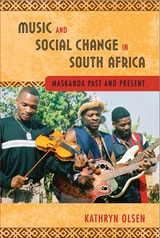
cover of Music and Social Change in South Africa: Maskanda Past and Present

Music and Social Change in South Africa

Maskanda Past and Present

Kathryn Olsen

Temple University Press, 2014

Music and Social Change in South Africa looks at contemporary maskanda-a folk musical genre distinguished by fast guitar picking and blues-style vocal intonation-against the backdrop of South Africa's history. A performance practice that emerged in the early decades of the twentieth century among Zulu migrant workers, maskanda is strongly associated with young Zulu men's experiences of repression and dislocation during imperial and, more particularly, apartheid rule.
 
Working closely with translated song lyrics and musical notation-and applying musical and socio-political analysis to this music and its cultural context-Olsen argues that maskanda offers insight into how the post-apartheid ideal of social transformation is experienced by those who were marginalized for most of the twentieth century. 
 
Drawing on a decade of research, Olsen strives to demystify the Zulu part of contemporary experience in South Africa and to reveal some of the complexities of the social, economic, and political landscape of contemporary South Africa.

[more]
cover of Myth of Iron: Shaka in History

Myth of Iron

Shaka in History

Dan Wylie

Ohio University Press, 2008

Over the decades a great deal has been written about Shaka, the most famous—or infamous—of Zulu leaders. It may come as a surprise, therefore, that even the most basic facts about his life are locked in obscurity. His date of birth, what he looked like, and the circumstances of his assassination remain unknown.

Meanwhile the public image, sometimes monstrous, sometimes heroic, juggernauts on—truly a “myth of iron” that is so intriguing, so dramatic, so archetypal, and sometimes so politically useful that few have subjected it to proper scrutiny.

Myth of Iron: Shaka in History is the first book-length scholarly study of Shaka to be published. It lays out, as far as possible, all the available evidence—mainly hitherto underutilized Zulu oral testimonies, supported by other documentary sources—and decides, item by item, legend by legend, what exactly is known about Shaka’s reign. The picture that emerges in this meticulously researched and absorbing antibiography is very different from the popular narrative.
[more]
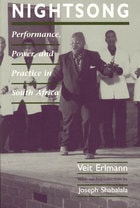
cover of Nightsong: Performance, Power, and Practice in South Africa

Nightsong

Performance, Power, and Practice in South Africa

Veit Erlmann

University of Chicago Press, 1996

First popularized by Ladysmith Black Mambazo and Paul Simon, the a cappella music known as isicathamiya has become internationally celebrated as one of South Africa's most vibrant and distinct performance traditions. But Ladysmith Black Mambazo is only one of hundreds of choirs that perform "nightsongs" during weekly all-night competitions in South Africa's cities.

Veit Erlmann provides the first comprehensive interpretation of isicathamiya performance practice and its relation to the culture and consciousness of the Zulu migrant laborers who largely compose its choirs. In songs and dances, the performers oppose the class and racial oppression that reduces them to "labor units." At the same time, Erlmann argues, the performers rework dominant images to symbolically reconstruct their "home," an imagined world of Zulu rural tradition and identity.

By contrasting the live performance of isicathamiya to its reproduction in mass media, recordings, and international concerts, Erlmann addresses important issues in performance studies and anthropology, and looks to the future of isicathamiya live performance in the new South Africa. Featuring an Introduction by Joseph Shabalala, the lead singer and founder of Ladysmith Black Mambazo, this book will be essential reading for anyone interested in the study of music, performance, popular culture, or South Africa.
[more]
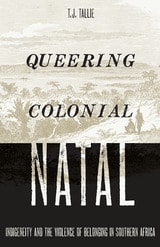
cover of Queering Colonial Natal: Indigeneity and the Violence of Belonging in Southern Africa

Queering Colonial Natal

Indigeneity and the Violence of Belonging in Southern Africa

T. J. Tallie

University of Minnesota Press, 2019

How were indigenous social practices deemed queer and aberrant by colonial forces?


In Queering Colonial Natal, T.J. Tallie travels to colonial Natalestablished by the British in 1843, today South Africa’s KwaZulu-Natal provinceto show how settler regimes “queered” indigenous practices. Defining them as threats to the normative order they sought to impose, they did so by delimiting Zulu polygamy; restricting alcohol access, clothing, and even friendship; and assigning only Europeans to government schools. 

Using queer and critical indigenous theory, this book critically assesses Natal (where settlers were to remain a minority) in the context of the global settler colonial project in the nineteenth century to yield a new and engaging synthesis. Tallie explores the settler colonial history of Natal’s white settlers and how they sought to establish laws and rules for both whites and Africans based on European mores of sexuality and gender. At the same time, colonial archives reveal that many African and Indian people challenged such civilizational claims. 

Ultimately Tallie argues that the violent collisions between Africans, Indians, and Europeans in Natal shaped the conceptions of race and gender that bolstered each group’s claim to authority. 
[more]
cover of Rituals of Fertility and the Sacrifice of Desire: Nazarite Women's Performance in South Africa

Rituals of Fertility and the Sacrifice of Desire

Nazarite Women's Performance in South Africa

Carol Ann Muller

University of Chicago Press, 1999

With close to one million members, the Church of the Nazarites (ibandla lamaNazaretha) is one of the most popular indigenous religious communities in South Africa. Founded in 1910 by Isaiah Shembe, it offers South Africans—particularly disadvantaged black women and girls—a way to remake and reconnect to ancient sacred traditions disrupted by colonialism and apartheid. Ethnomusicologist Carol Muller explores the everyday lives of Nazarite women through their religious songs and dances, dream narratives, and fertility rituals, which come to life both musically and visually on CD-ROM.

Against the backdrop of South Africa's turbulent history, Muller shows how Shembe's ideas of female ritual purity developed as a response to a regime and culture that pushed all things associated with women, cultural expression, and Africanness to the margins.

Carol Muller breaks new ground in the study of this changing region and along the way includes fascinating details of her own poignant journey, as a young, white South African woman, to the "other" side of a divided society.

[more]
cover of Speech and Song at the Margins of Global Health: Zulu Tradition, HIV Stigma, and AIDS Activism in South Africa

Speech and Song at the Margins of Global Health

Zulu Tradition, HIV Stigma, and AIDS Activism in South Africa

Steven P. Black

Rutgers University Press, 2019
Speech and Song at the Margins of Global Health tells the story of a unique Zulu gospel choir comprised of people living with HIV in South Africa, and how they maintained healthy, productive lives amid globalized inequality, international aid, and the stigma that often comes with having HIV. By singing, joking, and narrating about HIV in Zulu, the performers in the choir were able to engage with international audiences, connect with global health professionals, and also maintain traditional familial respect through the prism of performance. The focus on gospel singing in the narrative provides a holistic viewpoint on life with HIV in the later years of the pandemic, and the author’s musical engagement led to fieldwork in participants’ homes and communities, including the larger stigmatized community of infected individuals. This viewpoint suggests overlooked ways that aid recipients contribute to global health in support, counseling, and activism, as the performers set up instruments, waited around in hotel lobbies, and struck up conversations with passersby and audience members. The story of the choir reveals the complexity and inequities of global health interventions, but also the positive impact of those interventions in the crafting of community.
[more]
cover of The Other Zulus: The Spread of Zulu Ethnicity in Colonial South Africa

The Other Zulus

The Spread of Zulu Ethnicity in Colonial South Africa

Michael R. Mahoney

Duke University Press, 2012

In 1879, the British colony of Natal invaded the neighboring Zulu kingdom. Large numbers of Natal Africans fought with the British against the Zulus, enabling the British to claim victory and, ultimately, to annex the Zulu kingdom. Less than thirty years later, in 1906, many of those same Natal Africans, and their descendants, rebelled against the British in the name of the Zulu king. In The Other Zulus, a thorough history of Zulu ethnicity during the colonial period, Michael R. Mahoney shows that the lower classes of Natal, rather than its elites, initiated the transformation in ethnic self-identification, and they did so for multiple reasons. The resentment that Natal Africans felt toward the Zulu king diminished as his power was curtailed by the British. The most negative consequences of colonialism may have taken several decades to affect the daily lives of most Africans. Natal Africans are likely to have experienced the oppression of British rule more immediately and intensely in 1906 than they had in 1879. Meanwhile, labor migration to the gold mines of Johannesburg politicized the young men of Natal. Mahoney's fine-grained local history shows that these young migrants constructed and claimed a new Zulu identity, both to challenge the patriarchal authority of African chiefs and to fight colonial rule.
[more]