Results by title
6 books match the query 'background'
A Fateful Time
The Background And Legislative History Of The Indian Reorganization ActElmer R. Rusco
University of Nevada Press, 2026
The Indian Reorganization Act (IRA) of 1934 has been generally acknowledged as the most important statute affecting Native Americans after the General Allotment Act of 1887, and it is probably the most important single statute affecting Native Americans during the two-thirds of a century since its passage. Over half the Native governments in the contemporary U.S. are organized under its provisions or under separate statutes that parallel the IRA in major ways. Although the impact of the IRA has been widely studied and debated, no scholar until now has looked closely at the forces that shaped its creation and passage. Author Elmer Rusco spent over a decade of research in national and regional archives and other repositories to examine the legislative intent of the IRA, including the role of issues like the nature and significance of judge-made Indian law; the allotment policy and its relation to Indian self-government; the nature of Native American governments before the IRA; the views and actions of John Collier, commissioner of Indian Affairs and leader in the campaign to reform the nation’s Indian policy; and the influence of relations between the president and Congress during the second year of the New Deal. Rusco also discusses the role of conflicting ideologies and interests in this effort to expand the rights of Native Americans; the general ignorance of Native American concerns and policy on the part of legislators engaged in the writing and passage of the law; and the limited but crucial impact of Indian involvement in the struggle over the IRA.
Aquinas's Summa
background, structure, & receptionJean-Pierre Torrell
Catholic University of America Press, 2005

Background of Thomson’s Seasons
Alan Dugald McKillop
University of Minnesota Press, 1942
Background of Thomson's Seasons was first published in 1942. Minnesota Archive Editions uses digital technology to make long-unavailable books once again accessible, and are published unaltered from the original University of Minnesota Press editions.
There have been many valuable scattered studies of James Thomson's famous Seasons,but this is the first comprehensive book on the subject to be published in this country. This most popular long poem published in England in the eighteenth century well deserves reexamination. It is interesting not only to students of literature but also to those concerned with the history of ideas and the relationship of the fields of human knowledge.
Thomson's Seasons reflects the trends of his time in literature, philosophy, science, history, and religion. Professor McKillop presents an illuminating and systematic analysis of the general philosophic and literary situation in which Thomson worked. Then he discusses Thomson's use of the natural sciences and of the literature of history, geography, and travel. He shows that the poet was also concerned with the patterns of human society, both primitive and civilized.
The author reveals clearly how Thomson was indebted to the classical tradition; to the literary inspiration of Milton; to the scientific discussions and theories of Newton, Halley, Burnet, and the writers of popular physico-theological manuals; to the philosophical discussions of Shaftesbury and Locke; to the contemporary periodical essay; to the religious works of Blackmore and Hill; to the descriptions of remote regions and peoples in such writers as Scheffer, Varenius, and Maupertuis. All Thomson's borrowings and characteristic ideas fall into the framework of his poem.
As this book was leaving the bindery, discovery was made in Glasgow of a catalogue of Thomson's library. The document substantiates many of Professor McKillop's deductions.

Music in the Background
Bryce G. Boyer
Bridwell Press, 2026
I’ve been a professional journalist for over 50 years now, a prose writer whose favorite form is the essay. But there are emotions that poetry seems to capture better than prose. Not unique emotions because there are no such things as unique emotions, only the emotions shared by all of us, shared by the whole world. For me, prose seems much more observational, more a reflection of what our senses present and whatever meaning we attach to that reflection. Poetry is more an attempt to understand our feelings by digging down into ourselves like a spelunker explores a cave. The cave is ourselves, and we try to discover—or more probably uncover—what's down there that makes us human. In these few poems I've tried to throw a small flashlight beam on a few of those places down there.
The Background of Swedish Emigration to the United States
An Economic and Sociological Study in the Dynamics of MigrationJohn Lindberg
University of Minnesota Press, 1930
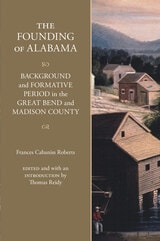
The Founding of Alabama
Background and Formative Period in the Great Bend and Madison CountyFrances Cabaniss Roberts, edited and introduced by Thomas Reidy
University of Alabama Press, 2020
The most thorough history of Alabama’s Madison County region, widely available for the first time
The 1956 dissertation by Frances Cabaniss Roberts is a classic text on Alabama history that continues to be cited by southern historians. Roberts was the first woman to earn a PhD from the University of Alabama’s history department. In the 1950s, she was the only full-time faculty member at what is now the University of Alabama in Huntsville, where she was appointed chair of the history department in 1966.
Roberts’s dissertation, “Background and Formative Period in the Great Bend and Madison County,” remains the most thorough history of the region yet produced. While certainly a product of its era, Roberts work is visionary in its own way and offers a useful look at Alabama’s rise to statehood. Thomas Reidy, editor of this edition, has kept Roberts’s words intact except for correction of minor typographical errors and helpful additions to the notes and citations. His introduction describes both the value of Roberts’s decades of service to UAH and the importance of her dissertation over time. While highlighting the great intrinsic value of Roberts’s research and writing, Reidy also notes its significance in demonstrating how the practice of history—its methods, priorities, and values—has evolved over the intervening decades.
In her examination of Madison County, Roberts spotlights exemplars of civic performance and good community behavior, giving readers one of the earliest accountings of the antebellum southern middle class. Unlike many historians of her time, Roberts displays an interest in both the “common folks” and leaders who built the region—rural and urban—and created the institutions that shaped Madison County. She examines the contributions of merchants, shopkeepers, lawyers, doctors, architects, craftsmen, planters, farmers, elected and appointed officials, board members, and entrepreneurs.