Results by title
5 books match the query 'duBois, Page'
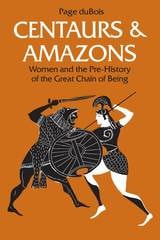
Centaurs and Amazons
Women and the Pre-History of the Great Chain of BeingPage duBois
University of Michigan Press, 1991
In Centaurs and Amazons, Page duBois offers a prehistory of hierarchy. Using structural anthropology, symbolic analysis, and recent literary theory, she demonstrates a shift in Greek thought from the fifth to the fourth century B.C. that had a profound influence upon subsequent Western culture and politics.
Through an analysis of mythology, drama, sculpture, architecture, and Greek vase painting, duBois documents the transition from a system of thought that organized the experience of difference in terms of polarity and analogy to one based upon a relatively rigid hierarchical scheme. This was the beginning of "the great chain of being," the philosophical construct that all life was organized in minute gradations of superiority and inferiority. This scheme, in various guises, has continued to influence philosophical and political thought.
The author's intelligent and discriminating use of scholarship from various fields makes Centaurs and Amazons an impressive interdisciplinary study of interest to classicists, feminist scholars, historians, art historians, anthropologists, and political scientists.

Democratic Swarms
Ancient Comedy and the Politics of the PeoplePage duBois
University of Chicago Press, 2022
With Democratic Swarms, Page duBois revisits the role of Greek comedy in ancient politics, considering how it has been overlooked as a political medium by modern theorists and critics. Moving beyond the popular readings of ancient Greece through the lens of tragedy, she calls for a revitalized look at Greek comedy. Rather than revisiting the sufferings of Oedipus and his family or tragedy’s relationship to questions of sovereignty, this book calls for comedy—its laughter, its free speech, its wild swarming animal choruses, and its rebellious women—to inform another model of democracy.
Ancient comedy has been underplayed in the study of Greek drama. Yet, with the irrepressible energy of the comic swarm, it provides a unique perspective on everyday life, gender and sexuality, and the utopian politics of the classical period of Athenian democracy. Using the concepts of swarm intelligence and nomadic theory, duBois augments tragic thought with the resistant, utopian, libidinous, and often joyous communal legacy of comedy, and she connects the lively anti-authoritarianism of the ancient comic chorus with the social justice movements of today.
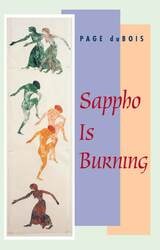
Sappho Is Burning
Page duBois
University of Chicago Press, 1995
In Sappho is Burning, duBois reads Sappho as a disruptive figure at the very origin of our story of Western civilization. Sappho is beyond contemporary categories, inhabiting a space outside of reductively linear accounts of our common history. She is a woman, but also an aristocrat, a Greek, but one turned toward Asia, a poet who writes as a philosopher before philosophy, a writer who speaks of sexuality that can be identified neither with Michel Foucault's account of Greek sexuality, nor with many versions of contemporary lesbian sexuality. She is named as the tenth muse, yet the nine books of her poetry survive only in fragments. She disorients, troubles, undoes many certitudes in the history of poetry, the history of philosophy, the history of sexuality. DuBois argues that we need to read Sappho again.
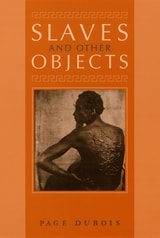
Slaves and Other Objects
Page duBois
University of Chicago Press, 2003
DuBois begins her study by exploring the material culture of slavery, including how most museum exhibits erase the presence of slaves in the classical world. Shifting her focus to literature, she considers the place of slaves in Plato's Meno, Aristotle's Politics, Aesop's Fables, Aristophanes' Wasps, and Euripides' Orestes. She contends throughout that portraying the difference between slave and free as natural was pivotal to Greek concepts of selfhood and political freedom, and that scholars who idealize such concepts too often fail to recognize the role that slavery played in their articulation.
Opening new lines of inquiry into ancient culture, Slaves and Other Objects will enlighten classicists and historians alike.

Sowing the Body
Psychoanalysis and Ancient Representations of WomenPage duBois
University of Chicago Press, 1988