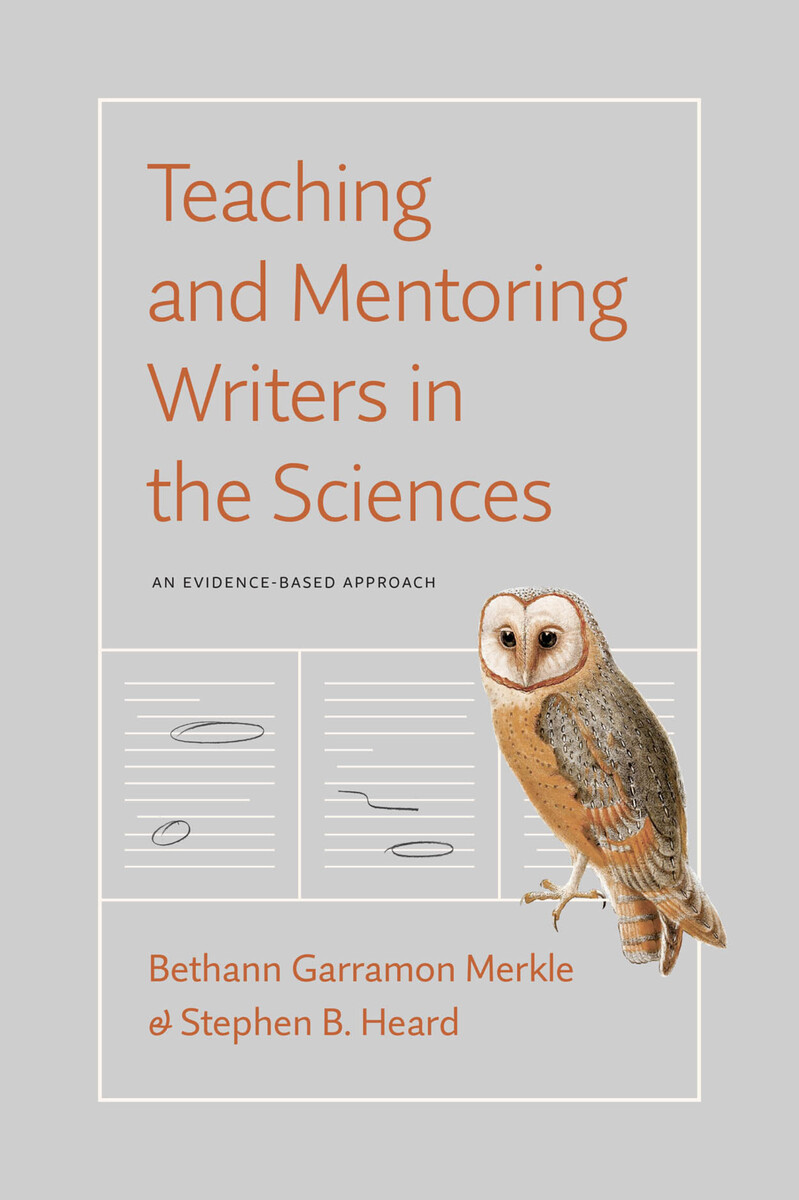
Teaching and Mentoring Writers in the Sciences: An Evidence-Based Approach
University of Chicago Press, 2025
Cloth: 978-0-226-82932-6 | Paper: 978-0-226-84388-9 | eISBN: 978-0-226-84387-2 (all)
Library of Congress Classification BX1959.5.S48 1995
Dewey Decimal Classification 238.2
Cloth: 978-0-226-82932-6 | Paper: 978-0-226-84388-9 | eISBN: 978-0-226-84387-2 (all)
Library of Congress Classification BX1959.5.S48 1995
Dewey Decimal Classification 238.2
ABOUT THIS BOOK | AUTHOR BIOGRAPHY | REVIEWS | TOC | REQUEST ACCESSIBLE FILE
ABOUT THIS BOOK
Blending deep experience, humor, and evidence-based advice, this is an invaluable resource for everyone involved in developing good scientific writers.
Every scientist eventually teaches scientific writing or mentors junior scientists as they develop their writing skills—only to discover that the task is both challenging and remarkably time-consuming. If you are in this position, Teaching and Mentoring Writers in the Sciences is the resource you need, offering approaches that will help you help writers develop their skills more effectively and with less time and effort.
Bethann Garramon Merkle and Stephen B. Heard, both experts in scientific communication, offer evidence-based advice that draws on their own extensive experience as well as on proven tactics from writing studies, science studies, and rhetoric and composition. Shorn of the unfamiliar and off-putting jargon that much pedagogy literature adopts, their advice is engaging and accessible to scientists. As you read, you’ll see where developing writers are coming from; how mastering scientific writing matters to the careers of students who do and don’t continue in academia; how writing occurs and is taught in both undergraduate and graduate curricula; how to find and harness teaching resources that help share the workload; how to teach writing to students who speak English as an additional language; and how to navigate the use (by yourself and by developing writers) of tools from pencils and dictionaries to AI writing assistants. If you teach or mentor scientific writers, this book will help you deliver what your students and mentees need most: clear, effective writing guidance.
See other books on: Academic & Scholarly | Catechisms | Catechismus Ecclesiae Catholicae | Sciences | Study & Teaching
See other titles from University of Chicago Press