Paper: 978-0-87154-839-9
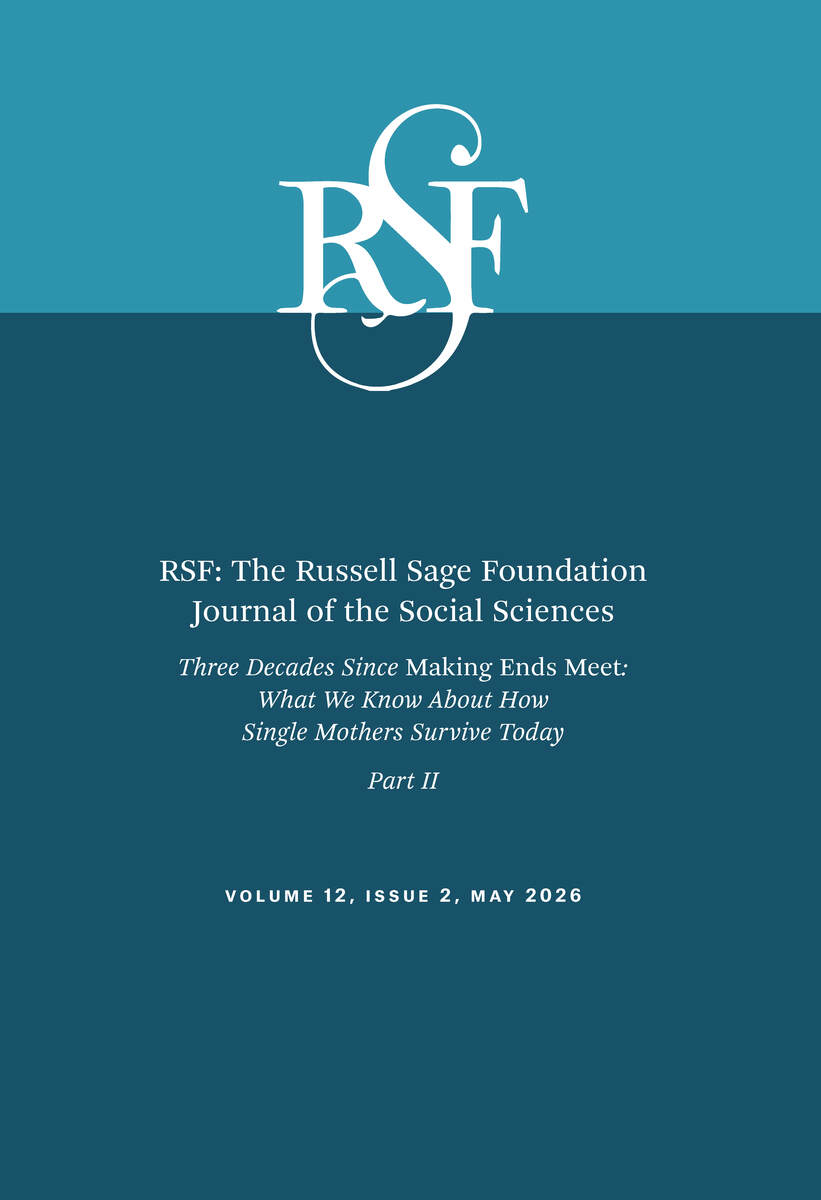
In their seminal 1995 book Making Ends Meet: How Low-Income Single Mothers Survive Welfare and Low-Wage Employment, Kathryn Edin and Laura Lein laid bare the strategies and challenges of low-income single mothers who were struggling to provide for their families. Even in an era when cash welfare was a federal entitlement, these women struggled to get by. In the thirty years since the book’s publication, many single parents wrestle with volatility and precarious resources from work, informal and formal supports. In this double issue of RSF, economist Elizabeth O. Ananat, political scientist and public policy scholar Carolyn Y. Barnes, sociologists Sandra K. Danziger and Kathryn Edin, and an interdisciplinary group of contributors examine how the policy landscape has changed since welfare reform and how it impacts low-income single mothers’ ability to make ends meet today.
Issue 1 has 8 articles that examine how the traditional safety net has evolved and new supports that have been developed since Making Ends Meet. For example, Sarah K. Bruch and colleagues assess changes to the social safety net since welfare reform in the 1990s and find that benefits have become more exclusive, have more constraints, and are less generous. Kelley Fong and Nora McCarthy reveal that, in an attempt to decrease child maltreatment, the child welfare system increasingly provides material resources to system-involved parents, including in-kind donations and assistance accessing childcare. However, parents often avoid obtaining resources through the system because it opens them up to increased state surveillance. Heather D. Hill and colleagues show that access to paid family and medical leave (PFML) varies greatly for single mothers, with two-thirds of single mothers living in states without PMFL. For those who live in states with PFML, the accessibility and generosity of benefits vary greatly.
Issue 2 has 5 articles that look at lessons that can be learned from COVID Era policies, how single mothers currently try to make ends meet, and men’s contributions to families. For example, Natasha V. Pilkauskas and Kevin Bruey find that low-income single mothers, with and without employment, utilize a variety of public and private resources to make ends meet. Despite this, both groups face high levels of material hardship, including food and housing insecurity. Hope Harvey examines how members of doubled up households understand their economic and social relationships and reveals that there are often disagreements about shared resources, such as money and food. However, it is not just the precise contributions that cause conflict, but how the exchanges are interpreted within the context of household members’ relationships. Allison Dwyer Emory and colleagues show that nonresident fathers often have trouble making ends meet themselves and are unable to make up for the loss of cash support post-welfare reform.
This double issue of RSF showcases the persistence of precarity that low-income families face since Making Ends Meet.
Note: This copy refers to both issues of the journal double issue.
See other books on: Human Services | Minority Studies | RSF | Russell Sage Foundation Journal | Social Services & Welfare
See other titles from Russell Sage Foundation