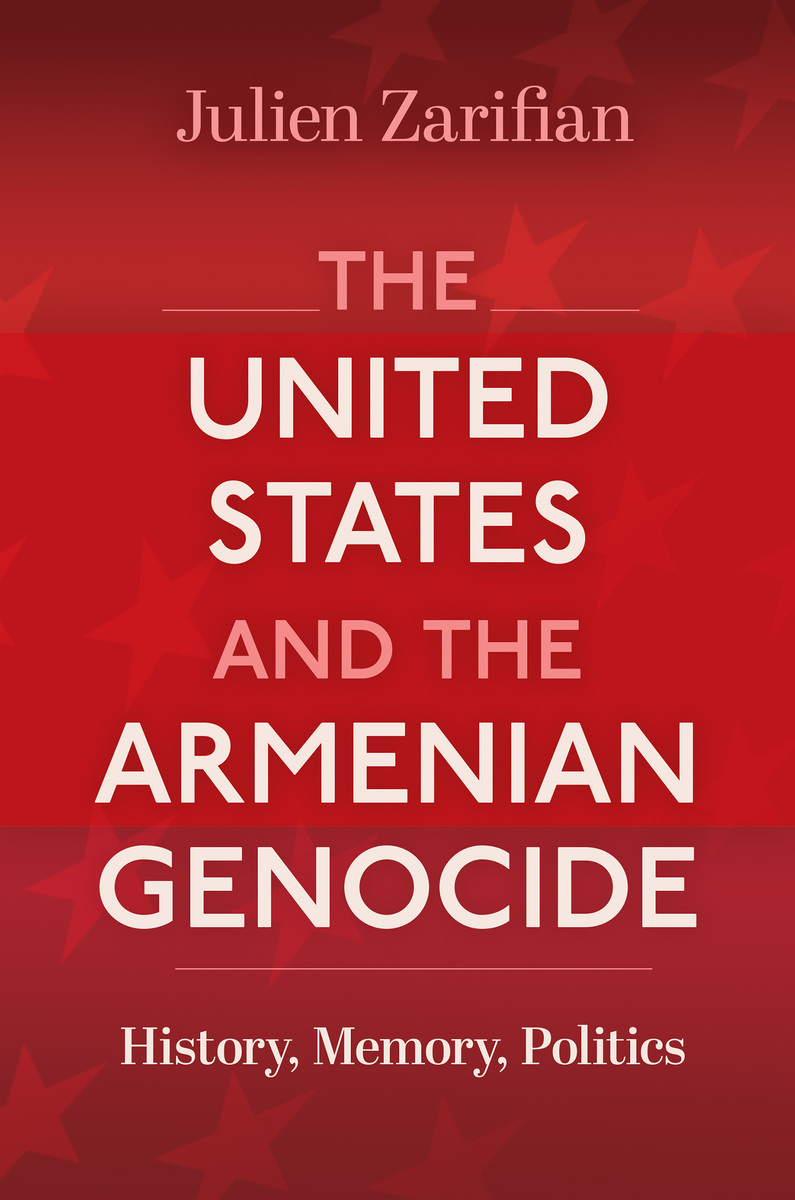
The United States and the Armenian Genocide: History, Memory, Politics
Rutgers University Press, 2024
Cloth: 978-1-9788-3793-5 | Paper: 978-1-9788-3792-8 | eISBN: 978-1-9788-3794-2 (ePub) | eISBN: 978-1-9788-3795-9 (PDF)
Library of Congress Classification DS195.5.Z38 2024
Dewey Decimal Classification 956.620154
Cloth: 978-1-9788-3793-5 | Paper: 978-1-9788-3792-8 | eISBN: 978-1-9788-3794-2 (ePub) | eISBN: 978-1-9788-3795-9 (PDF)
Library of Congress Classification DS195.5.Z38 2024
Dewey Decimal Classification 956.620154
ABOUT THIS BOOK | AUTHOR BIOGRAPHY | REVIEWS | TOC
ABOUT THIS BOOK
During the first World War, over a million Armenians were killed as Ottoman Turks embarked on a bloody campaign of ethnic cleansing. Scholars have long described these massacres as genocide, one of Hitler’s prime inspirations for the Holocaust, yet the United States did not officially recognize the Armenian Genocide until 2021.
This is the first book to examine how and why the United States refused to acknowledge the Armenian Genocide until the early 2020s. Although the American government expressed sympathy towards the plight of the Armenians in the 1910s and 1920s, historian Julien Zarifian explores how, from the 1960s, a set of geopolitical and institutional factors soon led the United States to adopt a policy of genocide non-recognition which it would cling to for over fifty years, through Republican and Democratic administrations alike. He describes the forces on each side of this issue: activists from the US Armenian diaspora and their allies, challenging Cold War statesmen worried about alienating NATO ally Turkey and dealing with a widespread American reluctance to directly confront the horrors of the past. Drawing from congressional records, rare newspapers, and interviews with lobbyists and decision-makers, he reveals how genocide recognition became such a complex, politically sensitive issue.
This is the first book to examine how and why the United States refused to acknowledge the Armenian Genocide until the early 2020s. Although the American government expressed sympathy towards the plight of the Armenians in the 1910s and 1920s, historian Julien Zarifian explores how, from the 1960s, a set of geopolitical and institutional factors soon led the United States to adopt a policy of genocide non-recognition which it would cling to for over fifty years, through Republican and Democratic administrations alike. He describes the forces on each side of this issue: activists from the US Armenian diaspora and their allies, challenging Cold War statesmen worried about alienating NATO ally Turkey and dealing with a widespread American reluctance to directly confront the horrors of the past. Drawing from congressional records, rare newspapers, and interviews with lobbyists and decision-makers, he reveals how genocide recognition became such a complex, politically sensitive issue.
See other books on: Armenia | Genocide | Genocide & War Crimes | Turkey | Turkey & Ottoman Empire
See other titles from Rutgers University Press