
 A SCHOLARLY BOOK REPOSITORY
Browse by Title
3 books by Aiello, Thomas
3 books by Aiello, Thomas
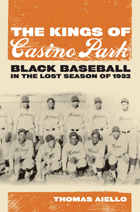
The Kings of Casino Park
Black Baseball in the Lost Season of 1932
Thomas Aiello
University of Alabama Press, 2011
In the 1930s, Monroe, Louisiana, was a town of twenty-six thousand in the northeastern corner of the state, an area described by the New Orleans Item as the “lynch law center of Louisiana.” race relations were bad, and the Depression was pitiless for most, especially for the working class—a great many of whom had no work at all or seasonal work at best. Yet for a few years in the early 1930s, this unlikely spot was home to the Monarchs, a national-caliber Negro League baseball team. Crowds of black and white fans eagerly filled their segregated grandstand seats to see the players who would become the only World Series team Louisiana would ever generate, and the first from the American South.
By 1932, the team had as good a claim to the national baseball championship of black America as any other. Partisans claim, with merit, that league officials awarded the National Championship to the Chicago American Giants in flagrant violation of the league’s own rules: times were hard and more people would pay to see a Chicago team than an outfit from the Louisiana back country. Black newspapers in the South rallied to support Monroe’s cause, railing against the league and the bias of black newspapers in the North, but the decision, unfair though it may have been, was also the only financially feasible option for the league’s besieged leadership, who were struggling to maintain a black baseball league in the midst of the Great Depression.
Aiello addresses long-held misunderstandings and misinterpretations of the Monarchs’ 1932 season. He tells the almost-unknown story of the team—its time, its fortunes, its hometown—and positions black baseball in the context of American racial discrimination. He illuminates the culture-changing power of a baseball team and the importance of sport in cultural and social history.
[more]
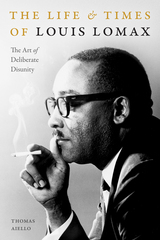
The Life and Times of Louis Lomax
The Art of Deliberate Disunity
Thomas Aiello
Duke University Press, 2021
Syndicated television and radio host. Serial liar. Pioneering journalist. Convicted criminal. Close ally of Malcolm X and Martin Luther King Jr. Publicity-seeking provocateur. Louis Lomax's life was a study in contradiction. In this biography, Thomas Aiello traces the complicated and fascinating arc of Lomax's life and career, showing how the contradictions, tumult, and inconsistencies that marked his life reflected those of 1960s America. Aiello takes readers from Lomax's childhood in the Deep South to his early confidence schemes to his emergence as one of the loudest and most influential voices of the civil rights movement. Regardless of what political position he happened to take at any given moment, Lomax preached “the art of deliberate disunity,” in which the path to democracy could only be achieved through a diversity of opinions. Engaging and broad in scope, The Life and Times of Louis Lomax is the definitive study of one of the civil rights era's most complicated, important, and overlooked figures.
[more]
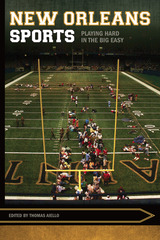
New Orleans Sports
Playing Hard in the Big Easy
Thomas Aiello
University of Arkansas Press, 2019
New Orleans has long been a city fixated on its own history and culture. Founded in 1718 by the French, transferred to the Spanish in the 1763 Treaty of Paris, and sold to the United States in 1803, the city’s culture, law, architecture, food, music, and language share the influence of all three countries. This cultural mélange also manifests in the city’s approach to sport, where each game is steeped in the city’s history.
Tracing that history from the early nineteenth century to the present, while also surveying the state of the city’s sports historiography, New Orleans Sports places sport in the context of race relations, politics, and civic and business development to expand that historiography—currently dominated by a text that stops at 1900—into the twentieth century, offering a modern examination of sports in the city.
Tracing that history from the early nineteenth century to the present, while also surveying the state of the city’s sports historiography, New Orleans Sports places sport in the context of race relations, politics, and civic and business development to expand that historiography—currently dominated by a text that stops at 1900—into the twentieth century, offering a modern examination of sports in the city.
[more]
READERS
Browse our collection.
PUBLISHERS
See BiblioVault's publisher services.
STUDENT SERVICES
Files for college accessibility offices.
RECENTLY PUBLISHED






UChicago Accessibility Resources
home | accessibility | search | about | contact us
BiblioVault ® 2001 - 2025
The University of Chicago Press