
 A SCHOLARLY BOOK REPOSITORY
Browse by Title
2 books by Dreby, Joanna
2 books by Dreby, Joanna
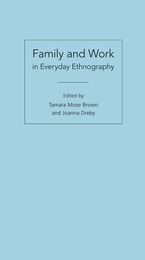
Family and Work in Everyday Ethnography
Tamara M. Brown
Temple University Press, 2013
Family and Work in Everyday Ethnography exposes the intimate relationship between ethnographers as both family members and researchers. The contributors to this exciting volume question and problematize the “artificial divide” between work and family that continues to permeate writing on ethnographic field work as social scientists try to juggle research and family tensions while “on the job.”
Essays relate experiences that mirror work-family dilemmas that all employed parents face, and show how deeply personal experiences affect social scientists’ home life and their studies. Bringing together voices of various family members—pregnant women, mothers, fathers, and children—Family and Work in Everyday Ethnography demonstrates how the mixture of work and family in this particular occupation has raised questions—both practical and theoretical—that relate to race, class, and gender.
Contributors include: Chris Bobel, Erynn Masi de Casanova, Randol Contreras, C. Aiden Downey, Tanya Golash-Boza, Steven Gold, Sherri Grasmuck, Barbara Katz Rothman,
Jennifer Reich, Leah Schmalzbauer, Gregory Smithsimon, and the editors.
[more]
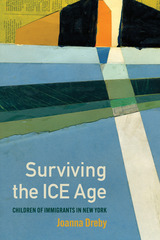
Surviving the ICE Age
Children of Immigrants in New York
Joanna Dreby
Russell Sage Foundation, 2025
For the past three decades, U.S. immigration policy has become increasingly restrictive, focused on enforcement both at the southern border and across the country. A shift in emphasis from status regularization to criminalization has had rippling effects for families and communities. While we know much about how immigration enforcement impacts the undocumented, we know less about longstanding effects on U.S. citizens. In Surviving the ICE Age, sociologist Joanna Dreby draws on interviews with young adults with foreign-born parents to better understand what it was like to grow up during a time of heightened U.S. migratory control.
Dreby shows that a restrictive approach to immigration creates problems over time and across generations. These issues occur regardless of one’s citizenship status and go beyond deportations. Despite having pride in their heritage, her interviewees did not talk much about immigration. She refers to this unwillingness—and at times, inability—to speak about immigration as silencing. Silencing in a community or family is often intended to protect children, but this can leave them with little information about their backgrounds and status, leading to fear and anxiety instead. Self-silencing often resulted from traumatic experiences tied to enforcement episodes, which sometimes took the form of memory loss or emotional withholding. Dreby finds that experiences with the immigration system that disrupted relationships in a child’s household arising from family separations, moves, or changing roles in the family had especially long-term effects, causing, at times, ongoing mental health issues. Even the risk of immigration involvement left some young adults feeling vulnerable and undermined their sense of safety and security as U.S. citizens.
Dreby also highlights stories that offer hope. Young adults developed strategies to persevere, and children who grew up in communities and families that openly talked about migration felt empowered and fared much better, especially when they had access to resources, such as adequate food and shelter, mental health services, and community support. Dreby calls for policies and practices to mitigate the harms of restrictive migratory control on children’s wellbeing, such avoiding the arrest of parents in front of children and ensuring that U.S. citizen children’s interests are considered in immigration court without their direct involvement.
Surviving the ICE Age details the generational harms caused by U.S. immigration policy and offers suggestions for a better way forward.
Dreby shows that a restrictive approach to immigration creates problems over time and across generations. These issues occur regardless of one’s citizenship status and go beyond deportations. Despite having pride in their heritage, her interviewees did not talk much about immigration. She refers to this unwillingness—and at times, inability—to speak about immigration as silencing. Silencing in a community or family is often intended to protect children, but this can leave them with little information about their backgrounds and status, leading to fear and anxiety instead. Self-silencing often resulted from traumatic experiences tied to enforcement episodes, which sometimes took the form of memory loss or emotional withholding. Dreby finds that experiences with the immigration system that disrupted relationships in a child’s household arising from family separations, moves, or changing roles in the family had especially long-term effects, causing, at times, ongoing mental health issues. Even the risk of immigration involvement left some young adults feeling vulnerable and undermined their sense of safety and security as U.S. citizens.
Dreby also highlights stories that offer hope. Young adults developed strategies to persevere, and children who grew up in communities and families that openly talked about migration felt empowered and fared much better, especially when they had access to resources, such as adequate food and shelter, mental health services, and community support. Dreby calls for policies and practices to mitigate the harms of restrictive migratory control on children’s wellbeing, such avoiding the arrest of parents in front of children and ensuring that U.S. citizen children’s interests are considered in immigration court without their direct involvement.
Surviving the ICE Age details the generational harms caused by U.S. immigration policy and offers suggestions for a better way forward.
[more]
READERS
Browse our collection.
PUBLISHERS
See BiblioVault's publisher services.
STUDENT SERVICES
Files for college accessibility offices.
RECENTLY PUBLISHED






UChicago Accessibility Resources
home | accessibility | search | about | contact us
BiblioVault ® 2001 - 2025
The University of Chicago Press