
 A SCHOLARLY BOOK REPOSITORY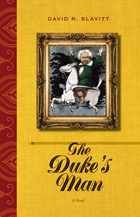
Focusing on one aspect of Dumas’ novel—the doomed love story of Bussy d’Amboise and Diana de Monsoreau—Slavitt excerpts key passages, which are extended and undercut by the narrator’s comments. The result is a radically abridged book with its own life and verve. The first of the quoted scenes, in which the names of Bussy’s assailants are replaced with those of French cheeses, sets the irreverent tone for all that follows. The book pokes fun at Dumas’ exclamatory style and flamboyant archaisms (“morbleu!” “pardieu!”), the implausibility of the swordfights, the unnecessary contortions of the political plot, the conventional passivity of the heroine, and the coyness of his love scenes. Residing somewhere between Nabokov’s Pale Fire and Quirk Books’ mash-ups (Pride and Prejudice and Zombies, etc.), The Duke’s Man’s blend of quotation, commentary, and fiction raises searching questions about realism and truth.

Originally published in 1961, this shrewd, smartly written novel follows two American men traveling in Europe. Though both have struck out for the same continent, each man’s methods of and motives for travel lead him to have a very different experience than the other. Underlying it all is the premise that Europe--the contrast, the otherness of it--can be a refiner’s fire, deeply affecting a person’s character. Europe represents a crucial step in Stern’s development as a writer and stands as a witty, sharp point of entry into his writings and the writings of novelists who rose to prominence in the 1960s.

Taking its inspiration from Sanders’s own autobiography Memoirs of a Professional Cad (1960), this book is part witty, bawdy, and irreverent memoir, part moving meditation on the price of fame; like most of David Slavitt’s work, it defies easy categorization.In George Sanders, Zsa Zsa, and Me, Slavittlooks back to his career as a film critic in the glamorous—at least superficially—world of 1950s Hollywood, when he traveled in circles that included the talented British actor George Sanders (1906–1972) and his then-wife, Zsa Zsa Gabor, who was talented at, well, being famous.
Sanders, who seemed to maintain an ironic detachment from roles that were often beneath him, nonetheless couldn’t bear the decline of his later years and committed suicide at the age of sixty-five. Darkly humorous to the end, his note read, "Dear World, I am leaving because I am bored. I feel I have lived long enough. I am leaving you with your worries in this sweet cesspool. Good luck." Zsa Zsa, on the other hand, remains in the headlines (with her dubiously named husband Frédéric Prinz von Anhalt) at age ninety-two. Although he punctuates his story with witty asides—the author’s encounter with Marilyn Monroe is particularly memorable—Slavitt turns a critic’s eye toward questions of talent and art, while also tackling the difficult and universal questions of aging, relationships, and mortality.
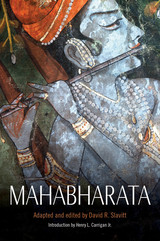
Within its 200,000 verse lines in Sanskrit the Mahabharata takes on many roles: epic poem, foundational text of Hinduism, and, more broadly, the engaging story of a dynastic struggle and the passing of an age when man and gods intermingled. David R. Slavitt’s sparkling new edition condenses the epic for the general reader.
At its core, the Mahabharata is the story of the rivalry between the Pandavas and the Kauravas, two related noble families who are struggling for control of a kingdom in ancient northern India. Slavitt’s readable, plot-driven, single-volume account describes an arc from the conception and birth of Bhishma to that hero's death, while also introducing the four goals of life at the center of Hinduism: dharma (righteousness, morality, duty), artha (purpose), kāma (pleasure), and moksa (spiritual liberation). The Mahabharata is engaging, thrilling, funny, charming, and finally awesome, with a range in timbre from the impish naivete of fairy tales to the solemnity of our greatest epics, and this single-volume edition is the best introduction available.
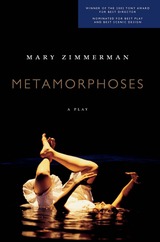
A beautiful and deeply humane reanimation of Ovid's myths
Called by Time the "theater event of the year," Mary Zimmerman's Metamorphoses brings Ovid's tales to stunning visual life. Set in and around a large pool of water onstage, Metamorphoses juxtaposes the ancient and the contemporary in both language and image to reflect the variety and persistence of narrative in the face of inevitable change. Nominated for three 2002 Tony Awards, including "Best Play," Metamorphoses earned Zimmerman a Tony for "Best Direction of a Play."
This edition is also notable for Slavitt’s extensive notes and commentary about the art of translation. He presents the problems he encountered in making the translation, discussing possible solutions and the choices he made among them. The effect of the notes is to bring the reader even closer to the original Latin and to understand better how to gauge the distance between the two languages.
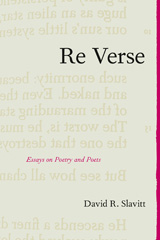
Combining personal reminiscence with deft literary analysis, incisive biographical sketches, and, sometimes, literary gossip, these essays give new perspectives on the famous--such as Harold Bloom, Robert Penn Warren, Robert Frost, and Stephen Spender--and recover the charms of the near-forgotten--such as Dudley Fitts, Winfield Townley Scott, Merrill Moore and John Hall Wheelock. Slavitt writes with self-deprecating humor of his own literary education, and uses his impressive experience and erudition to illuminate the whims of poetic influence, passion, and reputation. With a refreshing honesty and considerable poise, he gives readers an enlightening view of the vast and ever-changing literary universe.

As a member of the mid-sixteenth-century literary group La Pléiade, Joachim du Bellay sought to elevate his native French to the level of the classical languages—a goal pursued with great spirit, elegance, irony, and wit in the poems that comprise The Regrets. Widely viewed as one of the finest sonnet sequences in all of French literature, this Renaissance masterpiece wryly echoes the homesickness and longing of Ovid's poetry written in exile—because du Bellay finds himself lost in Rome, the very home Ovid longed for. In this translation by David R. Slavitt, these brilliant performances retain their original formal playfulness as well as their gracefully rendered but nonetheless moving melancholy. In decadent Rome, among hypocrites, thieves, and snobs, du Bellay uses his poetry as an opportunity for social satire and caustic self-criticism-it becomes a salvation of sorts, an approach peculiarly modern in its blending of the classical, the social, and the personal.

READERS
Browse our collection.
PUBLISHERS
See BiblioVault's publisher services.
STUDENT SERVICES
Files for college accessibility offices.
RECENTLY PUBLISHED






UChicago Accessibility Resources
home | accessibility | search | about | contact us
BiblioVault ® 2001 - 2026
The University of Chicago Press