front cover of Galaxies and the Cosmic Frontier
Galaxies and the Cosmic Frontier
William H. Waller and Paul W. Hodge
Harvard University Press, 2003

Orienting us with an insider’s tour of our cosmic home, the Milky Way, William Waller and Paul Hodge then take us on a spectacular journey, inviting us to probe the exquisite structures and dynamics of the giant spiral and elliptical galaxies, to witness colliding and erupting galaxies, and to pay our respects to the most powerful galaxies of all—the quasars. A basic guide to the latest news from the cosmic frontier—about the black holes in the centers of galaxies, about the way in which some galaxies cannibalize each other, about the vast distances between galaxies, and about the remarkable new evidence regarding dark energy and the cosmic expansion—this book gives us a firm foundation for exploring the more speculative fringes of our current understanding.

This is a heavily revised and completely updated version of Hodge’s Galaxies, which won an Association of American Publishers PROSE Award for Best Science Book of the Year in 1986.


[more]

logo for Vanderbilt University Press
Nashville, 1900 to 1910
William Waller
Vanderbilt University Press, 1972
Now back in print! The stories of Nashville at the turn of the century in the voices of the people who lived them.
[more]

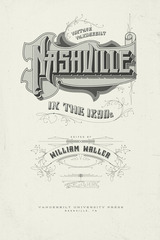
front cover of Nashville in the 1890s
Nashville in the 1890s
William Waller
Vanderbilt University Press, 1970
Derived from first-hand accounts and oral histories collected and stored at Vanderbilt University as well as newspapers and other local history sources, this collection is an invaluable look at the “Gay Nineties” in Nashvillians’ own words.
 
It is, however, not a complete insight into Nashville in the 1890s. Readers should take note that the book focuses almost exclusively on the experiences and worldviews of white Nashvillians. These stories have incredible value for local historians and anyone interested in Nashville history, but the book’s failure to deal with race—as evidenced by Waller’s belief that “the social order was thought to be providential,” which was clearly not true for Nashville’s Black residents who struggled against the unjust systems designed to oppress them—is a grave shortcoming.
 
[more]


Send via email Share on Facebook Share on Twitter