
 A SCHOLARLY BOOK REPOSITORY
Browse by Title
2 books by Ward, Brian
2 books by Ward, Brian

A&R Pioneers
Architects of American Roots Music on Record
Brian Ward
Vanderbilt University Press, 2018
Association for Recorded Sound Collections Certificate of Merit for the Best Historical Research in Recorded Roots or World Music, 2019
A&R Pioneers offers the first comprehensive account of the diverse group of men and women who pioneered artists-and-repertoire (A&R) work in the early US recording industry. In the process, they helped create much of what we now think of as American roots music. Resourceful, innovative, and, at times, shockingly unscrupulous, they scouted and signed many of the singers and musicians who came to define American roots music between the two world wars. They also shaped the repertoires and musical styles of their discoveries, supervised recording sessions, and then devised marketing campaigns to sell the resulting records. By World War II, they had helped redefine the canons of American popular music and established the basic structure and practices of the modern recording industry. Moreover, though their musical interests, talents, and sensibilities varied enormously, these A&R pioneers created the template for the job that would subsequently become known as "record producer."
Without Ralph Peer, Art Satherley, Frank Walker, Polk C. Brockman, Eli Oberstein, Don Law, Lester Melrose, J. Mayo Williams, John Hammond, Helen Oakley Dance, and a whole army of lesser known but often hugely influential A&R representatives, the music of Bessie Smith and Bob Wills, of the Carter Family and Count Basie, of Robert Johnson and Jimmie Rodgers may never have found its way onto commercial records and into the heart of America's musical heritage. This is their story.
A&R Pioneers offers the first comprehensive account of the diverse group of men and women who pioneered artists-and-repertoire (A&R) work in the early US recording industry. In the process, they helped create much of what we now think of as American roots music. Resourceful, innovative, and, at times, shockingly unscrupulous, they scouted and signed many of the singers and musicians who came to define American roots music between the two world wars. They also shaped the repertoires and musical styles of their discoveries, supervised recording sessions, and then devised marketing campaigns to sell the resulting records. By World War II, they had helped redefine the canons of American popular music and established the basic structure and practices of the modern recording industry. Moreover, though their musical interests, talents, and sensibilities varied enormously, these A&R pioneers created the template for the job that would subsequently become known as "record producer."
Without Ralph Peer, Art Satherley, Frank Walker, Polk C. Brockman, Eli Oberstein, Don Law, Lester Melrose, J. Mayo Williams, John Hammond, Helen Oakley Dance, and a whole army of lesser known but often hugely influential A&R representatives, the music of Bessie Smith and Bob Wills, of the Carter Family and Count Basie, of Robert Johnson and Jimmie Rodgers may never have found its way onto commercial records and into the heart of America's musical heritage. This is their story.
[more]
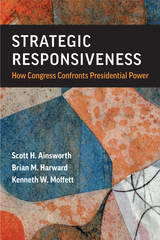
Strategic Responsiveness
How Congress Confronts Presidential Power
Scott H. Ainsworth, Brian M. Harward, and Kenneth W. Moffett
University of Michigan Press, 2025
Because the constitutional separation of powers often leads to delay or obstruction rather than coordinated policymaking, U.S. presidents are increasingly acting unilaterally to move policy. With the issuance of executive orders, signing statements, and policy memoranda, unilateralism has become a defining feature of the American presidency. Can Congress effectively use checks and balances to counter presidential unilateralism?
Strategic Responsiveness takes a theoretically developed and empirically oriented approach— situated within legal and historical contexts—to explore the system of separated powers. The authors find that Congress is not as weak as many perceive it to be and show how members of Congress often anticipate individualized policy loss and choose to respond. These policy struggles shape the constitutional order as surely as broad, statutory constraints might. While the aggrandizement of the presidency and the usurpation of congressional control are not countered, ordinary policy losses are. For members and senators, presidential overreach is fine as long as the policy wins continue, but policy losses may motivate members to reassert congressional prerogatives in policymaking through increased oversight. Strategic Responsiveness reveals how profoundly important policy-level disputes are in the politics of maintaining a particular constitutional order.
Strategic Responsiveness takes a theoretically developed and empirically oriented approach— situated within legal and historical contexts—to explore the system of separated powers. The authors find that Congress is not as weak as many perceive it to be and show how members of Congress often anticipate individualized policy loss and choose to respond. These policy struggles shape the constitutional order as surely as broad, statutory constraints might. While the aggrandizement of the presidency and the usurpation of congressional control are not countered, ordinary policy losses are. For members and senators, presidential overreach is fine as long as the policy wins continue, but policy losses may motivate members to reassert congressional prerogatives in policymaking through increased oversight. Strategic Responsiveness reveals how profoundly important policy-level disputes are in the politics of maintaining a particular constitutional order.
[more]
READERS
Browse our collection.
PUBLISHERS
See BiblioVault's publisher services.
STUDENT SERVICES
Files for college accessibility offices.
RECENTLY PUBLISHED





UChicago Accessibility Resources
home | accessibility | search | about | contact us
BiblioVault ® 2001 - 2025
The University of Chicago Press