
 A SCHOLARLY BOOK REPOSITORY
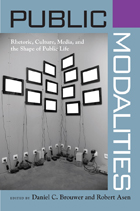
A bold rethinking of public discourse, Public Modalities explores how people shape civic life through protest, media, and identity in an ever-evolving public sphere.
This book explores the ways that scholars, journalists, politicians, and citizens conceive of “the public” or “public life,” and how those entities are defined and invented. For decades, scholars have used the metaphors of spheres, systems, webs, or networks to talk about, describe, and map various practices. This volume proposes a new metaphor—modalities—to suggest that publics are forever in flux, and much more fluid and dynamic than the static models of systems or spheres would indicate—especially in the digital age, where various publics rapidly evolve and dissipate.
Contributors to the volume—employing approaches from the fields of communication studies, English, sociology, psychology, and history—explore a broad range of texts and artifacts that give rise to publics, and discuss what they reveal about conceptualizations of social space. By focusing on process in public engagement, these scholars highlight questions of how people advance their interests and identities, and how they adapt to situational constraints.
Bringing together scholars in rhetorical, cultural, and media studies, this collection of new case studies illustrates a modalities approach to the study of publics. These case studies explore the implications of different ways of forming publics, including alternative means of expression (protests, culture jamming); the intersection of politics and consumerism (how people express their identities and interests through their consumer behavior); and online engagement (blogs as increasingly important public fora). In doing so, they raise important questions of access, community, and political efficacy
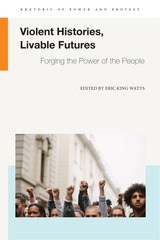
Our political landscape is crowded with competing voices—claims, demands, grievances, and even acts of violence—all made in the name of some idea of “the people.” This powerful concept has been wielded both to assert democratic sovereignty and to justify exclusion and control. Violent Histories, Livable Futures unpacks this complex dynamic through compelling historical case studies, spanning sub-Saharan Africa in the 1950s, post–World War II Guatemala, and the United States in the aftermath of George Floyd’s murder. By tracing how societies have contended over which people matter and which do not, this book offers a deeply relevant exploration of power, representation, and the struggle for justice, all in pursuit of a more livable future.
READERS
Browse our collection.
PUBLISHERS
See BiblioVault's publisher services.
STUDENT SERVICES
Files for college accessibility offices.
RECENTLY PUBLISHED





UChicago Accessibility Resources
home | accessibility | search | about | contact us
BiblioVault ® 2001 - 2025
The University of Chicago Press