
 A SCHOLARLY BOOK REPOSITORY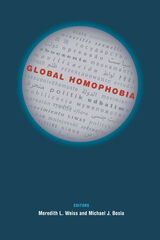
Combining rich empirical analysis with theoretical synthesis, these studies examine how homophobia travels across complex and ambiguous transnational networks, how it achieves and exerts decisive power, and how it shapes the collective identities and strategies of those groups it targets. The first comparative volume to focus specifically on the global diffusion of homophobia and its implications for an emerging worldwide LGBT movement, Global Homophobia opens new avenues of debate and dialogue for scholars, students, and activists.
Contributors are Mark Blasius, Michael J. Bosia, David K. Johnson, Kapya J. Kaoma, Christine (Cricket) Keating, Katarzyna Korycki, Amy Lind, Abouzar Nasirzadeh, Conor O'Dwyer, Meredith L. Weiss, and Sami Zeidan.
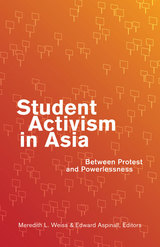
Since World War II, students in East and Southeast Asia have led protest movements that toppled authoritarian regimes in countries such as Indonesia, South Korea, and Thailand. Elsewhere in the region, student protests have shaken regimes until they were brutally suppressed—most famously in China’s Tiananmen Square and in Burma. But despite their significance, these movements have received only a fraction of the notice that has been given to American and European student protests of the 1960s and 1970s. The first book in decades to redress this neglect, Student Activism in Asia tells the story of student protest movements across Asia.
Taking an interdisciplinary, comparative approach, the contributors examine ten countries, focusing on those where student protests have been particularly fierce and consequential: China, Japan, Hong Kong, Taiwan, South Korea, Indonesia, Burma, Malaysia, Thailand, and the Philippines. They explore similarities and differences among student movements in these countries, paying special attention to the influence of four factors: higher education systems, students’ collective identities, students’ relationships with ruling regimes, and transnational flows of activist ideas and inspirations.
The authors include leading specialists on student activism in each of the countries investigated. Together, these experts provide a rich picture of an important tradition of political protest that has ebbed and flowed but has left indelible marks on Asia’s sociopolitical landscape.
Contributors: Patricio N. Abinales, U of Hawaii, Manoa; Prajak Kongkirati, Thammasat U, Thailand; Win Min, Vahu Development Institute; Stephan Ortmann, City U of Hong Kong; Mi Park, Dalhousie U, Canada; Patricia G. Steinhoff, U of Hawaii, Manoa; Mark R. Thompson, City U of Hong Kong; Teresa Wright, California State U, Long Beach.
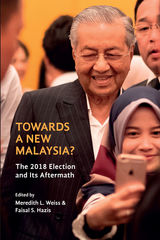
After the election, many Malaysians were optimistic about the possibility of a more representative, accountable, participatory, and equitable polity, but Meredith L. Weiss and Faisal S. Hazis do not see GE14 as a clear harbinger of full-on liberalization. While the political aftermath of the election continues to play out, the authors provide a clarion call for deeper, more critical, more comparative research on Malaysia’s politics. They upend commonly held beliefs about Malaysian politics and bring forward lesser-known theories, and they suggest agendas for empirically interesting, theoretically relevant further research. They also point to the broader insights Malaysia’s experience provides for the study of elections and political change in one-party dominant states around the world.

Over the last decade, a youth revolt has swept through Asia. Massive, regime-rocking protests have grabbed global attention as students and other young people have confronted security forces on the streets, taking great risks to condemn authoritarian rule, promote democracy, and to push forward new agendas of personal freedom and gender equality. Behind the scenes, young people have experimented with novel and diverse modes of political and social activism, often using new tools of online communication and cultural expression, forging new kinds of coalitions, and exploring nonconfrontational and subterranean networking.
Youth Activism in Asia focuses equally on the episodes of spectacular protest and on varieties of less visible engagement, examining the diversity, origins, and impact of contemporary youth activism in Asia. With fifteen case studies, the volume highlights shared patterns among demands, tactical repertoires, and activist networks, and examines what differentiates protest movements across countries and over time. Drawing on original fieldwork and, in many cases, their own experience, the authors address Brunei, China, Hong Kong, Indonesia, Malaysia, Myanmar, the Philippines, Singapore, Taiwan, Thailand, Timor-Leste, and transnational activism. Conceiving of “activism” broadly as any action intended to bring about social and political change, the volume makes theoretical contributions to our understanding of the relationship between protest and democratic backsliding, engagement with new communication technologies, and this generation’s distinctive intersectional politics. Youth Activism in Asia showcases the creativity, energy, boldness, and diversity of a new generation of Asian political activists.
READERS
Browse our collection.
PUBLISHERS
See BiblioVault's publisher services.
STUDENT SERVICES
Files for college accessibility offices.
RECENTLY PUBLISHED







UChicago Accessibility Resources
home | accessibility | search | about | contact us
BiblioVault ® 2001 - 2025
The University of Chicago Press