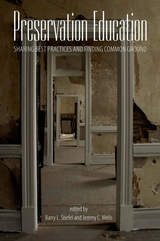
front cover of Preservation Education
Preservation Education
Sharing Best Practices and Finding Common Ground
Edited by Barry L. Stiefel and Jeremy C. Wells
University Press of New England, 2014
Over the past twenty years, there has been a fundamental shift in the institutional organization of historic preservation education. Historic preservation is the most recent arrival in the collection of built environment disciplines and therefore lacks the pedagogical depth and breadth found in allied endeavors such as architecture and planning. As the first degree programs in preservation only date to the 1970s and the first doctoral programs to the 1990s, new faculty are confronted with pedagogical challenges that are unique to this relatively nascent field. Based on a conference that included educators from around the world, Barry L. Stiefel and Jeremy C. Wells now present a collection that seeks to address fundamental issues of preservation pedagogy, outcome-based education and assessment, and global issues of authenticity and significance in historic preservation. The editors argue that the subject of the analysis has shifted from, “What is the best way to fix a historic building?” to, “What are the best ways for teaching people how to preserve historic properties (and why) according to the various standards that have been established?” This important reconsideration of the state of the field in historic preservation education will appeal to a broad audience across numerous disciplines.
[more]

front cover of Romances of the White Man's Burden
Romances of the White Man's Burden
Race, Empire, and the Plantation in American Literature, 1880-1936
Jeremy Wells
Vanderbilt University Press, 2011
"Take up the white man's burden!" So wrote the English writer Rudyard Kipling in 1899, in a poem aimed at Americans at a time when colonial ambitions were particularly high. The poem proved especially popular among white southern men, who saw in its vision of America's imperial future an image that appeared to reflect and even redeem the South's plantation past.


Romances of the White Man's Burden takes on works in American literature in which the proverbial "old plantation" is made to seem not a relic but a harbinger, a sign that the South had arrived at a multiracial modernity and harmony before the rest of the United States. Focusing on writers such as Joel Chandler Harris, Thomas Nelson Page, Henry W. Grady, Thomas Dixon, and William Faulkner, Jeremy Wells reveals their shared fixation on the figure of the white southern man as specially burdened by history. Each of these writers, in his own way, presented the plantation South as an emblem, not an aberration, of America.


[more]


Send via email Share on Facebook Share on Twitter