
 A SCHOLARLY BOOK REPOSITORY
Browse by Title
6 books by White, OP, Thomas Joseph
6 books by White, OP, Thomas Joseph
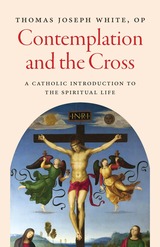
Contemplation and the Cross
A Catholic Introduction to the Spiritual Life
Thomas Joseph White, OP
Catholic University of America Press, 2025
What are the aims of the Christian spiritual life and how can we deepen our life in Christ? What is the Catholic form of the spiritual life and what are its causes? This book serves as an introduction to Catholic spirituality by examining the mystery of Jesus Christ- His Crucifixion, and His Resurrection- as the center of our spiritual life. The central argument of the book is that the life, death, and resurrection of Jesus present us with the form or essence of the Christian spiritual life and orient us toward union with the Trinity as the final end or aim of human existence. The means of union with God through sacraments, the interior life of the theological virtues (faith, hope, and charity), and the virtue of religion are considered as vehicles by which we rejoin God in Christ. The effects of the Cross are considered in our life by a study of the spiritual and corporal works of mercy. The Virgin Mary is considered as a model of the spiritual life. What results is a Christ-centered spirituality that is sacramental and Marian, and that depicts the life of the Church living in contemplative charity as the basic expression of Catholic spirituality.
[more]
The Fittingness of the Incarnation
Essays in Analytic Thomistic Philosophy and Theology
David Braine, David
Catholic University of America Press, 2025
The Fittingness of the Incarnation collects David Braine's best unpublished philosophical and theological essays. The essays contained herein are representative of Braine's careful, rich and distinctive work. As one of the more interesting philosophers of his generation, David Braine offered a realist account of the world - God's existence, the human person, and language - through his major works, and these essays help follow through on some of those thoughts, explain underlying metaphysical or epistemological principles, and we see many of these applied in his theological essays. Additionally, the book includes Braine's plans for books on the realism of St. Thomas Aquinas, which helps us see again his vision for a unified philosophical account, and the Incarnation, which shows how Braine's philosophical anthropology informs. Altogether, the book contributes the final papers of David Braine to the fields at large.
[more]
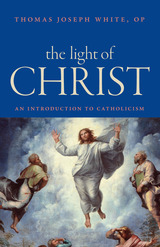
The Light of Christ
An Introduction to Catholicism
Thomas Joseph White, OP
Catholic University of America Press, 2017
The Light of Christ provides an accessible presentation of Catholicism that is grounded in traditional theology, but engaged with a host of contemporary questions or objections. Inspired by the theologies of Iranaeus, Thomas Aquinas and John Henry Newman, and rooted in a post-Vatican II context, Fr. Thomas Joseph White presents major doctrines of the Christian religion in a way that is comprehensible for non-specialists: knowledge of God, the mystery of the Trinity, the Incarnation and the atonement, the sacraments and the moral life, eschatology and prayer.
At the same time, The Light of Christ also addresses topics such as evolution, the modern historical study of Jesus and the Bible, and objections to Catholic moral teaching. Touching on the concerns of contemporary readers, Fr. White examines questions such as whether Christianity is compatible with the findings of the modern sciences, do historical Jesus studies disrupt or confirm the teaching of the faith, and does history confirm the antiquity of Catholic claims.
This book serves as an excellent introduction for young professionals with no specialized background in theology who are interested in learning more about Catholicism, or as an introduction to Catholic theology. It will also serve as a helpful text for theology courses in a university context.
As Fr. White states in the book’s introduction: “This is a book that offers itself as a companion. I do not presume to argue the reader into the truths of the Catholic faith, though I will make arguments. My goal is to make explicit in a few broad strokes the shape of Catholicism. I hope to outline its inherent intelligibility or form as a mystery that is at once visible and invisible, ancient and contemporary, mystical and reasonable.”
At the same time, The Light of Christ also addresses topics such as evolution, the modern historical study of Jesus and the Bible, and objections to Catholic moral teaching. Touching on the concerns of contemporary readers, Fr. White examines questions such as whether Christianity is compatible with the findings of the modern sciences, do historical Jesus studies disrupt or confirm the teaching of the faith, and does history confirm the antiquity of Catholic claims.
This book serves as an excellent introduction for young professionals with no specialized background in theology who are interested in learning more about Catholicism, or as an introduction to Catholic theology. It will also serve as a helpful text for theology courses in a university context.
As Fr. White states in the book’s introduction: “This is a book that offers itself as a companion. I do not presume to argue the reader into the truths of the Catholic faith, though I will make arguments. My goal is to make explicit in a few broad strokes the shape of Catholicism. I hope to outline its inherent intelligibility or form as a mystery that is at once visible and invisible, ancient and contemporary, mystical and reasonable.”
[more]
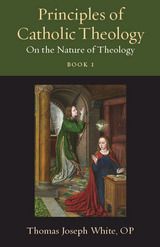
Principles of Catholic Theology, Book 1
On the Nature of Theology
Thomas Joseph White, OP
Catholic University of America Press, 2023
Catholic theology has to face a certain number of fundamental questions: what is the nature and content of Christian revelation, what are the sources of revelation, how are the mysteries of the faith to be understood in relation of one to another, and how do the truths of the Catholic faith relate to the acquisitions of natural reason. In the contemporary context, Catholic theology is marked by a diversity of approaches, many of which are seemingly incompatible or estranged from one another. How might we think about the unity of Catholic theology over and above the diversity of forms? What role, if any, can Aquinas play as a common doctor in facilitating exchanges between theological traditions in the Church?
Principles of Catholic Theology seeks to address directly the nature of Catholic theology and the challenge of its contemporary articulation with an eye towards its articulation in its Thomistic key. This book is also the first of a series of collections of essays by Thomas Joseph White, OP, extending over a range of fundamental topics in Catholic dogmatic theology.
[more]
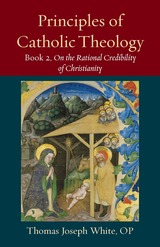
Principles of Catholic Theology, Book 2
On the Rational Credibility of Christianity
Thomas Joseph White, OP
Catholic University of America Press, 2023
Can a philosopher defend the rational warrant for belief in Christianity? Is it reasonable to be religious? Is it philosophically responsible to be a Christian who believes in the mystery of the Trinity? Principles of Catholic Theology explores these questions in a systematic way by considering questions of ultimate explanation. Why not hold that modern atheistic naturalism provides the best explanation of reality? Or, if there is a transcendent first principle that explains all of reality, is it impersonal rather than personal? Contrastingly, if monotheism constitutes the best explanation for created being, how can we reasonably believe in any particular revelation concerning God? What are the criteria for rational belief in revelation?
Thomas Joseph White, OP, considers these questions by exploring a series of topics: the transcendentals (existence, oneness, truth, goodness, beauty); rational argument for the existence of God; the immateriality and subsistence after death of the personal soul of the human being; the historical and conceptual coherence of Trinitarian doctrine; and the reasonableness of the natural desire to see God. The aim of Principles of Catholic Theology, Book 2 is to place contemporary natural reason in profound dialogue with the Catholic faith and to think about ways that we can consent to the profound mystery of the Holy Trinity that are in robust concord with the knowledge obtained from philosophical, scientific, and historical sources.
[more]
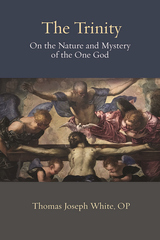
The Trinity
On the Nature and Mystery of the One God
Thomas Joseph White, OP
Catholic University of America Press, 2021
The Trinity is the central mystery of the Christian faith. What can we say about the divine nature, and what does it mean to say that God is Father, Son, Holy Spirit, three persons who are one in being? In this book, best selling author Thomas Joseph White, OP, examines the development of early Christian reflection on the Trinity, arguing that essential contributions of Patristic theology are preserved and expanded in the thought of Thomas Aquinas.
By focusing on Aquinas’ theology of the divine nature as well as his treatment of divine personhood, White explores in depth the mystery of Trinitarian monotheism. The Trinity: On the Nature and Mystery of the One God also engages with influential proposals of modern theologians on major topics such as Trinitarian creation, Incarnation and crucifixion, and presents creative engagements with these topics. Ultimately any theology of the cross is also a theology of the Trinity, and this book seeks to illustrate how the human life, death, and resurrection of Jesus reveal the inner life of God as Trinity.
[more]
READERS
Browse our collection.
PUBLISHERS
See BiblioVault's publisher services.
STUDENT SERVICES
Files for college accessibility offices.
RECENTLY PUBLISHED




UChicago Accessibility Resources
home | accessibility | search | about | contact us
BiblioVault ® 2001 - 2025
The University of Chicago Press