
 A SCHOLARLY BOOK REPOSITORY
Browse by Title
2 books by Wiener, Margaret J.
2 books by Wiener, Margaret J.

Magic’s Translations
Reality Politics in Colonial Indonesia
Margaret J. Wiener
Duke University Press, 2025
“Do you believe in magic?” This familiar question suggests magic is easily recognized but unreal. In Magic’s Translations, Margaret J. Wiener argues that such views are shaped by historical power struggles, especially in Europe’s relations with the wider world. Focusing on nineteenth- and twentieth-century Dutch interactions with Indonesians, Wiener reveals how colonial agents framed unfamiliar practices, practitioners, and objects as “magic,” rendering distinct phenomena fundamentally alike and advancing colonizing projects that deemed magic antithetical to reason and reality. While colonial authorities, including ethnologists, mobilized the concept of magic to differentiate Europeans from Indonesians, nature from culture, reason from superstition, and fact from fetish, their efforts produced unexpected outcomes: Some Indonesian artifacts and acts not only retained their power but invaded European experiences. As anthropologists were among the key translators of magic throughout the world, Wiener intersperses accounts of magic’s translations in the Indies with reflections on anthropology’s ongoing engagement with the concept. She demonstrates that magic became an object of expert knowledge, political control, and popular fascination, rather than a self-evident category or relic of naïve belief.
[more]
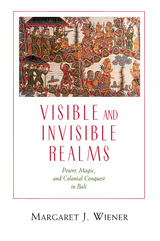
Visible and Invisible Realms
Power, Magic, and Colonial Conquest in Bali
Margaret J. Wiener
University of Chicago Press, 1995
In 1908, the ruler of the Balinese realm of Klungkung and more than 100 members of his family and court were massacred when they marched deliberately into the fire of the Dutch colonial army. The question of what their action meant and its continued significance in contemporary Klungkung forms the basis of Margaret Wiener's complex anthropolological history.
Wiener challenges colonial and academic claims that Klungkung had no "real" power and argues that such claims enabled colonial domination. By focusing on Balinese discourses she makes clear the choices open to Balinese, both at the time of the Dutch conquest and in its narration. At the same time, she shows how these discourses, which revolve around magical weapons acquired from invisible agents such as gods, spirits, and ancestors, offer an alternative understanding of Klungkung's power.
Moving between Balinese and Dutch narratives and between past and present, Wiener critiques colonial accounts by recounting Balinese memories and interpretations. Her attention to history and local situations illuminates the ways in which colonialism and orientalist scholarship have obscured the power of indigenous rulers and shows how Klungkung, once Bali's paramount realm, was relegated to a peripheral corner of the Indonesian nation-state. Both as a fascinating story and as a rich example of interdisciplinary scholarship, this book will interest students of colonialism, anthropology, history, religion, and Southeast Asia.
Wiener challenges colonial and academic claims that Klungkung had no "real" power and argues that such claims enabled colonial domination. By focusing on Balinese discourses she makes clear the choices open to Balinese, both at the time of the Dutch conquest and in its narration. At the same time, she shows how these discourses, which revolve around magical weapons acquired from invisible agents such as gods, spirits, and ancestors, offer an alternative understanding of Klungkung's power.
Moving between Balinese and Dutch narratives and between past and present, Wiener critiques colonial accounts by recounting Balinese memories and interpretations. Her attention to history and local situations illuminates the ways in which colonialism and orientalist scholarship have obscured the power of indigenous rulers and shows how Klungkung, once Bali's paramount realm, was relegated to a peripheral corner of the Indonesian nation-state. Both as a fascinating story and as a rich example of interdisciplinary scholarship, this book will interest students of colonialism, anthropology, history, religion, and Southeast Asia.
[more]
READERS
Browse our collection.
PUBLISHERS
See BiblioVault's publisher services.
STUDENT SERVICES
Files for college accessibility offices.
RECENTLY PUBLISHED






UChicago Accessibility Resources
home | accessibility | search | about | contact us
BiblioVault ® 2001 - 2025
The University of Chicago Press