
 A SCHOLARLY BOOK REPOSITORY
Browse by Title
3 books by Wilcox, Emily
3 books by Wilcox, Emily

Chinese Dance
National Movements in a Revolutionary Age
Liangyu Fu & Emily Wilcox
Michigan Publishing Services, 2019
This book documents and expands upon the exhibition “Chinese Dance: National Movements in a Revolutionary Age, 1945-1965,” which was on display at the Hatcher Library at the University of Michigan in the Spring of 2017. Emily Wilcox and Liangyu Fu co-curated this exhibition to showcase the Asia Library’s recently formed Chinese Dance Collection, which is currently the largest of its kind in North America. Drawing upon Wilcox’s expertise as a leading scholar of Chinese dance studies, the book contextualizes the University of Michigan Collection’s materials and offers an accessibly written, concise, and richly illustrated introduction to a foundational period of modern Chinese dance history. The book links dance to issues of race, ethnicity, gender, and class. It also details previously unknown stories of individual dancers and choreographers and explores relationships among dance, popular media, and global exchange.
[more]
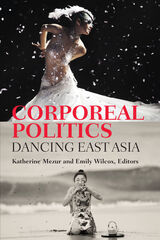
Corporeal Politics
Dancing East Asia
Katherine Mezur and Emily Wilcox, Editors
University of Michigan Press, 2020
In Corporeal Politics, leading international scholars investigate the development of dance as a deeply meaningful and complex cultural practice across time, placing special focus on the intertwining of East Asia dance and politics and the role of dance as a medium of transcultural interaction and communication across borders. Countering common narratives of dance history that emphasize the US and Europe as centers of origin and innovation, the expansive creativity of dance artists in East Asia asserts its importance as a site of critical theorization and reflection on global artistic developments in the performing arts.
Through the lens of “corporeal politics”—the close attention to bodily acts in specific cultural contexts—each study in this book challenges existing dance and theater histories to re-investigate the performer's role in devising the politics and aesthetics of their performance, as well as the multidimensional impact of their lives and artistic works. Corporeal Politics addresses a wide range of performance styles and genres, including dances produced for the concert stage, as well as those presented in popular entertainments, private performance spaces, and street protests.
Through the lens of “corporeal politics”—the close attention to bodily acts in specific cultural contexts—each study in this book challenges existing dance and theater histories to re-investigate the performer's role in devising the politics and aesthetics of their performance, as well as the multidimensional impact of their lives and artistic works. Corporeal Politics addresses a wide range of performance styles and genres, including dances produced for the concert stage, as well as those presented in popular entertainments, private performance spaces, and street protests.
[more]

Creating with Roots
Contemporary Chinese National Folk Dance Choreography
Rui Xu
University of Michigan Press, 2025
Creating with Roots is a critical introduction to the history, theory, and creative practice of Chinese national folk dance, the Chinese-speaking world’s most popular contemporary dance form. A complex cultural and artistic phenomenon that resists simple categorization, Chinese national folk dance merges folkloric material with contemporary stage aesthetics and blends rural folk dances of the Han majority with dances representing China’s minoritized ethnic communities, bridging cultural differences of geography, economic class, and ethnicity. As such, Chinese national folk dance has become a lightning rod for current debates in the arts worldwide—how to balance local heritage with artistic innovation, how to maintain cultural integrity amid commercialization and Eurocentrism, and the ethics of representation in contemporary multiculturalism. Chinese national folk dance is increasingly a globalized phenomenon: schools, classes, competitions, and performances of professionals and amateurs now exist all across the world. Originally published in Chinese and authored by prominent Chinese dance scholar, Rui Xu, this English translation will be an essential resource for the global conversation about how dancers and choreographers navigate tradition and innovation in contemporary national folk dance choreography.
Creating with Roots offers a detailed breakdown of key terms and concepts necessary for understanding Chinese national folk dance and analyzes 37 examples of choreography dating from the 1940s to 2000. The author situates these explanations within the longer history of cultural practice and theory in China and in relation to the international dance discourses of the former Soviet Union, Eastern Europe, Western Europe, and North America.
Creating with Roots offers a detailed breakdown of key terms and concepts necessary for understanding Chinese national folk dance and analyzes 37 examples of choreography dating from the 1940s to 2000. The author situates these explanations within the longer history of cultural practice and theory in China and in relation to the international dance discourses of the former Soviet Union, Eastern Europe, Western Europe, and North America.
[more]
READERS
Browse our collection.
PUBLISHERS
See BiblioVault's publisher services.
STUDENT SERVICES
Files for college accessibility offices.
RECENTLY PUBLISHED




UChicago Accessibility Resources
home | accessibility | search | about | contact us
BiblioVault ® 2001 - 2025
The University of Chicago Press