front cover of Dialogues in the Dark
Dialogues in the Dark
Interpreting “Heavenly Questions” across Two Millennia
Nicholas Morrow Williams
Harvard University Press, 2025
Dialogues in the Dark traces how Chinese readers and scholars since the Han dynasty have variously interpreted the ancient poem “Heavenly Questions” (Tianwen), an enigmatic work attributed to Qu Yuan (fl. ca. 300 BCE). The poem, composed entirely in the form of questions, is an extended inquiry into early Chinese cosmology and history. Over centuries, readers of the poem came to radically different understandings, each providing a unique perspective on its meaning. The poem’s reception history comprises three main stages: first, the commentary compiled by Han scholar Wang Yi (ca. 89–ca. 158); second, the response by Tang poet Liu Zongyuan (773–819); and third, the interpretations developed subsequently by late imperial and modern scholars. Nicholas Morrow Williams analyzes how the poem’s meaning evolved in different time periods and provides three new translations of “Heavenly Questions” to represent the three stages, respectively. The ultimate thesis of this study, inspired by the hermeneutics of Hans-Georg Gadamer, is that this poem is best understood in light of the different interpretations supplied by readers over time in lively dialogues that continue even now.
[more]

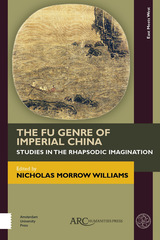
front cover of The Fu Genre of Imperial China
The Fu Genre of Imperial China
Studies in the Rhapsodic Imagination
Nicholas Morrow Williams
Arc Humanities Press, 2019
This is the first book in English to examine the fu, one of China’s oldest and culturally central literary forms, from its origins up to the late imperial era. Fu poems are highly revealing sources for understanding the culture, society, and politics of their periods. Though no English term even approximates it, “rhapsody” at least suggests the energy and recitative origins of the fu, which is a poetic form of tireless ambition that has been used for exhaustive descriptions of cities and palaces, as well as private reflections and lamentations, but also for carefully modulated political protest and esoteric ruminations on philosophical subtleties. In this volume, eleven essays by prominent scholars treat the fu from four major perspectives: its original use in court recitation; as a poetic genre with distinctive formal features; as a vehicle of philosophical inquiry; and as a major mode of political expression.
[more]


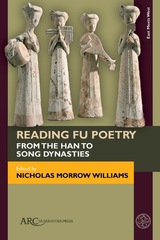
front cover of Reading Fu Poetry
Reading Fu Poetry
From the Han to Song Dynasties
Nicholas Morrow Williams
Arc Humanities Press, 2021
The fu genre (or “rhapsody” in English) is one of the major genres of Chinese poetry throughout imperial history. This volume presents close readings of representative works in the genre, spanning over a millennium of its history. Each chapter contains a complete translation of major fu poems, accompanied by an essay presenting the work or works in historical context and also examining their significance in contemporary culture.Ranging in style and topic from the exuberant accumulation of detail in Yang Xiong’s “Shu Capital,” translated by David R. Knechtges, to the luscious lyricism of Wang Bo’s “Spring Longings,” translated by Timothy W. K. Chan, the poems present a panorama of how the genre has been used for both personal and social expression. While the individual essays examine their respective subjects in depth and detail, collectively the essays also offer a sweeping survey of the fu genre from the Han (206 B.C.E.–220 C.E.) through the Song (960–1279 C.E.) dynasty.
[more]


Send via email Share on Facebook Share on Twitter