
 A SCHOLARLY BOOK REPOSITORY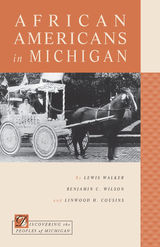
African Americans, as free laborers and as slaves, were among the earliest permanent residents of Michigan, settling among the French, British, and Native people with whom they worked and farmed. Lewis Walker and Benjamin Wilson recount the long history of African American communities in Michigan, delineating their change over time, as migrants from the South, East, and overseas made their homes in the state. Moreover, the authors show how Michigan's development is inextricably joined with the vitality and strength of its African American residents. In a related chapter, Linwood Cousins examines youth culture and identity in African American schools, linking education with historical and contemporary issues of economics, racism, and power.

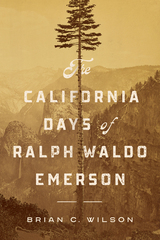
In the spring of 1871, Ralph Waldo Emerson boarded a train in Concord, Massachusetts, bound for a month-and-a-half-long tour of California—an interlude that became one of the highlights of his life. On their journey across the American West, he and his companions would take in breathtaking vistas in the Rockies and along the Pacific Coast, speak with a young John Muir in the Yosemite Valley, stop off in Salt Lake City for a meeting with Brigham Young, and encounter a diversity of communities and cultures that would challenge their Yankee prejudices.
Based on original research employing newly discovered documents, The California Days of Ralph Waldo Emerson maps the public story of this group’s travels onto the private story of Emerson’s final years, as aphasia set in and increasingly robbed him of his words. Engaging and compelling, this travelogue makes it clear that Emerson was still capable of wonder, surprise, and friendship, debunking the presumed darkness of his last decade.

Sedges can be difficult to identify, with differences between species based on small, technical characters. This comprehensive guide contains identification keys, descriptions, more than 650 color photographs, and distribution maps for each species, providing users with helpful tools and tips for identifying the plants in this challenging group. Information about sedge ecology, habitat, management and restoration, ethnobotanical uses, and propagation enhances the guide’s utility.
Field Guide to the Sedges of the Pacific Northwest provides an invaluable resource for botanists, land managers, restoration ecologists, and plant enthusiasts. And, as the genus Carex becomes increasingly important amongst landscapers, nurseries, and gardeners, the guide will serve as a handy tool for choosing Northwest natives for the garden.

The last fifteen years have seen a tremendous growth in the number of health rights cases focusing on issues such as access to health services and essential medications. This volume examines the potential of litigation as a strategy to advance the right to health by holding governments accountable for these obligations. It includes case studies from Costa Rica, South Africa, India, Brazil, Argentina and Colombia, as well as chapters that address cross-cutting themes.
The authors analyze what types of services and interventions have been the subject of successful litigation and what remedies have been ordered by courts. Different chapters address the systemic impact of health litigation efforts, taking into account who benefits both directly and indirectly—and what the overall impacts on health equity are.
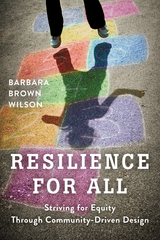
In many vulnerable neighborhoods, structural racism and classism prevent residents from having a seat at the table when decisions are made about their community. In an effort to overcome power imbalances and ensure local knowledge informs decision-making, a new approach to community engagement is essential.
In Resilience for All, Barbara Brown Wilson looks at less conventional, but often more effective methods to make communities more resilient. She takes an in-depth look at what equitable, positive change through community-driven design looks like in four communities—East Biloxi, Mississippi; the Lower East Side of Manhattan; the Denby neighborhood in Detroit, Michigan; and the Cully neighborhood in Portland, Oregon. These vulnerable communities have prevailed in spite of serious urban stressors such as climate change, gentrification, and disinvestment. Wilson looks at how the lessons in the case studies and other examples might more broadly inform future practice. She shows how community-driven design projects in underserved neighborhoods can not only change the built world, but also provide opportunities for residents to build their own capacities.

An eye-opening reconsideration of the Cold War arms control movement, showing how scientists who presented themselves as independent-minded opponents of the arms race in fact functioned as agents of the military-industrial complex that profited from it.
Do scientists speak truth to power? During the Cold War, a group of elite American strategists and science advisors claimed to do precisely that. Styling themselves as figures of rationality and restraint, they insisted that mutual assured destruction was the natural logic of the atomic age: as long as nuclear deterrence was credible, no one would ever shoot first. This doctrine, known as “strategic stability,” became the foundation of the arms control movement, earning its promoters widespread admiration as independent thinkers and steadfast peacemakers. But in this crucial counterhistory, Benjamin Wilson shows that we have misunderstood them and their efforts. Arms controllers, he reveals, worked not to restrain the nuclear arms race but to marginalize more radical approaches to disarmament.
As Wilson makes clear, strategic stability was never the objective condition the analysts presented it as. It was a flexible, contested metaphor based on ideas from physics, economics, and cybernetics, capable of justifying a wide range of policies. Yet the advisors insisted on one upshot above all: constant military research and development and the continuous upgrading of America’s strategic arsenal. That these policies benefited the military-industrial complex is no surprise, since many arms control thinkers were creatures of the Pentagon and corporate defense contractors. Some even spoke out against missile development in public while backing lavish funding behind closed doors.
Strange Stability powerfully corrects decades of mythmaking surrounding arms control. At the same time, Wilson offers a sobering reflection on the dream of technocratic restraint. The well-placed insider who resists powerful institutions is an enticing character, but more fictional than real.


As Brian C. Wilson describes them in this highly readable and entertaining book, Yankees—defined by their shared culture and sense of identity—had a number of distinctive traits and sought to impose their ideas across the state of Michigan.
After the ethnic label of "Yankee" fell out of use, the offspring of Yankees appropriated the term "Midwesterner." So fused did the identities of Yankee and Midwesterner become that understanding the larger story of America's Midwestern regional identity begins with the Yankees in Michigan.
READERS
Browse our collection.
PUBLISHERS
See BiblioVault's publisher services.
STUDENT SERVICES
Files for college accessibility offices.
RECENTLY PUBLISHED


UChicago Accessibility Resources
home | accessibility | search | about | contact us
BiblioVault ® 2001 - 2025
The University of Chicago Press