front cover of Academic Science, Higher Education, and the Federal Government, 1950-1983
Academic Science, Higher Education, and the Federal Government, 1950-1983
John T. Wilson
University of Chicago Press, 1983
Since World War II, the federal government and institutions of higher education have shared an unprecedented association. John T. Wilson is among the relatively few people who have played roles on both sides of this relationship. In this essay, he examines the substance of the relationship with an eye to the future, reviewing the policies and programs that have governed federal support of academic science and higher education during the past thirty years.
[more]

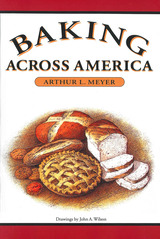
front cover of Baking across America
Baking across America
By Arthur L. Meyer
University of Texas Press, 1998

Whether it's a slice of warm bread and butter, a Thanksgiving pumpkin pie, or a piece of cake, baked goods have been among America's favorite comfort foods ever since the Pilgrims arrived. From the days of hand mixing and baking on the hearth to today's use of food processors and electric ranges, American cooks have created an amazing variety of breads and baked goods that are as distinctive as the cultures from which we came.

Spanning colonial times to the present and every region of the United States, this book is a comprehensive guide to baking in America. Certified master baker Arthur L. Meyer brings together some 700 kitchen-tested recipes for America's favorite breads, pies, cakes, and cookies. Compiled from almost 300 regional cookbooks dating from the 1890s to the 1980s, these are the authentic recipes for the traditional baked goods of every part of our country. In these pages, you'll find regional specialties such as Appalachian Buttermilk Cracklin' Bread and Hawaiian Pineapple-Macadamia Bread, as well as old family recipes.

In addition to the recipes, Meyer offers a fascinating overview of the history of baking in America, complete with descriptions of early breads, pies, cakes, and cookies. Whether you're a home or professional baker, a food historian, or someone who just enjoys reading cookbooks, you're sure to find lots of tasty treats here. Let Baking across America become your basic source for all the baked goodies Americans love to eat.
[more]

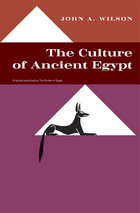
front cover of The Culture of Ancient Egypt
The Culture of Ancient Egypt
John A. Wilson
University of Chicago Press, 1956
The story of Egypt is the story of history itself—the endless rise and fall, the life and death and life again of the eternal human effort to endure, enjoy, and understand the mystery of our universe. Emerging from the ancient mists of time, Egypt met the challenge of the mystery in a glorious evolution of religious, intellectual, and political institutions and for two millenniums flourished with all the vigor that the human heart can invest in a social and cultural order. Then Egypt began to crumble into the desert sands and the waters of the Nile, and her remarkable achievements in civilization became her lingering epitaph. John A. Wilson has written a rich and interpretive biography of one of the greatest cultural periods in human experience. He answers—as best the modern Egyptologist can—the questions inevitably asked concerning the dissolution of Egypt's glory. Here is scholarship in its finest form, concerned with the humanity that has preceded us, and finding in man's past grandeur and failure much meaning for men of today.
[more]

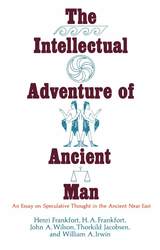
front cover of The Intellectual Adventure of Ancient Man
The Intellectual Adventure of Ancient Man
An Essay of Speculative Thought in the Ancient Near East
Henri Frankfort, H. A. Frankfort, John A. Wilson, Thorkild Jacobsen, and William A. Irwin
University of Chicago Press, 1946
The people in ancient times the phenomenal world was teeming with life; the thunderclap, the sudden shadow, the unknown and eerie clearing in the wood, all were living things. This unabridged edition traces the fascinating history of thought from the pre-scientific, personal concept of a "humanized" world to the achievement of detached intellectual reasoning.

The authors describe and analyze the spiritual life of three ancient civilizations: the Egyptians, whose thinking was profoundly influenced by the daily rebirth of the sun and the annual rebirth of the Nile; the Mesopotamians, who believed the stars, moon, and stones were all citizens of a cosmic state; and the Hebrews, who transcended prevailing mythopoeic thought with their cosmogony of the will of God. In the concluding chapter the Frankforts show that the Greeks, with their intellectual courage, were the first culture to discover a realm of speculative thought in which myth was overcome.

[more]

front cover of The Mormon History Association’s Tanner Lectures
The Mormon History Association’s Tanner Lectures
The First Twenty Years
Edited by Dean L. May and Reid L. Neilsonwith Richard Lyman Bushman, Jan Shipps, and Thomas G. Alexander
University of Illinois Press, 2000
The Tanner lectures, now firmly entrenched as an institution at the annual Mormon History Association meetings, were established in 1980 as a means of providing scholars of Mormonism with a valuable new perspective for their historical record. All twenty-one lectures are presented by well-known non-Mormon scholars that were invited to prepare presentations in their own specialties that also encompass some aspect of Mormon history.   In the course of preparing their talks, the presenters are expected to immerse themselves for a year in current historical writings on Mormons and Mormonism. As this collection amply demonstrates, when these scholars do their homework, the results are enlightening.  This volume includes the Tanner lectures for the last two decades of the twentieth century, a general introduction, and specialized introductions to each individual lecture. 
 
[more]

front cover of The Myth of Political Correctness
The Myth of Political Correctness
The Conservative Attack on Higher Education
John K. Wilson
Duke University Press, 1995
The classics of Western culture are out, not being taught, replaced by second-rate and Third World texts. White males are a victimized minority on campuses across the country, thanks to affirmative action. Speech codes have silenced anyone who won’t toe the liberal line. Feminists, wielding their brand of sexual correctness, have taken over. These are among the prevalent myths about higher education that John K. Wilson explodes.
The phrase "political correctness" is on everyone’s lips, on radio and television, and in newspapers and magazines. The phenomenon itself, however, has been deceptively described. Wilson steps into the nation’s favorite cultural fray to reveal that many of the most widely publicized anecdotes about PC are in fact more myth than reality. Based on his own experience as a student and in-depth research, he shows what’s really going on beneath the hysteria and alarmism about political correctness and finds that the most disturbing examples of thought policing on campus have come from the right. The image of the college campus as a gulag of left-wing totalitarianism is false, argues Wilson, created largely through the exaggeration of deceptive stories by conservatives who hypocritically seek to silence their political opponents.
Many of today’s most controversial topics are here: multiculturalism, reverse discrimination, speech codes, date rape, and sexual harassment. So are the well-recognized protagonists in the debate: Dinesh D’Souza, William Bennett, and Lynne Cheney, among others. In lively fashion and in meticulous detail, Wilson compares fact to fiction and lays one myth after another to rest, revealing the double standard that allows "conservative correctness" on college campuses to go unchallenged.
[more]

logo for The Ohio State University Press
The Ordeal of Mr. Pepys’s Clerk
John Harold Wilson
The Ohio State University Press, 1900

front cover of Praise of Folly
Praise of Folly
Desiderius Erasmus; Translated by John Wilson
University of Michigan Press, 1958
The Praise of Folly by Desiderius Erasmus is an enduring classic that satirically critiques the societal and religious norms of its time. Translated by John Wilson in 1668, this seminal work uses wit and humor to examine the folly prevalent in various human behaviors and institutions, making it a timeless piece that continues to resonate. With a foreword by Kenneth E. Boulding, this edition delves into the essence of folly through a monologue by the allegorical character, Folly herself. She extols the virtues of foolishness in a world riddled with pretentious wisdom and self-importance. Erasmus, with his sharp intellect and playful prose, not only entertains but also provokes deep reflection on the paradoxes of human nature and the pursuit of wisdom, making The Praise of Folly a profound yet accessible read for anyone interested in literature, philosophy, and social commentary.
[more]

front cover of Quantifying the Impact of Technical Barriers to Trade
Quantifying the Impact of Technical Barriers to Trade
Can It Be Done?
Keith E. Maskus and John S. Wilson, Editors
University of Michigan Press, 2001
This book provides an up-to-date discussion of economic issues involved in analyzing regulations of product quality and performance in international trade. Among the issues addressed in this collection are restrictions on genetically modified foods and pesticide use and compatibility standards for computers. While such regulations may serve important goals, they may also interfere with international trade flow by raising the costs of compliance. This is of special concern to developing countries, which have found it difficult to meet the increasingly exacting regulations imposed by the United States and Europe. Keith E. Maskus and John S. Wilson gather prominent international trade specialists to ask whether the impacts of such regulations may be quantified systematically in order to inform the international policy debate. The essays included here cover all fronts of the debate over regulatory issues and trade conflicts. The discussion ranges from a review of how trade conflicts emerge and how they are managed by the international trading system to a technical analysis of the potential impact of European restraints on trade in genetically modified products to an examination of methods for estimating the costs of compliance with environmental regulations. Considerable attention is paid to whether the emergence and enforcement of stronger standards among developed economies could result in diminished trade opportunities for developing countries. At the same time, the possibility that standards could expand market access through resolving consumer information problems is analyzed. This book will appeal to international economists, international relations specialists, and individuals concerned about appropriate regulation of safety and health issues in the global economy. Keith E. Maskus is Professor of Economics, University of Colorado, Boulder. John S. Wilson is Lead Economist, Development Economics Research Group, The World Bank.
[more]

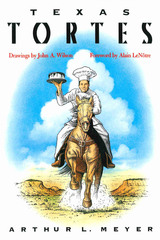
front cover of Texas Tortes
Texas Tortes
By Arthur L. Meyer
University of Texas Press, 1997

With layer upon layer of rich, dense cake and delicate buttercream subtly flavored with fruit, chocolate, or nuts, classic European tortes crown the pinnacle of Old World baking. Make them with the freshest produce of the fields and orchards of Texas—oranges, peaches, pecans, raspberries, blueberries, plums, apricots, figs, strawberries, and kiwis—and you will discover the New World's ultimate desserts.

In this cookbook, Master Baker Arthur L. Meyer presents forty-three original, kitchen-tested recipes for fruit, nut, and chocolate tortes, cassate, tarts and pies, cheesecakes, and other classic European desserts. The recipes take advantage of fresh Texas ingredients, and each recipe contains clear, easy-to-follow instructions that demystify the processes involved in creating these desserts.

In addition to the recipes, Meyer guides the home baker through the basic steps in producing tart and cheesecake crusts, fillings and icings, and other standard components of special desserts. Throughout the book, he gives tips on proper techniques and equipment drawn from many years of experience.

[more]


Send via email Share on Facebook Share on Twitter