front cover of Aristotle
Aristotle
Democracy and Political Science
Delba Winthrop
University of Chicago Press, 2018
A thought-provoking exploration of assertiveness within Aristotle’s work and how it affects democratic functioning.

Today, democracy is seen as the best or even the only legitimate form of govern­ment. With this book, Delba Winthrop punctures this complacency and takes up the chal­lenge of justifying democracy through Aristotle’s political science. In Aristotle’s time and in ours, democrats want inclu­siveness; they want above all to include everyone as a part of a whole. But what makes a whole? This is a question for both politics and philosophy, and Winthrop shows that Aristotle pursues the answer in the Politics. She uncovers in his political science the insights philoso­phy brings to politics and, especially, the insights politics brings to philosophy. Through her appreciation of this dual purpose and her skilled execution of her argument, Winthrop makes profound discoveries. Central to politics, she main­tains, is the quality of assertiveness—the kind of speech that demands to be heard. Aristotle, she shows for the first time, carries assertive speech into philosophy, where human reason claims its due as a contribution to the universe. Political science has the high role of teaching ordinary folk about democracy and what sustains it.

This posthumous publication is more than an honor to Delba Winthrop’s memory. It is a gift to partisans of democ­racy, advocates of justice, and students of Aristotle.

[more]

front cover of Democracy in America
Democracy in America
Alexis de Tocqueville
University of Chicago Press, 2000
The most faithful and nuanced translation of the definitive work for understanding America

Alexis de Tocqueville (1805-59) came to America in 1831 to see what a great republic was like. What struck him most was the country's equality of conditions, its democracy. The book he wrote on his return to France, Democracy in America, is both the best ever written on democracy and the best ever written on America. It remains the most often quoted book about the United States, not only because it has something to interest and please everyone, but also because it has something to teach everyone.
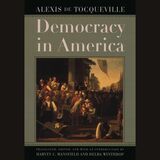
 
When it was published in 2000, Harvey Mansfield and Delba Winthrop's new translation of Democracy in America—only the third since the original two-volume work was published in 1835 and 1840—was lauded in all quarters as the finest and most definitive edition of Tocqueville's classic thus far. Mansfield and Winthrop have restored the nuances of Tocqueville's language, with the expressed goal "to convey Tocqueville's thought as he held it rather than to restate it in comparable terms of today." The result is a translation with minimal interpretation, but with impeccable annotations of unfamiliar references and a masterful introduction placing the work and its author in the broader contexts of political philosophy and statesmanship.
 
[more]

front cover of Democracy in America
Democracy in America
Alexis de Tocqueville
University of Chicago Press, 2000

This is an auto-narrated audiobook edition of this book. 

Alexis de Tocqueville (1805-59) came to America in 1831 to see what a great republic was like. What struck him most was the country's equality of conditions, its democracy. The book he wrote on his return to France, Democracy in America, is both the best ever written on democracy and the best ever written on America. It remains the most often quoted book about the United States, not only because it has something to interest and please everyone, but also because it has something to teach everyone.
 
When it was published in 2000, Harvey Mansfield and Delba Winthrop's new translation of Democracy in America—only the third since the original two-volume work was published in 1835 and 1840—was lauded in all quarters as the finest and most definitive edition of Tocqueville's classic thus far. Mansfield and Winthrop have restored the nuances of Tocqueville's language, with the expressed goal "to convey Tocqueville's thought as he held it rather than to restate it in comparable terms of today." The result is a translation with minimal interpretation, but with impeccable annotations of unfamiliar references and a masterful introduction placing the work and its author in the broader contexts of political philosophy and statesmanship.
 
[more]


Send via email Share on Facebook Share on Twitter