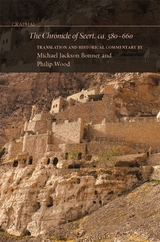
front cover of The Chronicle of Seert, ca. 580–660
The Chronicle of Seert, ca. 580–660
Michael Jackson Bonner and Philip Wood
Harvard University Press

The Chronicle of Seert, a Middle Arabic history written in the late tenth or eleventh century, draws on earlier Syriac sources from the Church of the East dating back to the sixth and seventh centuries and is the richest repository of these earlier materials. It is a monument to a literature that is now mostly destroyed and an invaluable source for those studying Late Antique history, Eastern Christianity, and the medieval Christians who lived under Muslim rule.

This volume is the first English translation of the portion of the Chronicle covering the period from 580 to 660, narrating the constant wars fought between the Roman Empire and Sassanid Persia as well as the arrival of Muhammad and the Muslim armies that upended the Late Antique world. But the Chronicle also includes extensive accounts of the theological controversies that beset the Church of the East, the monasteries and holy men that dotted the landscape, and political events within the Roman Empire from an outside perspective. Preserving a remnant of a lost, yet influential, history, the Chronicle allows us to see adaptations to a genre that was created in a Christian Roman Empire.

[more]

front cover of A Clubbable Man
A Clubbable Man
Essays on Eighteenth-Century Literature and Culture in Honor of Greg Clingham
Anthony W Lee
Bucknell University Press, 2022
Samuel Johnson famously referred to his future biographer, the unsociable magistrate Sir John Hawkins, as “a most unclubbable man." Conversely, this celebratory volume gathers distinguished eighteenth-century studies scholars to honor the achievements, professional generosity, and sociability of Greg Clingham, taking as its theme textual and social group formations. Here, Philip Smallwood examines the “mirrored minds” of Johnson and Shakespeare, while David Hopkins parses intersections of the general and particular in three key eighteenth-century figures. Aaron Hanlon draws parallels between instances of physical rambling and rhetorical strategies in Johnson’s Rambler, while Cedric D. Reverand dissects the intertextual strands uniting Dryden and Pope. Contributors take up other topics significant to the field, including post-feminism, travel, and seismology. Whether discussing cultural exchange or textual reciprocities, each piece extends the theme, building on the trope of relationship to organize and express its findings. Rounding out this collection are tributes from Clingham’s former students and colleagues, including original poetry.
 
[more]

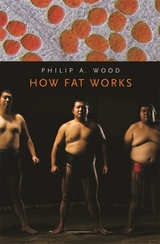
front cover of How Fat Works
How Fat Works
Philip A. Wood
Harvard University Press, 2006
An experimental pathologist and molecular geneticist, Philip Wood uses gene-knockout technology to study the way mouse genes regulate the metabolism of fat—research that provides insights into the workings of fatty-acid metabolism in humans and what can happen when that metabolic balance goes awry. Based on the classes he regularly teaches to first- and second-year medical students, Wood's book reviews the individual and public health burden of obesity and clarifies often-used, but often inadequately explained, terms employed in the continuing cultural and scientific debate about excess fat. He explains the role of fat in the healthy body, how fat is made, stored, and burned, and demonstrates how excess fat can lead to an array of metabolic disorders and diseases, from hypercholesterolemia and insulin resistance to diabetes. He reviews what recent research can tell us about specific genes or groups of genes that can lead to specific metabolic disorders. He explains the science behind common weight-loss regimens and why those regimens might succeed or fail, and reviews the complex interplay of hormones, genes, and stress in the way our bodies deal with fat through the life cycle. How Fat Works is a concise, clear, and up-to-date primer on the workings of fat, and essential reading for professionals entering careers in medicine and public health administration or anyone wanting a better understanding of one of our most urgent health crises.
[more]

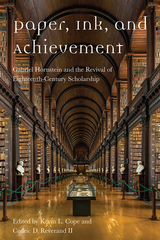
front cover of Paper, Ink, and Achievement
Paper, Ink, and Achievement
Gabriel Hornstein and the Revival of Eighteenth-Century Scholarship
Kevin L. Cope
Bucknell University Press, 2021
During his forty-two years as president of AMS Press, Gabriel Hornstein quietly sponsored and stimulated the revival of “long” eighteenth-century studies. Whether by reanimating long-running research publications; by creating scholarly journals; or by converting daring ideas into lauded books, “Gabe” initiated a golden age of Enlightenment scholarship. This understated publishing magnate created a global audience for a research specialty that many scholars dismissed as antiquarianism. Paper, Ink, and Achievement finds in the career of this impresario a vantage point on the modern study of the Enlightenment. An introduction discusses Hornstein’s life and achievements, revealing the breadth of his influence on our understanding of the early days of modernity. Three sets of essays open perspectives on the business of long-eighteenth-century studies: on the role of publishers, printers, and bibliophiles in manufacturing cultural legacies; on authors whose standing has been made or eclipsed by the book culture; and on literary modes that have defined, delimited, or directed Enlightenment studies.

Published by Bucknell University Press. Distributed worldwide by Rutgers University Press.
[more]

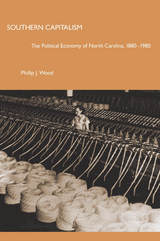
front cover of Southern Capitalism
Southern Capitalism
The Political Economy of North Carolina, 1880–1980
Philip J. Wood
Duke University Press, 1986
Southern Capitalism challenges prevailing views of Southern development by arguing that the persisting peculiarities of the Southern economy—such as low wages and high poverty rates—have not resulted from barriers to capitalist development, nor from the lingering influence of planter values. Wood argues that these peculiarities can instead be best understood as the consequence of a strategy of capitalist development, based on the creation and preservation of social conditions and relations conducive to the above-average exploitation of labor by capital. focusing on the evolving relationship between capital and labor as the core of this strategy, Wood follows the process of capitalist industrialization in North Carolina from its beginnings in the aftermath of the Civil War to the 1980s.
[more]


Send via email Share on Facebook Share on Twitter