
 A SCHOLARLY BOOK REPOSITORY
Penny Farfan / Victor Holtcamp / Lisa Jackson-Schebetta / Richard
L. Poole / Bill Rauch / Thomas Robson / Marlis Schweitzer / Virginia
Scott / Christine Woodworth
THEATRE HISTORY STUDIES, VOLUME 37
STEFAN AQUILINA
Meyerhold and The Revolution: A Reading through Henri Lefebvre’s Theories on “Everyday Life”
VIVIAN APPLER
“Shuffled Together under the Name of a Farce”: Finding Nature in Aphra Behn’s The Emperor of the Moon
KRISTI GOOD
Kate Soffel’s Life of Crime: A Gendered Journey from Warden’s Wife to Criminal Actress
PETER A. CAMPBELL
Staging Ajax’s Suicide: A Historiography
BRIAN E. G. COOK
Rousing Experiences: Theatre, Politics, and Change
MEGAN LEWIS
Until You See the Whites of Their Eyes: Brett Bailey’s Exhibit B and the Consequences of Staging the Colonial Gaze
PATRICIA GABORIK
Taking the Theatre to the People: Performance Sponsorship and Regulation in Mussolini’s Italy
ILINCA TODORUT AND ANTHONY SORGE
To Image and to Imagine: Walid Raad, Rabih Mouré, and the Arab Spring
SHULAMITH LEV-ALADGEM
Where Has the Political Theatre in Israel Gone? Rethinking the Concept of Political Theatre Today
CHRISTINE WOODWORTH
“Equal Rights By All Means!”: Beatrice Forbes-Robertson’s 1910 Suffrage Matinee and the Onstage Junction of the US And UK Franchise Movements
LURANA DONNELS O’MALLEY
“Why I Wrote the Phyllis Wheatley Pageant-Play”: Mary Church Terrell’s Bicentennial Activism
JULIET GUZZETTA
The Lasting Theatre of Dario Fo and Franca Rame
ASHLEY E. LUCAS
Chavez Ravine: Culture Clash and the Political Project of Rewriting History
NOE MONTEZ
The Heavy Lifting: Resisting the Obama Presidency’s Neoliberalist Conceptions of the American Dream in Kristoffer Diaz’s The Elaborate Entrance of Chad Deity
The official journal of the Mid-America Theatre Conference
Theatre History Studies (THS) is a peer-reviewed journal of theatre history and scholarship published annually since 1981 by the Mid-America Theatre Conference (MATC), a regional body devoted to theatre scholarship and practice. The conference encompasses the states of Illinois, Iowa, Nebraska, Kansas, Missouri, Minnesota, North Dakota, South Dakota, Wisconsin, Indiana, Michigan, and Ohio. The purpose of the conference is to unite persons and organizations within the region with an interest in theatre and to promote the growth and development of all forms of theatre. THS is a member of the Council of Editors of Learned Journals and is included in the MLA Directory of Periodicals. THS is indexed in Humanities Index, Humanities Abstracts, Book Review Index, MLA International Bibliography, International Bibliography of Theatre, Arts & Humanities Citation Index, IBZ International Bibliography of Periodical Literature, and IBR International Bibliography of Book Reviews. Full texts of essays appear in the databases of both Humanities Abstracts Full Text and SIRS.Along with book reviews on the latest publications from established and emerging voices in the field, this issue of Theatre History Studies contains three sections with fourteen essays total. In the general section, three essays offer an array of insights, methods, and provocations. In the special section on care, contributors capture their experience as scholars, humans, and citizens in 2022. In Part III, the 2022 Robert A. Schanke Research Award-winning paper by Heidi L. Nees asks historians to rethink Western constructions of time. Taken together, volume 42 captures how this journal serves theatre historians as scholars and laborers as they work to attend and tend to their field.
CONTRIBUTORS
Cheryl Black / Shelby Brewster / Matthieu Chapman / Meredith Conti / Zach Dailey / Michael DeWhatley / Whit Emerson / Katherine Gillen / Miles P. Grier / Patricia Herrera / Lisa Jackson-Schebetta / Nancy Jones / Joshua Kelly / Felicia Hardison Londré / Bret McCandless / Marci R. McMahon/ Tom Mitchell / Sherrice Mojgani / John Murillo III / Heidi L. Nees / Jessica N. Pabón-Colón / Kara Raphaeli / Leticia L. Ridley / Cynthia Running-Johnson / Alexandra Swanson / Catherine Peckinpaugh Vrtis / Shane Wood / Christine Woodworth / Robert O. Yates
transvestite theatre, Annie Oakley and the disruption of Victorian audiences, and historical attempts to create ideal audiences. Edited by E. Bert Wallace, this latest publication from the largest regional theatre organization in the United States collects the most current scholarship on theatre history and theory.
Contributors To Volume 20
Susan Bennett / Jane Barnette / Becky Becker / Lisa Bernd / Evan
Bridenstine / Michael Jaros / Robert I. Lublin / Paulette Marty
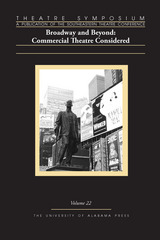
The eleven contributors to this fascinating collection illuminate many aspects of commercial theatre and how best to examine it. George Pate analyzes the high-stakes implication of a melodramatic legal battle. Christine Woodworth recounts the difficulties encountered by British actresses near the turn of the twentieth century, while Boone J. Hopkins considers newly found images of Margo Jones along with the commercial appeal they represent.
The volume continues with articles that follow developments with ties to commercial theatre, such as the interplay between Broadway companies and regional theatres, musical productions in communist Poland, and the influence of Korean popular culture on theatre and the unique production arrangements that have resulted. Other essays investigate alternative concepts related to commercial themes with regard to audience interaction and the burgeoning world of geek theatre.
Edited by David S. Thompson, this latest publication by the largest regional theatre organization in the United States collects the most current scholarship on theatre history and theory.
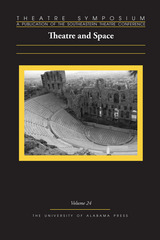
Exploring the dynamic intersections of performance and place.
At a time when so many options exist for access to theatrical entertainments, it is no surprise that theatre practitioners and scholars are often preoccupied with the role of the audience. While space undoubtedly impacts the rehearsal and production processes, its greater significance seems to rest in the impact a specific location has on the audience.
This volume provides diverse viewpoints on theatre and space, as well as its relationship to the audience. Sebastian Trainor and Samuel T. Shanks offer contemporary perspectives on two ancient theatre spaces, while Lisa Marie Bowler describes the Globe Theatre, a replica of the original, as embodying a kind of absence despite its rich link to the past. Focusing on distinctly different periods and settings, both Andrew Gibb and Christine Woodworth describe a politics of space in which specific players gain prestige and power. Chase Bringardner identifies the audience as playing an important role in creating a space for parody in a historic Nashville venue, while Arnab Banerji describes an exhausting process for members of the Bengali group theatre who must continually move from space to space. Finally, Alicia Corts discusses virtual performance spaces and the degree to which participants are able to control their online identities within virtual performances. Bookending these eight essays are Marvin Carlson’s keynote presentation “Whose Space Is It Anyway?” and his closing remarks for the symposium, both of which allude to, and richly explicate, the ultimate arbiters of theatrical space: the audience.
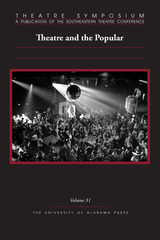
The essays in the thirty-first volume of Theatre Symposium traverse disciplinary boundaries to explore what constitutes the “popular” in theater and performance in an increasingly frenetic and mediated landscape. Amid the current resurgence of populist discourse and the enduring impact of popular culture, this volume explores what is considered popular, how that determination gets made, and who makes it. The answers to these questions shape the structures and systems of performance in an interaction that is reciprocal, intricate, and multifaceted. Productions often succeed or fail based on their ability to align with what is popular—sometimes productively, sometimes clumsily, sometimes brazenly, and sometimes tragically.
In our current moment, what constitutes the popular profoundly affects the real world politically, economically, and socially. Controversies about the electoral college system hinge on the primacy of the “popular” vote. Streaming services daily update lists of their most popular content and base future decisions on opaque measures of popularity. Social media platforms broadcast popular content across the globe, triggering new products, social activism, and political revolutions.
The contributors to this volume engage with a range of contemporary and historical examples and argue with clarity and acuity the interplay of performance and the popular. Theatre and performance deeply engage with the popular at every level—from audience response to box office revenue. The variety of methodologies and sites of inquiry showcased in this volume demonstrates the breadth and depth of the popular and the importance of such work to understanding our present moment onstage and off.
CONTRIBUTORS
Mysia Anderson / Chase Bringardner / Elizabeth M. Cizmar / Chelsea Curto / Janet M. Davis / Tom Fish / Kyla Kazuschyk / Sarah McCarroll / Eleanor Owicki / Sunny Stalter-Pace / Chelsea Taylor / Chris Woodworth
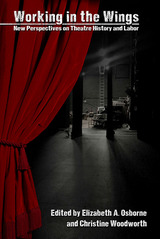
Theatre has long been an art form of subterfuge and concealment. Working in the Wings: New Perspectives on Theatre History and Labor, edited by Elizabeth A. Osborne and Christine Woodworth, brings attention to what goes on behind the scenes, challenging, and revising our understanding of work, theatre, and history.
Essays consider a range of historic moments and geographic locations—from African Americans’ performance of the cakewalk in Florida’s resort hotels during the Gilded Age to the UAW Union Theatre and striking automobile workers in post–World War II Detroit, to the struggle in the latter part of the twentieth century to finish an adaptation of Moby Dick for the stage before the memory of creator Rinde Eckert failed. Contributors incorporate methodologies and theories from fields as diverse as theatre history, work studies, legal studies, economics, and literature and draw on traditional archival materials, including performance texts and architectural structures, as well as less tangible material traces of stagecraft.
Working in the Wings looks at the ways in which workers' identities are shaped, influenced, and dictated by what they do; the traces left behind by workers whose contributions have been overwritten; the intersections between the sometimes repetitive and sometimes destructive process of creation and the end result—the play or performance; and the ways in which theatre affects the popular imagination. This collected volume draws attention to the significance of work in the theatre, encouraging a fresh examination of this important subject in the history of the theatre and beyond.
READERS
Browse our collection.
PUBLISHERS
See BiblioVault's publisher services.
STUDENT SERVICES
Files for college accessibility offices.
RECENTLY PUBLISHED




UChicago Accessibility Resources
home | accessibility | search | about | contact us
BiblioVault ® 2001 - 2025
The University of Chicago Press