
 A SCHOLARLY BOOK REPOSITORY
16 start with A start with A
The Wounded Knee Massacre of December 29, 1890, known to U.S. military historians as the last battle in "the Indian Wars," was in reality another tragic event in a larger pattern of conquest, destruction, killing, and broken promises that continue to this day.
On a cold winter's morning more than a century ago, the U.S. Seventh Cavalry attacked and killed more than 260 Lakota men, women, and children at Wounded Knee Creek in South Dakota. In the aftermath, the broken, twisted bodies of the Lakota people were soon covered by a blanket of snow, as a blizzard swept through the countryside. A few days later, veteran army surgeon John Vance Lauderdale arrived for duty at the nearby Pine Ridge Indian Reservation. Shocked by what he encountered, he wrote numerous letters to his closest family members detailing the events, aftermath, and daily life on the Reservation under military occupation. He also treated the wounded, both Cavalry soldiers and Lakota civilians. What distinguishes After Wounded Knee from the large body of literature already available on the massacre is Lauderdale's frank appraisals of military life and a personal observation of the tragedy, untainted by self-serving reminiscence or embellished newspaper and political reports. His sense of frustration and outrage toward the military command, especially concerning the tactics used against the Lakota, is vividly apparent in this intimate view of Lauderdale's life. His correspondence provides new insight into a familiar subject and was written at the height of the cultural struggle between the U.S. and Lakota people. Jerry Green's careful editing of this substantial collection, part of the John Vance Lauderdale Papers in the Western Americana Collection in Yale University's Beinecke Library, clarifies Lauderdale's experiences at the Pine Ridge Indian Reservation.

On 28 March, 1941, at the height of Hitler's victories during the Second World War, Virginia Woolf filled her pockets with stones and drowned herself in the River Ouse near her home in Sussex. At the time of her death some voices in the press attacked her for showing cowardice in the face of the enemy and for setting a bad example to the general population. Woolf's suicide has been the subject of controversy for the media, for literary scholars, and for her biographers ever since.
Just when it may seem that nothing else could be said about Virginia Woolf and the ambiguous details of her suicide, Afterwords provides an entirely fresh perspective. It makes available to a wide readership for the first time letters sent to Leonard Woolf and Vanessa Bell (Virginia Woolf's sister) in the aftermath of the event. This unique volume brings together over two hundred letters from T. S. Eliot, H. G. Wells, May Sarton, Vita Sackville-West, Edith Sitwell, E. M. Forster, Radclyffe Hall, and many others, including political figures and religious leaders. In addition, informative annotations reveal the identities of many unexpected condolence-letter writers from among the general public.
In her introduction, editor Sybil Oldfield confronts the contemporary controversy over Woolf's suicide note, arguing that no one who knew Woolf or her work believed that she had deserted Britain. The ensuing collection of letters supports Oldfield's assertion. In elegant prose that rises to the stature of the occasion, these writers share remembrances of Virginia Woolf in life, comment on the quality of her work and her antifascist values, and reveal previously unknown facets of her capacity for friendship.
A richly deserved tribute to the life of an extraordinary woman as well as a testimony to the human capacity for sympathy, Afterwords is essential reading for anyone interested in the life, death, and enduring impact of Virginia Woolf.
In the daring letters presented in this bilingual edition, Montpensier condemns the alliance system of marriage, proposing instead to found a republic that she would govern, "a corner of the world in which . . . women are their own mistresses," and where marriage and even courtship would be outlawed. Her pastoral utopia would provide medical care and vocational training for the poor, and all the homes would have libraries and studies, so that each woman would have a "room of her own" in which to write books.
Joan DeJean's lively introduction and accessible translation of Montpensier's letters—four previously unpublished—allow us unprecedented access to the courageous voice of this extraordinary woman.
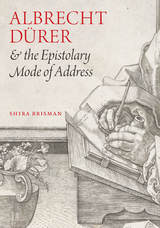
In the early modern period, before the establishment of a reliable postal system, letters faced risks of interception and delay. During the Reformation, the printing press threatened to expose intimate exchanges and blur the line between public and private life. Exploring the complex travel patterns of sixteenth-century missives, Brisman explains how these issues of sending and receiving informed Dürer’s artistic practices. His success, she contends, was due in large part to his development of pictorial strategies—an epistolary mode of address—marked by a direct, intimate appeal to the viewer, an appeal that also acknowledged the distance and delay that defers the message before it can reach its recipient. As images, often in the form of prints, coursed through an open market, and artists lost direct control over the sale and reception of their work, Germany’s chief printmaker navigated the new terrain by creating in his images a balance between legibility and concealment, intimacy and public address.

The editors present in this volume transcriptions of Starkey's texts, their translations, and valuable commentary for the modern reader. Dispelling the myth that alchemy was an irrational enterprise, this remarkable collection of laboratory notebooks and correspondence reveals the otherwise hidden methodologies of one of the seventeenth century's most influential alchemists.
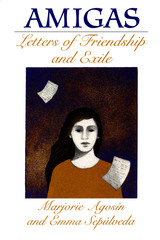
This collection of letters chronicles a remarkable, long-term friendship between two women who, despite differences of religion and ethnicity, have followed remarkably parallel paths from their first adolescent meeting in their native Chile to their current lives in exile as writers, academics, and political activists in the United States. Spanning more than thirty years (1966-2000), Agosín's and Sepúlveda's letters speak eloquently on themes that are at once personal and political—family life and patriarchy, women's roles, the loneliness of being a religious or cultural outsider, political turmoil in Chile, and the experience of exile.
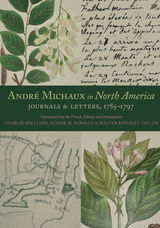
Tracing the roots of American botany through the journals of an eighteenth-century explorer.
Known to today’s biologists primarily as the “Michx.” at the end of more than 700 plant names, André Michaux was an intrepid French naturalist. Under the directive of King Louis XVI, he was commissioned to search out and grow new, rare, and never-before-described plant species and ship them back to his homeland in order to improve French forestry, agriculture, and horticulture. He made major botanical discoveries and published them in his two landmark books, Histoire des chênes de l’Amérique (1801), a compendium of all oak species recognized from eastern North America, and Flora Boreali-Americana (1803), the first account of all plants known in eastern North America.
Straddling the fields of documentary editing, history of the early republic, history of science, botany, and American studies, André Michaux in North America: Journals and Letters, 1785–1797 is the first complete English edition of Michaux’s American journals. This copiously annotated translation includes important excerpts from his little-known correspondence as well as a substantial introduction situating Michaux and his work in the larger scientific context of the day.
To carry out his mission, Michaux traveled from the Bahamas to Hudson Bay and west to the Mississippi River on nine separate journeys, all indicated on a finely rendered, color-coded map in this volume. His writings detail the many hardships—debilitating disease, robberies, dangerous wild animals, even shipwreck—that Michaux endured on the North American frontier and on his return home. But they also convey the soaring joys of exploration in a new world where nature still reigned supreme, a paradise of plants never before known to Western science. The thrill of discovery drove Michaux ever onward, even ultimately to his untimely death in 1802 on the remote island of Madagascar.
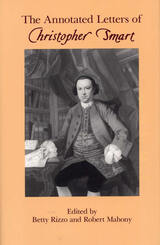
The only collection of all known letters of Christopher Smart provides the best psychological explanation to date of that complex and elusive eighteenth-century poet.
The significant characteristics that distinguish Smart’s prose letters from his poetry, Betty Rizzo and Robert Mahony note, are that his letters were requests for assistance while his verses were bequests, gifts in which he set great store. Indeed, it was Smart’s lifelong conviction that he was a poet of major importance.
As Smart biographer Karina Williamson notes, "The splendidly informative and vivaciously written accounts of the circumstances surrounding each letter, or group of letters, add up to what is in effect a miniature biography."
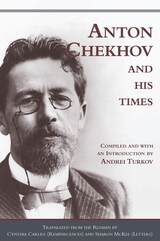
This anthology comprises reminiscences by a number of Anton Pavlovich Chekhov’s contemporaries, including the artist Konstantin Korovin, the writer Maxim Gorky, and Chekhov’s wife, Olga Knipper-Chekhova, and numerous letters written by Chekhov to his fellow writers and artists, family, publishers, and others.
Now available for the first time in English in America, these sixty-eight letters and ten essay-length reminiscences trace the development of Chekhov’s personality and talent, opening a window into the life and times of one of the world’s greatest short-story writers and playwrights. These perspectives on his family life and marriage, his early works, the stage productions of his plays, his literary successes, and the philosophies behind his writing create a rich biography of Chekhov that will reward writers, scholars, and all lovers of literature.
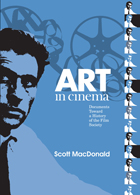
Scott MacDonald's Art in Cinema presents complete programs presented by the legendary society; dozens of previously unavailable letters between Stauffacher, his collaborators, and filmmakers including Maya Deren, Hans Richter, Vincent Minelli, and Man Ray; a reprint of the society's original catalog, which features essays by Henry Miller and others; and a wide range of other remarkable historical documents.
A companion to Cinema 16 (Temple), a documentary history of the first west coast film society, Art in Cinema provides cineastes, students, teachers, and scholars with extensive and fascinating documentation of one of the most important film societies in American history. Together or separately, the books provide an indispensable reference source for the beginning of this country's love affair with independent film.
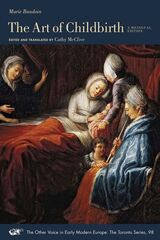
In 1671, Marie Baudoin (1625–1700), head midwife and governor of the Hôtel-Dieu of Clermont-Ferrand, sent a treatise on the art of childbirth to her powerful Parisian patron, Dr. Vallant. The story of how Baudoin’s knowledge and expertise as a midwife came to be expressed, recorded, and archived raises the question: Was Baudoin exceptional because she was herself extraordinary, or because her voice has reached us through Vallant’s careful archival practices? Either way, Baudoin’s treatise invites us to reconsider the limits of what we thought we knew midwives “could be and do” in seventeenth-century France. Grounding Marie Baudoin’s text in a microanalysis of her life, work, and the Jansenist network between Paris and Clermont-Ferrand, this book connects historiographies of midwifery, Jansenism, hospital administration, public health, knowledge and record-keeping, and women’s work, underscoring both Baudoin’s capabilities and the archival accidents and intentions behind the preservation of her treatise in a letter.
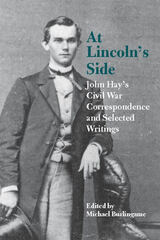
John Hay believed that “real history is told in private letters,” and the more than 220 surviving letters and telegrams from his Civil War days prove that to be true, showing Abraham Lincoln in action: “The Tycoon is in fine whack. I have rarely seen him more serene & busy. He is managing this war, the draft, foreign relations, and planning a reconstruction of the Union, all at once. I never knew with what tyrannous authority he rules the Cabinet, till now. The most important things he decides & there is no cavil.”
Along with Hay’s personal correspondence, Burlingame includes his surviving official letters. Though lacking the “literary brilliance of [Hay’s] personal letters,” Burlingame explains, “they help flesh out the historical record.” Burlingame also includes some of the letters Hay composed for Lincoln’s signature, including the celebrated letter of condolence to the Widow Bixby.
More than an inside glimpse of the Civil War White House, Hay’s surviving correspondence provides a window on the world of nineteenth-century Washington, D.C.
READERS
Browse our collection.
PUBLISHERS
See BiblioVault's publisher services.
STUDENT SERVICES
Files for college accessibility offices.
RECENTLY PUBLISHED



UChicago Accessibility Resources
home | accessibility | search | about | contact us
BiblioVault ® 2001 - 2026
The University of Chicago Press