
 A SCHOLARLY BOOK REPOSITORY
107 books about Penology and 3
start with A
107 books about Penology and 3
107 books about Penology
3 start with A start with A
3 start with A start with A
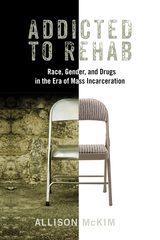
Addicted to Rehab
Race, Gender, and Drugs in the Era of Mass Incarceration
McKim, Allison
Rutgers University Press, 2017
Winner of the 2018 Book Award from the American Society of Criminology's Division of Critical Criminology and Social Justice
Winner of the 2018 Book of the Year Award from the American Society of Criminology's Division on Women and Crime
After decades of the American “war on drugs” and relentless prison expansion, political officials are finally challenging mass incarceration. Many point to an apparently promising solution to reduce the prison population: addiction treatment.
In Addicted to Rehab, Bard College sociologist Allison McKim gives an in-depth and innovative ethnographic account of two such rehab programs for women, one located in the criminal justice system and one located in the private healthcare system—two very different ways of defining and treating addiction. McKim’s book shows how addiction rehab reflects the race, class, and gender politics of the punitive turn. As a result, addiction has become a racialized category that has reorganized the link between punishment and welfare provision. While reformers hope that treatment will offer an alternative to punishment and help women, McKim argues that the framework of addiction further stigmatizes criminalized women and undermines our capacity to challenge gendered subordination. Her study ultimately reveals a two-tiered system, bifurcated by race and class.
Winner of the 2018 Book of the Year Award from the American Society of Criminology's Division on Women and Crime
After decades of the American “war on drugs” and relentless prison expansion, political officials are finally challenging mass incarceration. Many point to an apparently promising solution to reduce the prison population: addiction treatment.
In Addicted to Rehab, Bard College sociologist Allison McKim gives an in-depth and innovative ethnographic account of two such rehab programs for women, one located in the criminal justice system and one located in the private healthcare system—two very different ways of defining and treating addiction. McKim’s book shows how addiction rehab reflects the race, class, and gender politics of the punitive turn. As a result, addiction has become a racialized category that has reorganized the link between punishment and welfare provision. While reformers hope that treatment will offer an alternative to punishment and help women, McKim argues that the framework of addiction further stigmatizes criminalized women and undermines our capacity to challenge gendered subordination. Her study ultimately reveals a two-tiered system, bifurcated by race and class.
[more]
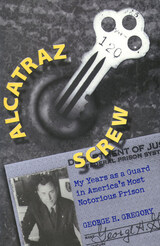
Alcatraz Screw
My Years as a Guard in America's Most Notorious Prison
George H. Gregory & Intro by John W. Roberts
University of Missouri Press, 2002
Alcatraz Screw is a firsthand account from a prison guard’s perspective of some of the most storied years at the infamous U.S. Penitentiary at Alcatraz. George Gregory began his career as a guard for the Federal Bureau of Prisons in 1940. Following his training, he was sent to the federal prison at Sandstone, Minnesota. A few years later he enlisted in the Marine Corps. Badly wounded at Iwo Jima, he returned to Sandstone after a long rehabilitation. When the Bureau of Prisons closed Sandstone in 1947, Gregory was transferred to Alcatraz, which had been a federal penitentiary since 1934.
For the next fifteen years, Gregory worked on “The Rock.” He takes the reader along on a correctional officer’s tour of duty, showing what it was like to pull a lonely, tedious night of sentry duty in the Road Tower, or witness illicit transactions in the clothing room, or forcibly quell a riot in the cell blocks. Gregory provides an insider’s account of the tenures of all four of Alcatraz’s wardens and their sometimes contradictory approaches to administering the institution. He knew and regularly interacted with such legendary inmates as Robert Stroud (the Birdman of Alcatraz) and George “Machine Gun” Kelly.
Without glamorizing or demonizing either the staff or the convicts, Alcatraz Screw provides a candid portrayal of corruption, drug abuse, and sexual practices, as well as efforts at reform and unrecorded acts of kindness. Various incidents in the memoir convey the fear, hatred, frustration, boredom, and unavoidable tension of being incarcerated. With the inclusion of maps and diagrams of Alcatraz Island, as well as photographs of inmates, officers, and the prison itself, this book offers insight into life at the notorious Alcatraz from an unprecedented perspective.
[more]

The Archaeology of South-East Italy in the First Millennium BC
Greek and Native Societies of Apulia and Lucania between the 10th and the 1st Century BC
Douwe Yntema
Amsterdam University Press, 2014
Synthesizing some 30 years of archaeological research in south-east Italy, this book discusses a millennium that witnessed breathtaking changes: the first millennium BC. In nine to ten centuries the Mediterranean societies changed from a great variety of mostly small entities of predominantly tribal nature into the enormous state currently indicated as the Roman Empire.
This volume is a case study discussing the pathway to complexity of one of the regions that contributed to the formation of this large state:south-east Italy. It highlights how initially small groups developed into complex societies, how and why these adapted to increasingly wide horizons, and how and why Italic groups and migrants from the eastern Mediterranean interacted and created entirely new social, economic, cultural and physical landscapes. This synthesis is based on research carried out by many Italian archaeologists and by research groups from quite a variety of other countries.
Amsterdam Archaeological Studies is a series devoted to the study of past human societies from the prehistory up into modern times, primarily based on the study of archaeological remains. The series will include excavation reports of modern fieldwork; studies of categories of material culture; and synthesising studies with broader images of past societies, thereby contributing to the theoretical and methodological debates in archaeology.
This volume is a case study discussing the pathway to complexity of one of the regions that contributed to the formation of this large state:south-east Italy. It highlights how initially small groups developed into complex societies, how and why these adapted to increasingly wide horizons, and how and why Italic groups and migrants from the eastern Mediterranean interacted and created entirely new social, economic, cultural and physical landscapes. This synthesis is based on research carried out by many Italian archaeologists and by research groups from quite a variety of other countries.
Amsterdam Archaeological Studies is a series devoted to the study of past human societies from the prehistory up into modern times, primarily based on the study of archaeological remains. The series will include excavation reports of modern fieldwork; studies of categories of material culture; and synthesising studies with broader images of past societies, thereby contributing to the theoretical and methodological debates in archaeology.
[more]
READERS
Browse our collection.
PUBLISHERS
See BiblioVault's publisher services.
STUDENT SERVICES
Files for college accessibility offices.
RECENTLY PUBLISHED



UChicago Accessibility Resources
home | accessibility | search | about | contact us
BiblioVault ® 2001 - 2025
The University of Chicago Press