
 A SCHOLARLY BOOK REPOSITORY
30 start with B start with B


From Berlin to the Bering Strait, the business of banking has sprung to life. This analysis considers the impact of banking reform on macroeconomic stabilization and the suitability of universal banks, the role of banking regulation and the advantages of 'narrow banks' during transition, the cleaning up of bad debts, and the reform of the payments system.
The book assesses the lessons which can be drawn from reforms in Central Europe for the later reformers in the former Soviet Union and the Balkans. It considers the impact of banking reform on macroeconomic stabilization and the suitability of German-type universal banks; the role of banking regulation and the advantages of 'narrow banks' during transition; the cleaning-up of bad debts; bank privatization and reform of the payments system. Five chapters follow which review the experience of some of the 'second-wave' countries: Estonia, Georgia, Romania, Russia and Ukraine.


Be Faithful unto Death is the moving story of a bright and sensitive schoolboy growing up in an old-established boarding school in the city of Debrecen in eastern Hungary. Misi, a dreamer and would-be writer, is falsely accused of stealing a winning lottery ticket. The torments through which he goes – and grows – are superbly described.
The novel is brimming with vivid detail from the provincial life that Móricz knew so well and shot through with a sense of the tragic fate of a newly truncated Hungary.
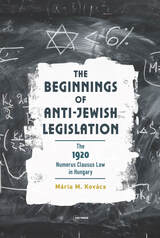
The Nazi 1933 Civil Service Law and the 1935 Nuremberg Laws are often considered the first anti-Jewish decrees in interwar Europe. Mária M. Kovács convincingly argues that Hungary’s numerus clausus law of 1920, which introduced a Jewish quota at Hungary’s institutions of higher learning, was, in fact, interwar Europe’s first antisemitic law. By defining—and discriminating against—Jews as a separate “racial” or “national” group, it abrogated the principle of equal rights that had been enshrined into law; as such, it marked an abrupt reversal of Jewish emancipation in Hungary. Moreover, the numerus clausus law set the stage for subsequent “Jewish Laws” (in the late 1930s and early 1940s) that sought to solve Hungary’s “Jewish Question” by means of extraordinary legal measures that targeted Jews alone. This book examines the origins and implementation of the numerus clausus, as well as the attempts to dampen its impact on Hungary’s international reputation, focusing on the debates surrounding it promulgation (1920), its modification (1928) and its eventual application to other areas of Jewish life (1938–45).

The proclamation of Belarusian independence on March 25, 1918, and the rival establishment of the Soviet Belarusian state on January 1, 1919, created two distinct and mutually exclusive national myths, which continue to define contemporary Belarusian society. This book examines the processes that resulted in this dual resolution in the context of World War I and the subsequent Russian Revolutions.
Based on original archival material, Lizaveta Kasmach scrutinizes the development of competing concepts of Belarusian nationhood in the context of rivaling national aspirations and imperial policies. The analysis convincingly demonstrates the divisions within the nationalist movement, both politically between the moderates and socialists, and geographically between German-occupied territory with Vilna as a center versus Russian-controlled territory around Minsk. Besides the case study of Belarusian nation-building efforts, the book is a contribution to the study of the First World War in East Central Europe, approaching the war and its aftermath as a mobilizational moment in the region.

Drawing on evidence from a wide collection of surviving family papers, Beloved Children is a valuable contribution to literature available concerning childhood history in pre-industrial Central Europe.
With the aid of detailed case studies, the volume illustrates every aspect of Hungarian childhood in the early modern age from a variety of contrasting perspectives—birth, care, education, marriage, orphanhood and death. The book also includes a unique portrayal of family life in the Hungarian aristocracy.
Beloved Children is a comprehensive study examining topics such as family intimacy, paternal and maternal attitudes, providing the reader with a valuable insight into a child’s life in Hungary during the sixteenth and seventeenth centuries.



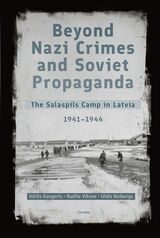
The Salaspils camp near Riga, which was operated during the Nazi occupation of Latvia, has long been the subject ofcontrovery. Around 23,000 people were imprisoned there: half were political prisoners, labor resisters and convicted soldiers, the rest prisoners from special operations against civilians in Belarus, Russia and the Latgale region of Latvia. The death toll in the camp, including the number of Jews who died during construction, is well over 3,000 people.
Despite the relatively small size of this camp, it became a model for Russian remembrance policy. Soviet propaganda claimed that up to 100,000 prisoners were killed there, charged that children were used to extract blood, and greatly exaggerated the extent of the persecution of imprisoned lawbreakers and political dissidents . Salaspils became a myth in Russian-speaking society in Latvia that served to reinforce Soviet narratives of the “Great Patriotic War.”
The three authors drew on sources from the archives of Latvia, Germany and Russia and critically analyzed oral testimonies and earlier research to create a comprehensive account of the Salaspils camp in Nazi-occupied Latvia. Their book furthers the understanding of processes of deformation of collective memory and the techniques of memory politics from the Cold War to the present.
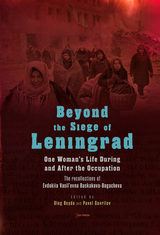
This memoir about the experiences of German occupation during the siege of Leningrad (now Saint Petersburg) was written by Moscow-born Evdokiia Vasil’evna Baskakova-Bogacheva (1888–1976), an émigré in Australia, at the age of eighty-one. The text had been forgotten in the Museum of Russian Culture in San Francisco since 1970 until the editors of this volume discovered it.
In the memoirs, after accounting on her youth spent against the background of the First World War and of the two Russian revolutions of 1917, Evdokiia describes the inferno of the Nazi occupation as experienced in a suburb of Leningrad in 1941-43. She survived for nearly two years almost on the front line, within a few kilometers of the blockade ring. As a medical practitioner, she became useful for the occupational authorities and the ever-shrinking town population, until her family was evacuated to the west in October 1943. Besides hunger, discord, disease, the hunt for food and firewood, along with violence and death, Evdokiia’s account deals with various forms of cooperation between Soviet citizens and the new authorities.
All the events she recalls can be confirmed through other sources. The introduction and the detailed notes to the text help the reader to locate Evdokiia’s recollections in time and place, and situate them in their historical context.

The bibliography volume of the three-volume East Looks West: East European Travel Writing in Europe collates travel writing published in book form by east Europeans travelling in Europe from ca. 1550 to 2000. It is intended as a fundamental research tool, collecting together travel writings within each national/linguistic tradition, and enabling comparative analysis of such material. It fills an important gap in the existing reference literature, both in western and east European languages, and will be of use to those working in the growing fields of comparative travel writing, regional and national identities, and postcolonialism.
These texts exist in surprisingly large numbers, and include writings of high literary quality as well as of historical interest, but they have been relatively little studied as a genre. Much of this material is rare and difficult to find, even in national libraries. As a result, there are few bibliographical surveys of the literature of east European travel and self-representation, and none that are region-wide or comparative in scope.
This is the third volume of a three-part set of East Looks West.
Vol. 1. Orientations. An Anthology of East European Travel Writing on Europe.
Vol. 2. Undern Eastern Eyes. A Comparative Introduction to East European Travel Writing on Europe.

The current social turmoil enveloping the world has produced knee jerk reactions and a plethora of policy declarations. At the same time, the scenario is marked with response of those with low socioeconomic status to the worldwide chaos and precarious living conditions. In this context, how do we make sense of what is being described variously as a breakdown of democracy, its exhaustion, and the new challenges in the form of an alternative politics of life or a phenomenon that we may term as “biopolitics from below”?
The theme of the book is crisis, conjuncture, and rupture. It relates to the question of correlation of social and political forces in the emergence of certain events, presents certain events as illustrations, and takes a historiographical-analytical route to argue why certain things happen in the way they happen. Usually, crisis is the explanatory factor. This book seeks to go deeper and find out why some crises and not all produce unexpected outcomes. Or, as this book puts it differently, the essential gradient of a crisis is the correlation of forces at a particular time - and thus the question of conjuncture. The book seeks to open up to new adventures in thought, imagining new openings, and creating exits from the situation we find ourselves in.
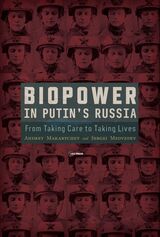
In this book, Makarychev and Medvedev examine the importance of biopolitics in fueling Russia’s confrontation with the West. In their view, the development of Putin’s illiberal authoritarianism was largely triggered by what they call a biopolitical turn. This shift is exemplified by the use of an increasing number of regulatory mechanisms to discipline and constrain the human body. Such political practices concern issues of sexuality, reproductive behavior, adoption, fertility, family planning, public hygiene, and demography. This turn created a new disciplinary framework for the population and the elite. Bans and restrictions of a biopolitical nature, became one of the main tools for articulating the rules of belonging in the political community and drawing its political boundaries. Biopolitical discourses have taken up the core of the Russian identity formation, which contrasts a positive “conservative Russia” with a supposedly vicious “liberal West.”
The presentation of the political genealogy of the body-centric structures of power and hegemony in Russia implies their transformation from bio- to necropolitics. Necropolitical (repressive and life-depriving) components are inscribed in the biopolitical regimes of power: they form the core of Putin’s rule over Russia and are a key factor behind the war against Ukraine.


As a minority group for most of their history, Jews were often marginalized and persecuted. Traces of their lives can be found in the archives of the dominant societies, but only as they intersected with the concerns of those in power. Just as Natalie Zemon Davis, Emmanuel Le Roy Ladurie, Carlo Ginzburg, and others recovered the voices of the peasants, so, too, scholars of Jewish history and culture have productively mined these reservoirs of evidence to retrieve glimpses of the ordinary lives of Jews. Blood Libels, Hostile Archives explores what can be reclaimed about everyday lives from what can be called “hostile archives”—from archival evidence produced and collected explicitly to manufacture malicious tales and pass them as “facts.” For Jewish history, in some places, these archival sources may be the only remaining records documenting the lives of Jews there.
The book explores two places: Trent, in northern Italy, and Sandomierz, in eastern Poland. Though hundreds of miles away, the towns have many things in common: both had been sites of anti-Jewish libels falsely accusing Jews of killing Christian children, Trent in 1475 and Sandomierz twice—in 1698 and 1710; in both, the instigators of the Jews’ persecution left unique and extensive archives, both towns have physical remnants of these deadly affairs, and, finally, neither town has an existing Jewish population. Yet, centuries later, these anti-Jewish libels have not been relegated to the past; in both towns, their legacies still reverberate today.

This farcical tale tells how the British bombing of a Finnish port city changes the life of the Russian governor, his wife, their cook, and the cook's Finnish fiancé. The story takes place during a Nordic offshoot of the Crimean conflict, known as the Åland War, in which a British-French naval force attacked military and civilian facilities on the coast of the Grand Duchy of Finland in 1854–1856. The location of the novella is Åbo, today’s Turku, where soldiers in the Russian garrison enjoy life, Cossacks dance and drink, and the governor’s wife is preoccupied about her cook’s marriage to a local lad, against which the governor and the English admiral devise a plot.
After studies in Swiss and German universities, Carl Spitteler worked in Russia between 1871 and 1879 as the private tutor in the family of a Finnish general. In the process he came to know Finnish and Baltic noble families in Saint Petersburg and Finland. He published this story in 1889, and went on to become, in 1919, the first Swiss winner of the Nobel Prize for literature. The Bombardment of Åbo is an ironic Western gaze on life and culture in the Tsarist Empire. Spitteler’s deeply held pacifism breaks through his otherwise sarcastic description of the characters and episodes in the novella.


By addressing the enigma of the exceptional success of Hungarian emigrant scientists and telling their life stories, Brilliance in Exile combines scholarly analysis with fascinating portrayals of uncommon personalities. István and Balazs Hargittai discuss the conditions that led to five different waves of emigration of scientists from the early twentieth century to the present. Although these exodes were driven by a broad variety of personal motivations, the attraction of an open society with inclusiveness, tolerance, and – needless to say – better circumstances for working and living, was the chief force drawing them abroad.
While emigration from East to West is a general phenomenon, this book explains why and how the emigration of Hungarian scientists is distinctive. The high number of Nobel Prizes among this group is only one indicator. Multicultural tolerance, a quickly emerging, considerably Jewish, urban middle class, and a very effective secondary school system were positive legacies of the Austro-Hungarian Monarchy. Multiple generations, shaped by these conditions, suffered from the increasingly exclusionist, intolerant, antisemitic, and economically stagnating environment, and chose to go elsewhere. “I would rather have roots than wings, but if I cannot have roots, I shall use wings," explained Leo Szilard, one of the fathers of the Atom Bomb.

Broken Masculinities portrays the post-dictatorial novel of the 1970s in all its complexity, and introduces the reader to a 1968-era Turkey, a period which challenges Turkey’s now reinforced Islamic image by portraying the quest for sexual liberation and critical student uprisings. Günay-Erkol argues that the literature written after the 1971 coup in Turkey constitutes a coherent sub-genre and needs to be considered together. These novels share a common ground which is rich in images of men and women craving for power: general isolation, sexual-emotional frustration, and a traumatic sense of solitude and alienation.
This book is an original and significant contribution to two major fields of study: (1) gender and sexuality with respect to formation of subjectivity through literature, and (2) modern literature and history through the study of Turkish literature. The chief concern in this book is not only literature’s response to a particular period in Turkey, but also the role of literature in bearing witness to trauma and drastic political acts of violence—and coming to terms with them.B


Stamatopoulos undertakes the first systematic comparison of the dominant ethnic historiographic models and divergences elaborated by Greek, Bulgarian, Serbian, Albanian, Romanian, Turkish, and Russian intellectuals with reference to the ambiguous inheritance of Byzantium. The title alludes to the seminal work of Nicolae Iorga in the 1930s, Byzantium after Byzantium, that argued for the continuity between the Byzantine and the Ottoman empires. Rival Balkan nationalisms engaged in a “war of interpretation” as to the nature of Byzantium, assuming different positions of adoption or rejection of its imperial model and leading to various schemes of continuity in each national historiographic canon.
Stamatopoulos discusses what Byzantium represented for nineteenth-, and twentieth-century scholars and how their perceptions related to their treatment of the imperial model: whether a different perception of the medieval Byzantine period prevailed in the Greek national center as opposed to Constantinople; how nineteenth-century Balkan nationalists and Russian scholars used Byzantium to invent their own medieval period (and, by extension, their own antiquity); and finally, whether there exist continuities or discontinuities in these modes of making ideological use of the past.
READERS
Browse our collection.
PUBLISHERS
See BiblioVault's publisher services.
STUDENT SERVICES
Files for college accessibility offices.
RECENTLY PUBLISHED



UChicago Accessibility Resources
home | accessibility | search | about | contact us
BiblioVault ® 2001 - 2026
The University of Chicago Press