logo for Intellect Books
The Baroque Technotext
Literature in a Digital Mediascape
Elise Takehana
Intellect Books, 2020
To date, most criticism of print and digital technotexts—literary objects that foreground the role of their media of inscription—has emphasized the avant-garde contexts of a text’s production. The Baroque Technotexts opens new perspectives on this important and innovative literary canon, analyzing the role of baroque and neo-baroque aesthetics in the emergence and possible futures of technotexts. Combining the insights of poststructuralist theory of the baroque, postcolonial theory of the neobaroque, and insightful critique of the prevailing modernist approaches to technotexts, The Baroque Technotexts reframes critical debate of contemporary experiments in literary practice in the late age of print. Analyses of works from authors including Jonathan Safran Foer, Chris Ware, and David Clark are matched with reflections on other media texts—film, visual art, and interface design—that have adopted baroque aesthetic tropes.
[more]

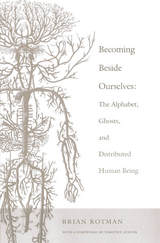
front cover of Becoming Beside Ourselves
Becoming Beside Ourselves
The Alphabet, Ghosts, and Distributed Human Being
Brian Rotman
Duke University Press, 2008
Becoming Beside Ourselves continues the investigation that the renowned cultural theorist and mathematician Brian Rotman began in his previous books Signifying Nothing and Ad Infinitum...The Ghost in Turing’s Machine: exploring certain signs and the conceptual innovations and subjectivities that they facilitate or foreclose. In Becoming Beside Ourselves, Rotman turns his attention to alphabetic writing or the inscription of spoken language. Contending that all media configure what they mediate, he maintains that alphabetic writing has long served as the West’s dominant cognitive technology. Its logic and limitations have shaped thought and affect from its inception until the present. Now its grip on Western consciousness is giving way to virtual technologies and networked media, which are reconfiguring human subjectivity just as alphabetic texts have done for millennia.

Alphabetic texts do not convey the bodily gestures of human speech: the hesitations, silences, and changes of pitch that infuse spoken language with affect. Rotman suggests that by removing the body from communication, alphabetic texts enable belief in singular, disembodied, authoritative forms of being such as God and the psyche. He argues that while disembodied agencies are credible and real to “lettered selves,” they are increasingly incompatible with selves and subjectivities formed in relation to new virtual technologies and networked media. Digital motion-capture technologies are restoring gesture and even touch to a prominent role in communication. Parallel computing is challenging the linear thought patterns and ideas of singularity facilitated by alphabetic language. Barriers between self and other are breaking down as the networked self is traversed by other selves to become multiple and distributed, formed through many actions and perceptions at once. The digital self is going plural, becoming beside itself.
[more]

front cover of Behind the Search Box
Behind the Search Box
Google and the Global Internet Industry
ShinJoung Yeo
University of Illinois Press, 2023
Once seen as a harbinger of a new enlightened capitalism, Google has become a model of robber baron rapaciousness thanks to its ruthless monetizing of private data, obsession with monopoly, and pervasive systems of labor discrimination and exploitation. Using the company as a jumping-off point, ShinJoung Yeo explores the political economy of the search engine industry against the backdrop of the relationship between information and capitalism’s developmental processes. Yeo’s critical analysis draws on in-depth discussions of essential issues like how the search engine evolved into a ubiquitous commercial service, it’s place in a global information business that is restructuring the information industry and our very social lives, who exactly designs and uses search technology, what kinds of workers labor behind the scenes, and the influence of geopolitics.

An incisive look at a pervasive presence in our lives, Behind the Search Box places the search engine industry’s rise and ongoing success within an original political economy of digital capitalism.
[more]

front cover of The Best of Technology Writing 2006
The Best of Technology Writing 2006
Brendan I. Koerner, Editor
University of Michigan Press, 2006
“The essays collected in this book are sparkling, imaginative pieces of journalism that just happen to be about technology. People steeped in the world of AJAX or Massively Mulitplayer Online Games will find a lot to value here, but so will readers simply in search of good writing.”
—James Fallows, National Correspondent for Atlantic Monthly


“The human experience is being shaped by our symbiotic relationship to technology. What makes this collection wonderful is that it’s not about the technology, per se, but it’s about this changing human experience. I will look forward to it every year.”
—Po Bronson, author of What Should I Do With My Life?


The Best of Technology Writing 2006 brings together some of the most important, timely, and just plain readable writing in the fast-paced, high-stakes field of technology. The first annual collection to target this vibrant and versatile area, The Best of Technology Writing 2006 features innovative work from an unusually diverse array of writers: best-selling authors, noted academics, and indie journalists and bloggers. The culmination of an open, on-line nominating process, this collection covers topics ranging from jetpacks, to the ethics of genetically cloned pets, to the meaning of life in the information age. By turns epic and intimate, serious and playful, The Best of Technology Writing 2006 captures the vitality, importance, and complexity of technology today. Koerner

Featuring contributions from:
David A. Bell
David Bernstein
Mike Daisey
Joshua Davis
Jay Dixit
Daniel Engber
Dan Ferber
Steven Johnson
Steven Levy
Farhad Manjoo
Lisa Margonelli
David McNeill
Justin Mullins
Koranteng Ofosu-Amaah
Adam L. Penenberg
Daniel H. Pink
Evan Ratliff
Alex Ross
Jim Rossignol
Jesse Sunenblick
Edward Tenner
Clive Thompson
Joseph Turow
Richard Waters
Brendan I. Koerner is a contributing editor for Wired, a columnist for both New York Times and Slate, and a fellow at the New America Foundation. His first book will be published by Henry Holt & Company in 2008.

digitalculturebooks is an imprint of the University of Michigan Press and the Scholarly Publishing Office of the University of Michigan Library dedicated to publishing innovative and accessible work exploring new media and their impact on society, culture, and scholarly communication. Visit the website at www.digitalculture.org.

[more]

front cover of The Best of Technology Writing 2007
The Best of Technology Writing 2007
Steven Levy, Editor
University of Michigan Press, 2007

The year’s best writing on tech: a collection as imaginative and compelling as its dynamic subject

“This book is not just an illuminating and instructive guide to our high-tech frontier. It’s also a great testimony to the power of that most ancient of technologies, the written word.”

—Steven Johnson, author of Everything Bad is Good for You

Together the essays in The Best of Technology Writing 2007 capture the versatility and verve of technology writing today. Solicited through an open online nominating process, these pieces explore a wide range of intriguing topics—from “crowdsourcing” to the online habits of urban moms to the digital future of movie production. The Best of Technology Writing 2007 will appeal to anyone who enjoys stellar writing.

Steven Levy is a Senior Editor at Newsweek, where he writes the biweekly column “The Technologist.” One of the most acclaimed and versatile technology writers in the country, Levy has written six books, including The Perfect Thing (about Apple’s iPod) and Hackers, which PC Magazine’s readers voted the best sci-tech book written in the last twenty years. He has written for many publications, including the New Yorker, the New York Times Magazine, Rolling Stone, and Wired.

Featuring contributions from

Kevin Berger

Paul Boutin

Kiera Butler

Joshua Davis

Julian Dibbell

Matt Gaffney

Lori Gottlieb

John Gruber

Jeff Howe

Kevin Kelly

Jaron Lanier

Preston Lerner

Farhad Manjoo

Justin McElroy

Ben McGrath

Katharine Mieszkowski

Emily Nussbaum

Jeffrey M. O’Brien

Larry O’Brien

The Onion

Adam L. Penenberg

John Seabrook

Philip Smith

Aaron Swartz

Clive Thompson

Jeffrey R. Young

digitalculturebooks is an imprint of the University of Michigan Press and the Scholarly Publishing Office of the University of Michigan Library dedicated to publishing innovative and accessible work exploring new media and their impact on society, culture, and scholarly communication. Visit the website at www.digitalculture.org.


[more]

front cover of Big Data and Software Defined Networks
Big Data and Software Defined Networks
Javid Taheri
The Institution of Engineering and Technology, 2018
Big Data Analytics and Software Defined Networking (SDN) are helping to drive the management of data and usage of the extraordinary increase of computer processing power provided by Cloud Data Centres (CDCs). SDN helps CDCs run their services more efficiently by enabling managers to configure, manage, secure, and optimize the network resources very quickly. Big-Data Analytics in turn has entered CDCs to harvest the massive computing powers and deduct information that was never reachable by conventional methods.
[more]

front cover of Big Data Recommender Systems
Big Data Recommender Systems
Algorithms, Architectures, Big Data, Security and Trust, Volume 1
Osman Khalid
The Institution of Engineering and Technology, 2019
First designed to generate personalized recommendations to users in the 90s, recommender systems apply knowledge discovery techniques to users’ data to suggest information, products, and services that best match their preferences. In recent decades, we have seen an exponential increase in the volumes of data, which has introduced many new challenges.
[more]

front cover of Big Data Recommender Systems
Big Data Recommender Systems
Application Paradigms, Volume 2
Osman Khalid
The Institution of Engineering and Technology, 2019
First designed to generate personalized recommendations to users in the 90s, recommender systems apply knowledge discovery techniques to users’ data to suggest information, products, and services that best match their preferences. In recent decades, we have seen an exponential increase in the volumes of data, which has introduced many new challenges.
[more]

logo for The Institution of Engineering and Technology
Big Data Recommender Systems
Recent trends and advances
Osman Khalid
The Institution of Engineering and Technology, 2019
This timely volume combines experimental and theoretical research on big data recommender systems to help computer scientists develop new concepts and methodologies for complex applications. It includes original scientific contributions in the form of theoretical foundations, comparative analysis, surveys, case studies, techniques and tools. The authors give special attention to key topics such as data filtering and cleaning techniques for recommendations, novelty and diversity, privacy issues, security threats and their mitigation, trust, cold start, sparsity, scalability, application domains, and recommender system evaluations.
[more]

front cover of Big Data-Enabled Internet of Things
Big Data-Enabled Internet of Things
Muhammad Usman Shahid Khan
The Institution of Engineering and Technology, 2020
The fields of Big Data and the Internet of Things (IoT) have seen tremendous advances, developments, and growth in recent years. The IoT is the inter-networking of connected smart devices, buildings, vehicles and other items which are embedded with electronics, software, sensors and actuators, and network connectivity that enable these objects to collect and exchange data. The IoT produces a lot of data. Big data describes very large and complex data sets that traditional data processing application software is inadequate to deal with, and the use of analytical methods to extract value from data. This edited book covers analytical techniques for handling the huge amount of data generated by the Internet of Things, from architectures and platforms to security and privacy issues, applications, and challenges as well as future directions.
[more]

front cover of The Birth of Computer Vision
The Birth of Computer Vision
James E. Dobson
University of Minnesota Press, 2023

A revealing genealogy of image-recognition techniques and technologies
 

Today’s most advanced neural networks and sophisticated image-analysis methods come from 1950s and ’60s Cold War culture—and many biases and ways of understanding the world from that era persist along with them. Aerial surveillance and reconnaissance shaped all of the technologies that we now refer to as computer vision, including facial recognition. The Birth of Computer Vision uncovers these histories and finds connections between the algorithms, people, and politics at the core of automating perception today.

James E. Dobson reveals how new forms of computerized surveillance systems, high-tech policing, and automated decision-making systems have become entangled, functioning together as a new technological apparatus of social control. Tracing the development of a series of important computer-vision algorithms, he uncovers the ideas, worrisome military origins, and lingering goals reproduced within the code and the products based on it, examining how they became linked to one another and repurposed for domestic and commercial uses. Dobson includes analysis of the Shakey Project, which produced the first semi-autonomous robot, and the impact of student protest in the early 1970s at Stanford University, as well as recovering the computer vision–related aspects of Frank Rosenblatt’s Perceptron as the crucial link between machine learning and computer vision.

Motivated by the ongoing use of these major algorithms and methods, The Birth of Computer Vision chronicles the foundations of computer vision and artificial intelligence, its major transformations, and the questionable legacy of its origins.


Cover alt text: Two overlapping circles in cream and violet, with black background. Top is a printed circuit with camera eye; below a person at a 1977 computer.


[more]

front cover of Blockchain and Machine Learning for e-Healthcare Systems
Blockchain and Machine Learning for e-Healthcare Systems
Balusamy Balamurugan
The Institution of Engineering and Technology, 2021
Blockchain and machine learning technologies can mitigate healthcare issues such as slow access to medical data, poor system interoperability, lack of patient agency, and data quality and quantity for medical research. Blockchain technology facilitates and secures the storage of information in such a way that doctors can see a patient's entire medical history, but researchers see only statistical data instead of any personal information. Machine learning can make use of this data to notice patterns and give accurate predictions, providing more support for the patients and also in research related fields where there is a need for accurate data to predict credible results.
[more]

front cover of Blockchain for 5G Healthcare Applications
Blockchain for 5G Healthcare Applications
Security and privacy solutions
Sudeep Tanwar
The Institution of Engineering and Technology, 2022
A secured system for Healthcare 4.0 is vital to all stakeholders, including patients and caregivers. Using the new Blockchain system of trusted ledgers would help guarantee authenticity in the multi-access system that is Healthcare 4.0. This is the first comprehensive book that explores how to achieve secure systems for Healthcare 4.0 using Blockchain, with emphasis on the key challenges of privacy and security.
[more]

front cover of Blockchain Foundations
Blockchain Foundations
For the Internet of Value
Mary C. Lacity
Epic Books, 2020
While there are many books on blockchains, this guide focuses on blockchain applications for business. The target audience is business students, professionals, and managers who want to learn about the overall blockchain landscape — the investments, the size of markets, major players and the global reach — as well as the potential business value of blockchain applications and the challenges that must be overcome to achieve that value. We present use cases and derive action principles for building enterprise blockchain capabilities. Readers will learn enough about the underlying technologies to speak intelligently to technology experts in the space, as the guide also covers the blockchain protocols, code bases and provides a glossary of terms. We use this guide as the textbook for our undergraduate and graduate Blockchain Fundamentals course at the University of Arkansas. Other professors interested in adopting this guide for instructional purposes are welcome to contact the author for supporting instructional materials.
[more]

front cover of Blockchain Fundamentals for Web 3.0
Blockchain Fundamentals for Web 3.0
-
Mary C. Lacity
Epic Books, 2022
Our book explains the movement to establish online trust through the decentralization of value, identity, and data ownership. This movement is part of ‘Web 3.0’, the idea that individuals rather than institutions will control and benefit from online social and economic activities. Blockchain technologies are the digital infrastructure for Web 3.0. While there are many books on blockchains, crypto, and digital assets, we focus on blockchain applications for Web 3.0. Our target audience is students, professionals, and managers who want to learn about the overall Web 3.0 landscape—the investments, the size of markets, major players, and the global reach—as well as the economic and social value of applications.
 
We present applications that use Web 3.0 technologies to unlock value in DeFi, NFTs, supply chains, media, identity, credentials, metaverses, and more. Readers will learn about the underlying technologies, the maturity of Web 3.0 today, and the future of the space from thought-leaders. This textbook is used by undergraduate and graduate Blockchain Fundamentals courses at the University of Arkansas, the University of Wyoming, and other universities around the world. Professors interested in adopting this book for instructional purposes are welcome to contact the authors for supporting instructional materials.
[more]

front cover of Blockchain, Smart Contracts and Distributed Ledger Technologies in the Built Environment
Blockchain, Smart Contracts and Distributed Ledger Technologies in the Built Environment
Key concepts, technologies, and applications
Mohamad Kassem
The Institution of Engineering and Technology, 2025
The built environment, encompassing the spaces we inhabit, the infrastructure that connects us, and the systems that sustain our societies, is foundational to human progress. It shapes how we live, work and interact, serving as a fundamental for social and economic prosperity. Yet, despite its importance, the sector faces enduring challenges: inefficiencies, insufficient collaboration, significant environmental impact, and a slow pace of transformative innovation, particularly in areas such as value creation, business model evolution, and major sector-wide transformations.
[more]

front cover of Blockchain Technology for Secure Social Media Computing
Blockchain Technology for Secure Social Media Computing
Robin Singh Bhadoria
The Institution of Engineering and Technology, 2023
Blockchain is a digital ledger of transactions duplicated and distributed across an entire network of computer systems on the blockchain which makes it more difficult to hack or tamper with. The popularity of blockchain has been increasing with the growth of social media and the internet of things (IoT). Social media are interactive digitally mediated technologies that facilitate the creation or sharing and exchange of information, ideas, opinions and interests via virtual communities and social network platforms. However, unmonitored social accounts can be the target of hackers who post fraudulent messages or virus-infected links that spread to contacts and followers, and "employee weakness" is responsible for 20% of cyberattacks in companies. So, it has become essential to secure both personal and professional social media networks, accounts and data.
[more]

front cover of Blockchain Technology in e-Healthcare Management
Blockchain Technology in e-Healthcare Management
Suyel Namasudra
The Institution of Engineering and Technology, 2022
The healthcare arena has seen a shift in recent years, with more healthcare provisions being delivered or managed via electronic means. Healthcare providers can now provide patients with diagnosis, treatment, monitoring, or a prescription without ever sharing the same physical space. With so much more patient data now stored and accessed electronically, the security of this information is ever more critical to the delivery of effective and efficient healthcare services. As blockchains are resistant to modification of their data, blockchain technology therefore provides traceable and reliable security to e-Healthcare systems and services.
[more]

front cover of Blockchains for Network Security
Blockchains for Network Security
Principles, technologies and applications
Haojun Huang
The Institution of Engineering and Technology, 2021
Blockchain technology is a powerful, cost-effective method for network security. Essentially, it is a decentralized ledger for storing all committed transactions in trustless environments by integrating several core technologies such as cryptographic hash, digital signature and distributed consensus mechanisms.
[more]

front cover of Bodies In Technology
Bodies In Technology
Don Ihde
University of Minnesota Press, 2001

An original exploration of the ways cyberspace affects human experience.

New technologies suggest new ideas about embodiment: our "reach" extends to global sites through the Internet; we enter cyberspace through the engines of virtual reality. In this book, a leading philosopher of technology explores the meaning of bodies in technology-how the sense of our bodies and of our orientation in the world is affected by the various information technologies.

Bodies in Technology begins with an analysis of embodiment in cyberspace, then moves on to consider ways in which social theorists have interpreted or overlooked these conditions. An astute and sensible judge of these theories, Don Ihde is a uniquely provocative and helpful guide through contemporary thinking about technology and embodiment, drawing on sources and examples as various as video games, popular films, the workings of e-mail, and virtual reality techniques.Charting the historical, philosophical, and practical territory between virtual reality and real life, this work is an important contribution to the national conversation on the impact technology-and information technology in particular-has on our lives in a wired, global age.


[more]

front cover of The Burden of Choice
The Burden of Choice
Recommendations, Subversion, and Algorithmic Culture
Jonathan Cohn
Rutgers University Press, 2019
The Burden of Choice examines how recommendations for products, media, news, romantic partners, and even cosmetic surgery operations are produced and experienced online. Fundamentally concerned with how the recommendation has come to serve as a form of control that frames a contemporary American as heteronormative, white, and well off, this book asserts that the industries that use these automated recommendations tend to ignore and obscure all other identities in the service of making the type of affluence they are selling appear commonplace. Focusing on the period from the mid-1990s to approximately 2010 (while this technology was still novel), Jonathan Cohn argues that automated recommendations and algorithms are far from natural, neutral, or benevolent. Instead, they shape and are shaped by changing conceptions of gender, sexuality, race, and class. With its cultural studies and humanities-driven methodologies focused on close readings, historical research, and qualitative analysis, The Burden of Choice models a promising avenue for the study of algorithms and culture.
[more]

front cover of Buy It Now
Buy It Now
Lessons from eBay
Michele White
Duke University Press, 2012
In Buy It Now, Michele White examines eBay and its emphasis on community and social norms, revealing the cultural assumptions about gender, race, and sexuality that are reinforced throughout the site. She shows how instructional texts, rule systems, and advertisements "configure the user," allowing eBay to indicate how the site is supposed to function while also upholding particular values and practices. White details how eBay reinforces stereotypes about gender and sexuality, looking, for example, at descriptions included in wedding dress listings, and how eBay directs individuals to the "Adult Only" part of the website when they use the search terms "gay" and "lesbian." She discloses the ways that eBay promises a caring community but its "Black Americana" category reproduces racism by allowing sellers' narratives that excuse and romanticize slavery and insult African Americans. White also looks at how participants challenge eBay's categories, rules, and values, examining widely used strategies of resistance by sellers and buyers in the lesbian and gay interest listings. By analyzing the organizational and cultural logics present in eBay, White emphasizes how other Internet settings, including craigslist, are not as transparent, community-oriented, and empowering as they claim. She proposes methods for researching and reconceptualizing new media sites.
[more]


Send via email Share on Facebook Share on Twitter