
 A SCHOLARLY BOOK REPOSITORY
7 start with B start with B
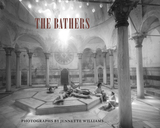
To create the images in The Bathers, Williams drew on gestures and poses found in iconic paintings of nude women, including tableaux of bathers by Paul Cézanne and Auguste Renoir, renderings of Venus by Giorgione and Titian, Dominique Ingres’s Odalisque and Slave, and Pablo Picasso’s Les Demoiselles d’Avignon. By alluding to these images and others, Williams sought to reflect the religious and mythological associations of water with birth and rebirth, comfort and healing, purification and blessing. She also used copies of the paintings to communicate with her Hungarian- and Turkish-speaking subjects—homemakers, factory workers, saleswomen, secretaries, managers, teachers, and students. Working in steam-filled environments, Williams created quiet, dignified images that evoke not only canonical representations of female nudes but also early pictorial photography. At the same time, they raise contemporary questions about the gaze, the definition of documentary photography, and the representation and perception of beauty and femininity, particularly as they relate to the aging body. Above all else, her photos are sensuously evocative. They invite the viewer to feel the steam, hear the murmur of conversation, and reflect on the allure of the female form.
A CDS Book
Published by Duke University Press and the Center for Documentary Photography

Be Faithful unto Death is the moving story of a bright and sensitive schoolboy growing up in an old-established boarding school in the city of Debrecen in eastern Hungary. Misi, a dreamer and would-be writer, is falsely accused of stealing a winning lottery ticket. The torments through which he goes – and grows – are superbly described.
The novel is brimming with vivid detail from the provincial life that Móricz knew so well and shot through with a sense of the tragic fate of a newly truncated Hungary.
The Nazi 1933 Civil Service Law and the 1935 Nuremberg Laws are often considered the first anti-Jewish decrees in interwar Europe. Mária M. Kovács convincingly argues that Hungary’s numerus clausus law of 1920, which introduced a Jewish quota at Hungary’s institutions of higher learning, was, in fact, interwar Europe’s first antisemitic law. By defining—and discriminating against—Jews as a separate “racial” or “national” group, it abrogated the principle of equal rights that had been enshrined into law; as such, it marked an abrupt reversal of Jewish emancipation in Hungary. Moreover, the numerus clausus law set the stage for subsequent “Jewish Laws” (in the late 1930s and early 1940s) that sought to solve Hungary’s “Jewish Question” by means of extraordinary legal measures that targeted Jews alone. This book examines the origins and implementation of the numerus clausus, as well as the attempts to dampen its impact on Hungary’s international reputation, focusing on the debates surrounding it promulgation (1920), its modification (1928) and its eventual application to other areas of Jewish life (1938–45).

Drawing on evidence from a wide collection of surviving family papers, Beloved Children is a valuable contribution to literature available concerning childhood history in pre-industrial Central Europe.
With the aid of detailed case studies, the volume illustrates every aspect of Hungarian childhood in the early modern age from a variety of contrasting perspectives—birth, care, education, marriage, orphanhood and death. The book also includes a unique portrayal of family life in the Hungarian aristocracy.
Beloved Children is a comprehensive study examining topics such as family intimacy, paternal and maternal attitudes, providing the reader with a valuable insight into a child’s life in Hungary during the sixteenth and seventeenth centuries.

By addressing the enigma of the exceptional success of Hungarian emigrant scientists and telling their life stories, Brilliance in Exile combines scholarly analysis with fascinating portrayals of uncommon personalities. István and Balazs Hargittai discuss the conditions that led to five different waves of emigration of scientists from the early twentieth century to the present. Although these exodes were driven by a broad variety of personal motivations, the attraction of an open society with inclusiveness, tolerance, and – needless to say – better circumstances for working and living, was the chief force drawing them abroad.
While emigration from East to West is a general phenomenon, this book explains why and how the emigration of Hungarian scientists is distinctive. The high number of Nobel Prizes among this group is only one indicator. Multicultural tolerance, a quickly emerging, considerably Jewish, urban middle class, and a very effective secondary school system were positive legacies of the Austro-Hungarian Monarchy. Multiple generations, shaped by these conditions, suffered from the increasingly exclusionist, intolerant, antisemitic, and economically stagnating environment, and chose to go elsewhere. “I would rather have roots than wings, but if I cannot have roots, I shall use wings," explained Leo Szilard, one of the fathers of the Atom Bomb.
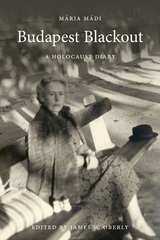
Mádi’s family donated the entire collection of her diaries to the US Holocaust Memorial Museum. This edition transcribes a selection of Mádi’s writings focusing on the period of March 1944 to November 1945, from the Nazi invasion and occupation of Hungary, through the Battle of Budapest, to the ensuing Soviet occupation. While bearing witness to the catastrophe in Hungary, Mádi hid a Jewish family in her small flat from October 1944 to February 1945. She received a posthumous Righteous among Nations Medal from Yad Vashem, the World Holocaust Remembrance Center.
Editorial commentary by James W. Oberly situates Mádi’s observations, and a critical introduction by the Holocaust scholar András Lénárt outlines the wider sociopolitical context in which her diaries gain meaning.

Exploring the concept of time in the work of one of Europe’s greatest filmmakers
From Almanac of Fall (1984) to The Turin Horse (2011), renowned Hungarian filmmaker Béla Tarr has followed the collapse of the communist promise. The “time after” is not the uniform and morose time of those who no longer believe in anything. It is the time when we are less interested in histories and their successes or failures than we are in the delicate fabric of time from which they are carved. It is the time of pure material events against which belief will be measured for as long as life will sustain it.
READERS
Browse our collection.
PUBLISHERS
See BiblioVault's publisher services.
STUDENT SERVICES
Files for college accessibility offices.
RECENTLY PUBLISHED





UChicago Accessibility Resources
home | accessibility | search | about | contact us
BiblioVault ® 2001 - 2026
The University of Chicago Press