
 A SCHOLARLY BOOK REPOSITORY
170 books about Origins and 6
start with B
170 books about Origins and 6
170 books about Origins
6 start with B start with B
6 start with B start with B
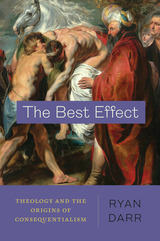
The Best Effect
Theology and the Origins of Consequentialism
Ryan Darr
University of Chicago Press, 2023
A theological history of consequentialism and a fresh agenda for teleological ethics.
Consequentialism—the notion that we can judge an action by its effects alone—has been among the most influential approaches to ethics and public policy in the Anglophone world for more than two centuries. In The Best Effect, Ryan Darr argues that consequentialist ethics is not as secular or as rational as it is often assumed to be. Instead, Darr describes the emergence of consequentialism in the seventeenth century as a theological and cosmological vision and traces its intellectual development and eventual secularization across several centuries. The Best Effect reveals how contemporary consequentialism continues to bear traces of its history and proposes in its place a more expansive vision for teleological ethics.
Consequentialism—the notion that we can judge an action by its effects alone—has been among the most influential approaches to ethics and public policy in the Anglophone world for more than two centuries. In The Best Effect, Ryan Darr argues that consequentialist ethics is not as secular or as rational as it is often assumed to be. Instead, Darr describes the emergence of consequentialism in the seventeenth century as a theological and cosmological vision and traces its intellectual development and eventual secularization across several centuries. The Best Effect reveals how contemporary consequentialism continues to bear traces of its history and proposes in its place a more expansive vision for teleological ethics.
[more]
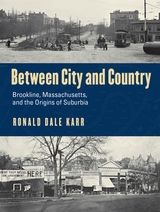
Between City and Country
Brookline, Massachusetts, and the Origins of Suburbia
Ronald Dale Karr
University of Massachusetts Press, 2018
Since 1945, American popular culture has portrayed suburbia as a place with a culture, politics, and economy distinct from cities, towns, and rural areas. In Between City and Country, Ronald Dale Karr examines the evolution of Brookline, Boston's most renowned nineteenth-century suburb, arguing that a distinctively suburban way of life appeared here long before World War II.
Already a fashionable retreat for wealthy Bostonians, Brookline began to suburbanize in the 1840s with the arrival of hundreds of commuter families—and significant numbers of Irish Catholic immigrants drawn by opportunities to work as laborers and servants. In Brookline the poor were segregated but not excluded altogether, as they would be from twentieth-century elite suburbs. A half century later, a distinct suburban way of life developed that combined rural activities with urban pastimes, and a political consensus emerged that sought efficient government and large expenditures on education and public works. Brookline had created the template for the concept of suburbia, not just in wealthy communities but in the less affluent communities of postwar America.
Already a fashionable retreat for wealthy Bostonians, Brookline began to suburbanize in the 1840s with the arrival of hundreds of commuter families—and significant numbers of Irish Catholic immigrants drawn by opportunities to work as laborers and servants. In Brookline the poor were segregated but not excluded altogether, as they would be from twentieth-century elite suburbs. A half century later, a distinct suburban way of life developed that combined rural activities with urban pastimes, and a political consensus emerged that sought efficient government and large expenditures on education and public works. Brookline had created the template for the concept of suburbia, not just in wealthy communities but in the less affluent communities of postwar America.
[more]
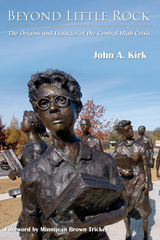
Beyond Little Rock
The Origins and Legacies of the Central High Crisis
John A. Kirk
University of Arkansas Press, 2007
Based on extensive archival work, private paper collections, and oral history, this book includes eight of John Kirk’s essays, two of which have never been published before. Together, these essays locate the dramatic events of the crisis within the larger story of the African American struggle for freedom and equality in Arkansas. Examining key episodes in state history from before the New Deal to the present, Kirk covers a wide range of topics that include the historiography of the school crisis; the impact of the New Deal; early African American politics and mass mobilization; race, gender, and the civil rights movement; the role of white liberals in the struggle; and the intersections of race and city planning policy. Kirk unearths many previously neglected individuals, organizations, and episodes, and provides a thought-provoking analytical framework for understanding them.
[more]
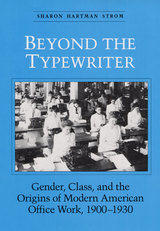
Beyond the Typewriter
Gender, Class, and the Origins of Modern American Office Work, 1900-1930
Sharon Hartman Strom
University of Illinois Press, 1992
In the early twentieth century, office jobs allowed increasing numbers of women a new option for careers. Sharon Hartman Strom's detailed account of early office working conditions and practices draws on archival and anecdotal data to analyze women office workers' ambitions. She also explores how the influences of scientific management, personnel management, and secondary vocational education affected office workplaces and hierarchies.
[more]
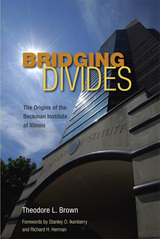
Bridging Divides
The Origins of the Beckman Institute at Illinois
Theodore L. Brown. Forewords by Stanley O. Ikenberry and Richard H. Herman.
University of Illinois Press, 2009
Bridging Divides offers a first-hand account of the origins of the Beckman Institute for Advanced Science and Technology, an interdisciplinary research institute at the University of Illinois at Urbana-Champaign devoted to leading-edge research in the physical sciences, computation, engineering, biology, behavior, cognition, and neuroscience. The book follows the progress of the Beckman Institute's creation, from the initial conceptualization of a large, multi-disciplinary institute; through proposal formulation; to the architectural design and actual construction of its state-of-the-art building, made possible by the largest gift made to any public university at the time: a $40 million contribution from Illinois alumnus and founder of Beckman Instruments, Inc., Arnold O. Beckman and his wife Mabel M. Beckman. Theodore L. Brown, the founding director of the Beckman Institute, brings an insider's personal perspective on its conception and its early operations. The evolution of a physical facility that matched a developing sense of what multidisciplinary and interdisciplinary research might be was a vital ingredient in the Institute's development. In addition, because the Institute represented a dramatic departure from traditional university organization, many challenges involving its administration and faculty had to be overcome. A celebration of the Beckman Institute's first twenty years of operation since the building's completion in 1989, Bridging Divides provides an informative look back at the history of this groundbreaking interdisciplinary research center. The book also includes forewords by Stanley O. Ikenberry, former president of the University of Illinois, and Richard H. Herman, chancellor of the University of Illinois at Urbana-Champaign.
[more]
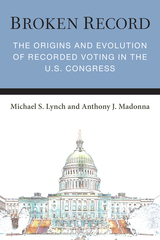
Broken Record
The Origins and Evolution of Recorded Voting in the U.S. Congress
Michael S. Lynch & Anthony J. Madonna
University of Michigan Press, 2025
Since the 1920s, the roll call voting record has influenced American politics. Using recorded votes, candidates attack electoral opponents, interest groups attempt to drum up financial or electoral support for their preferred candidates, scholars test theories of legislative behavior, and the media characterizes the ideological leanings of Congress. Despite this, there has not been a systematic attempt to document the changing usage of the roll call record. Michael S. Lynch and Anthony J. Madonna have undertaken a massive, multiyear data collection effort that culminated in four new datasets covering from 1905 to the contemporary period. Using data on approximately 120,000 amendments, 60,000 roll call votes, 2,000 important enactments, and 8,000 special rules from 1905 to 2015, the authors demonstrate how the roll call recording system has evolved.
Consistent with the Founders’ skepticism of the impact of recorded voting in Congress, Broken Record shows that the contemporary roll call voting record includes far more meaningless position-taking and procedural roll call votes than it did during earlier congresses. The book argues that the removal of practical barriers to roll calls, internal changes to legislative procedures, and increased electoral competitiveness have led to more roll call votes on proposals sponsored by more extreme members. In addition to policy making being more difficult, increased roll call voting has played a substantial role in artificially increasing observed levels of polarization. This book argues that solving polarization requires a more nuanced set of solutions than simply replacing legislators; it will require increased public education about how Congress operates and specific procedural reforms.
Consistent with the Founders’ skepticism of the impact of recorded voting in Congress, Broken Record shows that the contemporary roll call voting record includes far more meaningless position-taking and procedural roll call votes than it did during earlier congresses. The book argues that the removal of practical barriers to roll calls, internal changes to legislative procedures, and increased electoral competitiveness have led to more roll call votes on proposals sponsored by more extreme members. In addition to policy making being more difficult, increased roll call voting has played a substantial role in artificially increasing observed levels of polarization. This book argues that solving polarization requires a more nuanced set of solutions than simply replacing legislators; it will require increased public education about how Congress operates and specific procedural reforms.
[more]
READERS
Browse our collection.
PUBLISHERS
See BiblioVault's publisher services.
STUDENT SERVICES
Files for college accessibility offices.
RECENTLY PUBLISHED


UChicago Accessibility Resources
home | accessibility | search | about | contact us
BiblioVault ® 2001 - 2026
The University of Chicago Press