logo for Rutgers University Press
Backtalk
Women Writers Speak Out
Donna Perry
Rutgers University Press, 1993

Agents or victims, liberated or oppressed, "bad girls" or "good girls." What do these labels mean and do they further or hinder women's progress? How are today's visions of female sexuality and power like or unlike those of the past? How do younger women define feminism? Isn't the personal still political?

Dismayed by the media's tendency to reduce the feminist enterprise to labels and superstars, Donna Perry and Nan Bauer Maglin decided to find out what a diverse group of feminists think about women, sex, and power in the nineties. The result is a provocative and varied collection of twenty-four essays by second- and third-wave feminists; artists and activists; professors and graduate students; professional journalists and just-published writers; mothers and daughters. By focusing on society's construction, containment, and exploitation of female sexuality, in particular, these essays offer fresh perspectives on women's agency or lack of it.

The contributors focus on the oversimplifications and false dichotomies in current discussions of female sexuality, as well as the privileged perspective and individualism that currently dominate the popularized feminist message. Individual writers--including Emma Amos, bell hooks, Ann Jones, Lisa Jones, Paula Kamen, Matuschka, Marge Piercy, Katha Pollitt, Anna Quindlen, Elayne Rapping, Lillian S. Robinson, and Ellen Willis--reexamine women's empowerment in the light of issues like AIDS, battering, acquaintance rape, narratives of childhood sexual abuse, and pornography. Several draw political conclusions from their personal struggles, while others read stories and texts--from history, the art world, the media, popular culture, and social science research--in new and controversial ways.
[more]

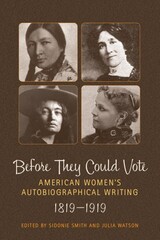
front cover of Before They Could Vote
Before They Could Vote
American Women's Autobiographical Writing, 1819–1919
Edited by Sidonie A. Smith and Julia Watson
University of Wisconsin Press, 2006
The life narratives in this collection are by ethnically diverse women of energy and ambition—some well known, some forgotten over generations—who confronted barriers of gender, class, race, and sexual difference as they pursued or adapted to adventurous new lives in a rapidly changing America. The engaging selections—from captivity narratives to letters, manifestos, criminal confessions, and childhood sketches—span a hundred years in which women increasingly asserted themselves publicly. Some rose to positions of prominence as writers, activists, and artists; some sought education or wrote to support themselves and their families; some transgressed social norms in search of new possibilities. Each woman's story is strikingly individual, yet the brief narratives in this anthology collectively chart bold new visions of women's agency.

"This rich new anthology sets in motion an inter-textual conversation of remarkable vitality that will change the ways we understand gender, class, ethnicity, culture, and nation in nineteenth-century America."—Susanna Egan, author of Mirror-Talk
[more]

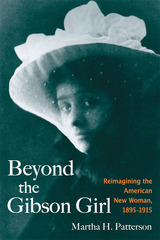
front cover of Beyond the Gibson Girl
Beyond the Gibson Girl
Reimagining the American New Woman, 1895-1915
Martha H. Patterson
University of Illinois Press, 2005

Challenging monolithic images of the New Woman as white, well-educated, and politically progressive, this study focuses on important regional, ethnic, and sociopolitical differences in the use of the New Woman trope at the turn of the twentieth century. Using Charles Dana Gibson's "Gibson Girls" as a point of departure, Martha H. Patterson explores how writers such as Pauline Hopkins, Margaret Murray Washington, Sui Sin Far, Mary Johnston, Edith Wharton, Ellen Glasgow, and Willa Cather challenged and redeployed the New Woman image in light of other “new” conceptions: the "New Negro Woman," the "New Ethics," the "New South," and the "New China."

As she appears in these writers' works, the New Woman both promises and threatens to effect sociopolitical change as a consumer, an instigator of evolutionary and economic development, and (for writers of color) an icon of successful assimilation into dominant Anglo-American culture. Examining a diverse array of cultural products, Patterson shows how the seemingly celebratory term of the New Woman becomes a trope not only of progressive reform, consumer power, transgressive femininity, modern energy, and modern cure, but also of racial and ethnic taxonomies, social Darwinist struggle, imperialist ambition, assimilationist pressures, and modern decay.
[more]

front cover of Black Internationalist Feminism
Black Internationalist Feminism
Women Writers of the Black Left, 1945-1995
Cheryl Higashida
University of Illinois Press, 2013
Black Internationalist Feminism examines how African American women writers affiliated themselves with the post-World War II Black Communist Left and developed a distinct strand of feminism. This vital yet largely overlooked feminist tradition built upon and critically retheorized the postwar Left's "nationalist internationalism," which connected the liberation of Blacks in the United States to the liberation of Third World nations and the worldwide proletariat. Black internationalist feminism critiques racist, heteronormative, and masculinist articulations of nationalism while maintaining the importance of national liberation movements for achieving Black women's social, political, and economic rights.
 
Cheryl Higashida shows how Claudia Jones, Lorraine Hansberry, Alice Childress, Rosa Guy, Audre Lorde, and Maya Angelou worked within and against established literary forms to demonstrate that nationalist internationalism was linked to struggles against heterosexism and patriarchy. Exploring a diverse range of plays, novels, essays, poetry, and reportage, Higashida illustrates how literature is a crucial lens for studying Black internationalist feminism because these authors were at the forefront of bringing the perspectives and problems of black women to light against their marginalization and silencing.
 
In examining writing by Black Left women from 1945–1995, Black Internationalist Feminism contributes to recent efforts to rehistoricize the Old Left, Civil Rights, Black Power, and second-wave Black women's movements.
[more]

front cover of Black Speculative Feminisms
Black Speculative Feminisms
Memory and Liberated Futures in Black Women's Fiction
Cassandra L. Jones
The Ohio State University Press, 2024
How do Black women writing speculative fiction explore the use of memory as a potential strategy for liberation? In Black Speculative Feminisms, Cassandra L. Jones looks at the writings of Octavia E. Butler, Tananarive Due, Nalo Hopkinson, Rasheedah Phillips, and Nnedi Okorafor to chart those moments where characters harness, or fail to harness, the power of memory. These instances transform memory—individual and collective, bodily and archival—from passive recollection into direct or indirect social action. Taking a Black feminist approach, Jones addresses several emancipatory themes within Afrofuturism: the decolonization of time that can be found in fiction employing non-Western and non-linear expressions of time, exploring futurity and the projection of a full range of expressions of Black humanity into anticipated futures, and imagining new worlds and novel approaches to old problems. Drawing on critical fabulation and restorative justice, she forwards restorative fabulation as the mechanism by which speculative fiction offers a healing site for authors and readers to process generational trauma while imagining more equitable futures.
[more]

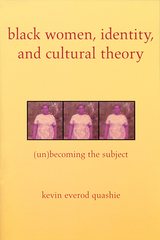
front cover of Black Women, Identity, and Cultural Theory
Black Women, Identity, and Cultural Theory
(Un)Becoming the Subject
Kevin Everod Quashie
Rutgers University Press, 2004

 In Black Women, Identity, and Cultural Theory, Kevin Everod Quashie explores the metaphor of the “girlfriend” as a new way of understanding three central concepts of cultural studies: self, memory, and language. He considers how the work of writers such as Toni Morrison, Ama Ata Aidoo, Dionne Brand, photographer Lorna Simpson, and many others, inform debates over the concept of identity. Quashie argues that these authors and artists replace the notion of a stable, singular identity with the concept of the self developing in a process both communal and perpetually fluid, a relationship that functions in much the same way that an adult woman negotiates with her girlfriend(s). He suggests that memory itself is corporeal, a literal body that is crucial to the process of becoming. Quashie also explores the problem language poses for the black woman artist and her commitment to a mastery that neither colonizes nor excludes.

The analysis throughout interacts with schools of thought such as psychoanalysis, postmodernism, and post-colonialism, but ultimately moves beyond these to propose a new cultural aesthetic, one that ultimately aims to center black women and their philosophies.
[more]

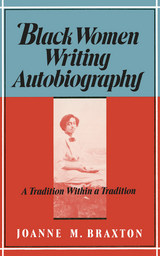
front cover of Black Women Writing Autobiography
Black Women Writing Autobiography
A Tradition Within a Tradition
Joanne Braxton
Temple University Press, 1990
"In this illuminating study Joanne Braxton shows the continuity and tradition in the writing of Afra-American women. An important work for teachers and students of Literature, History, and Women's Studies." --Gerda Lerner "As black American women, we are born into a mystic sisterhood, and we live our lives within a magic circle, a realm of shared language, reference, and allusion within the veil of our blackness and our femaleness. We have been as invisible to the dominant culture as rain; we have been knowers, but we have not been known." Joanne Braxton argues for a redefinition of the genre of black American autobiography to include the images of women as well as their memoirs, reminiscences, diaries, and journals--as a corrective to both black and feminist literary criticism. Beginning with slave narratives and concluding with modern autobiography, she deals with individual works as representing stages in a continuum and situates these works in the context of other writings by both black and white writers. Braxton demonstrates that the criteria used to define the slave narrative genre are inadequate for analyzing Harriet "Linda Brent" Jacobs's pseudonymously published Incidents in the Life of a Slave Girl: Written by Herself (1861). She examines "sass" as a mode of women's discourse and a weapon of self-defense, and she introduces the "outraged mother" as a parallel to the articulate hero archetype. Not even emancipation authorized black women to define themselves or address an audience. Late-nineteenth-century accounts in the form of confessional spiritual autobiographies, travelogue/adventure stories, and slave memoirs enabled such women as Jarena Lee, Rebecca Cox Jackson, Elizabeth Keckley, Susie King Taylor, as well as Harriet Tubman and Sojourner Truth to tell their own extraordinary stories and to shed light on the thousands of lives obscured by illiteracy and sexual and racial oppression. In her diaries, Charlotte Forten Grimké, the gifted poet, epitomizes the problems faced by a well-educated, extremely articulate black woman attempting to find a public voice in America. Moving into the twentieth century, Braxton analyzes the memoir of Ida B. Wells, journalist and anti-lynching activist, and the work of Zora Neale Hurston and Era Bell Thompson. They represent the first generation of black female autobiographers who did not continually come into contact with former slaves and who transcended the essential struggle for survival that occupied earlier writings. For the contemporary black woman autobiographer, the quest for personal fulfillment is the central theme. Braxton concludes with Maya Angelou's I Know Why the Caged Bird Sings (1996), which represents the black woman of the 1960s who has found the place to recreate the self in her own image--the place all the others had been searching for. "Braxton's book is scrupulously researched. She has been creative in finding resources and courageous in analyzing and interpreting her finds. This is the word of a diligent mind. The material is mountainous, yet the book sings. Braxton is a poet. Thank goodness." --Maya Angelou "Joanne Braxton's essays on black women's autobiographies delineate and illuminate the personal and historical dimension of an important literary tradition. Emphasizing the distinct character of Afra-American women's experience and relations with each other, she ground their writing of their lives in the struggles and triumphs of the lives they actually led." --Elizabeth Fox-Genovese "In this compelling and lucid study examining the content, context, and continuum of black women autobiographers, Braxton clears the place for it in the curriculum: at the center of black and feminist studies." --Paula Giddings "This is the fullest and most sympathetic study of black American autobiographers I know. By paying close attention to private and public history, to social networks and literary kinships, to narrative structures and patterns of imagery, Braxton leads her readers to see the black woman 'at the center of her own [written] experiences.' At once scholarly and passionate, Braxton's critique will immediately secure her a place among the leading analysts of black American autobiography." --Albert E. Stone "A highly readable and original contribution to the important fields of Afro-American studies, feminist criticism, and autobiographical narrative." --Elaine Showalter "Rich in empathy and insight, Joanne M. Braxton's trailblazing study attends to both the textual and historical dimensions of a powerful literary inheritance. She brings to bear a keen sense of the departures and continuities of which any tradition consists; and an appreciation of the distinctive Afro-American dynamic between literary convention and a vernacular substrate. Braxton doesn't just read--she listens." --Henry Louis Gates, Jr. "Joanne Braxton makes a unique contribution to the scholarship of American autobiography. Her focus on the outraged mother as a figure of rebellion is a significant challenge to our conventional understanding of autobiographical acts." --Hazel Carby "This is the most inclusive and thoughtful literary history of black American women's autobiography in existence…It is not just a collection of essays; it is well knit together and displays multiple traditions as they evolved and are in the process of evolving still." --William L. Andrews "This book marks another milestone in the critical appraisal of American autobiographical writings. In tracing the evolution of a tradition of black women in autobiography in America, Braxton takes us on the first journey of this kind: the black American woman's search for a dignified, self-defining identity through the rejection of traditional female roles. This book sets the tone for future studies of black women's autobiographies." --Nellie McKay
[more]

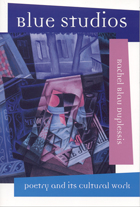
front cover of Blue Studios
Blue Studios
Poetry and Its Cultural Work
Rachel Blau DuPlessis
University of Alabama Press, 2006
Examines the work of experimental poets and the innovative forms they create to disrupt assumptions about gender and cultural power
 
In her now-classic The Pink Guitar, Rachel Blau DuPlessis examined a number of modern and contemporary poets and artists to explore the possibility of finding a language that would question deeply held assumptions about gender. In the 12 essays and introduction that constitute Blue Studios, DuPlessis continues that task, examining the work of experimental poets and the innovative forms they have fashioned to challenge commonplace assumptions about gender and cultural authority.
 
The essays in “Attitudes and Practices” deal with two questions: what a feminist reading of cultural texts involves, and the nature of the essay itself as a mode of knowing: how poetry can be discursive and how the essay can be poetic. The goal of “Marble Paper,” with its studies of William Wordsworth, Ezra Pound, and Charles Olson is to suggest terms for a “feminist history of poetry.”
 
“Perspectives must be fashioned that displace and estrange the world,” Theodore Adorno wrote, and in the section "Urrealism" DuPlessis examines the work of poets from several schools (the Objectivists, the New York School, the surrealists) whose work embodies that displacement, among them George Oppen, Lorine Niedecker, H.D., and Barbara Guest. These writers’ radical deployment of line, sound, and structure, DuPlessis argues, demonstrate poetry’s power not as a purely literary, artistic, or aesthetic force but as a rhetorical form intricately tied to issues of power and ethics. And in "Migrated Into,” the author probes the ways these issues have informed her, as a poet and a critic; how the political has “migrated into” and suffused her own work; and how the practice of poetry can be an arousal to a deeper understanding of what we stand for.
 
[more]

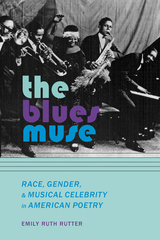
front cover of The Blues Muse
The Blues Muse
Race, Gender, and Musical Celebrity in American Poetry
Emily Ruth Rutter
University of Alabama Press, 2018
A critical analysis of the poetic representations and legacies of five landmark blues artists
 
The Blues Muse: Race, Gender, and Musical Celebrity in American Poetry focuses on five key blues musicians and singers—Gertrude “Ma” Rainey, Bessie Smith, Billie Holiday, Robert Johnson, and Lead Belly—and traces the ways in which these artists and their personas have been invoked and developed throughout American poetry. This study spans nearly one hundred years of literary and musical history, from the New Negro Renaissance to the present.

Emily Ruth Rutter not only examines blues musicians as literary touchstones or poetic devices, but also investigates the relationship between poetic constructions of blues icons and shifting discourses of race and gender. Rutter’s nuanced analysis is clear, compelling, and rich in critical assessments of these writers’ portraits of the musical artists, attending to their strategies and oversights.
 
[more]

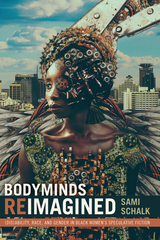
front cover of Bodyminds Reimagined
Bodyminds Reimagined
(Dis)ability, Race, and Gender in Black Women's Speculative Fiction
Sami Schalk
Duke University Press, 2018
In Bodyminds Reimagined Sami Schalk traces how black women's speculative fiction complicates the understanding of bodyminds—the intertwinement of the mental and the physical—in the context of race, gender, and (dis)ability. Bridging black feminist theory with disability studies, Schalk demonstrates that this genre's political potential lies in the authors' creation of bodyminds that transcend reality's limitations. She reads (dis)ability in neo-slave narratives by Octavia Butler (Kindred) and Phyllis Alesia Perry (Stigmata) not only as representing the literal injuries suffered under slavery, but also as a metaphor for the legacy of racial violence. The fantasy worlds in works by N. K. Jemisin, Shawntelle Madison, and Nalo Hopkinson—where werewolves have obsessive-compulsive-disorder and blind demons can see magic—destabilize social categories and definitions of the human, calling into question the very nature of identity. In these texts, as well as in Butler’s Parable series, able-mindedness and able-bodiedness are socially constructed and upheld through racial and gendered norms. Outlining (dis)ability's centrality to speculative fiction, Schalk shows how these works open new social possibilities while changing conceptualizations of identity and oppression through nonrealist contexts.
[more]

logo for University of Iowa Press
Boomer Girls
Poems by Women from the Baby Boom Generation
Pamela Gemin
University of Iowa Press, 1999

Where were you between Betty Crocker and Gloria Steinem? With that question in mind poets Pamela Gemin and Paula Sergi began collecting the poems in Boomer Girls, an anthology of coming-of-age poems written by women born between 1945 and 1964, give or take a few years on either side. The answers to that question fill this volume with the energy, passion, heartbreak, and giddiness of women's lives from childhood to adolescence to middle age.

The poems in Boomer Girls are by unknown, emerging, and established writers, women who participated in the second wave of feminism. From Sandra Cisneros' "My Wicked Wicked Ways" to Barbara Crooker's "Nearing Menopause, I Run into Elvis at Shoprite," from Wendy Mnookin's "Polio Summer" to Kyoko Mori's "Barbie Says Math Is Hard," these poems call for us to celebrate (in the words of poet Diane Seuss-Brakeman) "glances, romances, beauty and guilt, regret, remorse, rebates and rejuvenations."

Boomer Girls share a common culture, bound by their generation's political history, by pop icons like Barbie—that pedestaled Boomer Girl who's just turned forty—and by the music that's never stopped playing: Janis Joplin, Marvin Gaye, Jimi Hendrix, the Ronettes, Van Morrison, Patsy Cline, John Lennon. The Boomer poets in this feisty anthology speak with diverse voices and embody a wide range of experiences, yet their generation's universal images—the hula hoops, TV shows, finned automobiles, and other household gods of their youth—unite them in ways both hilarious and tender.
[more]

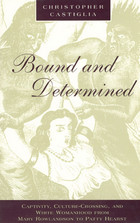
front cover of Bound and Determined
Bound and Determined
Captivity, Culture-Crossing, and White Womanhood from Mary Rowlandson to Patty Hearst
Christopher Castiglia
University of Chicago Press, 1996
In Bound and Determined, Christopher Castiglia gives shape for the first time to a tradition of American women's captivity narrative that ranges across three centuries, from Puritan colonist Mary Rowlandson's abduction by Narragansett Indians to Patty Hearst's kidnapping by the Symbionese Liberation Army.

Examining more than sixty accounts by women captives, as well as novels ranging from Susanna Rowson's eighteenth-century classic Rueben and Rachel to today's mass-market romances, Castiglia investigates paradoxes central to the genre. In captivity, women often find freedom from stereotypical roles as helpless, dependent, sexually vulnerable, and xenophobic. In their condemnations of their non-white captors, they defy assumptions about race that undergird their own societies. Castiglia questions critical conceptions of captivity stories as primarily an appeal to racism and misogyny, and instead finds in them an appeal of a much different nature: as all-too-rare stories of imaginative challenges to rigid gender roles and racial ideologies.

Whether the women of these stories resist or escape captivity, endure until they are released, or eventually choose to live among their captors, they end up with the power to be critical of both cultures. Castiglia shows that these compelling narratives, with their boundary crossings and persistent explorations of cultural divisions and differences, have significant implications for current critical investigations into the construction of gender, race, and nation.
[more]

front cover of Brave Humanism
Brave Humanism
Black Women Rewriting the Human in the Age of Jane Crow
Mollie Godfrey
The Ohio State University Press, 2025
In Brave Humanism, Mollie Godfrey argues that long before the post-1960s critiques of Western humanism emerged, an earlier generation of Black women writers were committed to reclaiming and redefining the human on their own terms. For the writers under study here—Pauline Hopkins, Nella Larsen, Zora Neale Hurston, Ann Petry, Gwendolyn Brooks, and Lorraine Hansberry—narrative forms offered intellectual space to challenge the white supremacist and patriarchal logics of Western humanism that underwrote de jure segregation. Through these narratives, they worked toward their own visions of humanity and human freedom—visions that would come to inspire later generations of Black feminists. By recovering Jane Crow–era Black women writers’ undervalued intellectual work of critique and creation, Godfrey also intervenes in critical conversations about the relationships between Black creative work, Black women’s intellectual work, and our ideas about human agency and collectivity. In recovering this hidden intellectual genealogy, this book offers a more nuanced history of Black women’s engagement with the idea of the human and places a longer history of Black women’s writing at the heart of humanist and posthumanist study.
[more]


Send via email Share on Facebook Share on Twitter