
 A SCHOLARLY BOOK REPOSITORY
16 start with C start with C
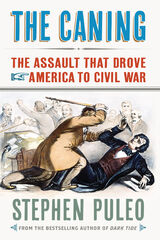
Early in the afternoon of May 22, 1856, ardent pro-slavery Congressman Preston S. Brooks of South Carolina strode into the United States Senate Chamber in Washington, D.C., and began beating renowned anti-slavery Senator Charles Sumner with a gold-topped walking cane. Brooks struck again and again—more than thirty times across Sumner’s head, face, and shoulders—until his cane splintered into pieces and the helpless Massachusetts senator, having nearly wrenched his desk from its fixed base, lay unconscious and covered in blood. It was a retaliatory attack. Forty-eight hours earlier, Sumner had concluded a speech on the Senate floor that had spanned two days, during which he vilified Southern slaveowners for violence occurring in Kansas, called Stephen A. Douglas of Illinois a “noise-some, squat, and nameless animal,” and famously charged Brooks’s second cousin, South Carolina Senator Andrew Butler, as having “a mistress. . . who ugly to others, is always lovely to him. . . . I mean, the harlot, Slavery.” Brooks not only shattered his cane during the beating, but also destroyed any pretense of civility between North and South.
One of the most shocking and provocative events in American history, the caning convinced each side that the gulf between them was unbridgeable and that they could no longer discuss their vast differences of opinion regarding slavery on any reasonable level.The Caning: The Assault That Drove America to Civil War tells the incredible story of this transformative event. While Sumner eventually recovered after a lengthy convalescence, compromise had suffered a mortal blow. Moderate voices were drowned out completely; extremist views accelerated, became intractable, and locked both sides on a tragic collision course.
The caning had an enormous impact on the events that followed over the next four years: the meteoric rise of the Republican Party and Abraham Lincoln; the Dred Scott decision; the increasing militancy of abolitionists, notably John Brown’s actions; and the secession of the Southern states and the founding of the Confederacy. As a result of the caning, the country was pushed, inexorably and unstoppably, to war. Many factors conspired to cause the Civil War, but it was the caning that made conflict and disunion unavoidable five years later.
American Indian women have traditionally played vital roles in social hierarchies at the family, clan, and tribal levels. In the Cherokee Nation, specifically, women and men are considered equal contributors to the culture. With this study, however, we learn that three key historical events in the 19th and early 20th centuries—removal, the Civil War, and allotment of their lands—forced a radical renegotiation of gender roles and relations in Cherokee society.
Carolyn Johnston (who is related to John Ross, principal chief of the Nation) looks at how Cherokee women navigated these crises in ways that allowed them to retain their traditional assumptions, ceremonies, and beliefs and to thereby preserve their culture. In the process, they both lost and retained power. The author sees a poignant irony in the fact that Europeans who encountered Native societies in which women had significant power attempted to transform them into patriarchal ones and that American women struggled for hundreds of years to achieve the kind of equality that Cherokee women had enjoyed for more than a millennium.
Johnston examines the different aspects of Cherokee women’s power: authority in the family unit and the community, economic independence, personal autonomy, political clout, and spirituality. Weaving a great-grandmother theme throughout the narrative, she begins with the protest of Cherokee women against removal and concludes with the recovery of the mother town of Kituwah and the elections of Wilma Mankiller and Joyce Dugan as principal chiefs of the Cherokee Nation and the Eastern Band of Cherokees.
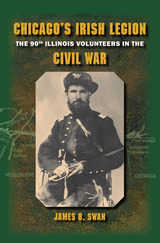
Extensively documented and richly detailed, Chicago’s Irish Legion tells the compelling story of Chicago’s 90th Illinois Volunteer Infantry, the only Irish regiment in Major General William Tecumseh Sherman’s XV Army Corps. Swan’s sweeping history of this singular regiment and its pivotal role in the Western Theater of the Civil War draws heavily from primary documents and first-person observations, giving readers an intimate glimpse into the trials and triumphs of ethnic soldiers during one of the most destructive wars in American history.
At the onset of the bitter conflict between the North and the South, Irish immigrants faced a wall of distrust and discrimination in the United States. Many Americans were deeply suspicious of Irish religion and politics, while others openly doubted the dedication of the Irish to the Union cause. Responding to these criticisms with a firm show of patriotism, the Catholic clergy and Irish politicians in northern Illinois—along with the Chicago press and community—joined forces to recruit the Irish Legion. Composed mainly of foreign-born recruits, the Legion rapidly dispelled any rumors of disloyalty with its heroic endeavors for the Union. The volunteers proved to be instrumental in various battles and sieges, as well as the marches to the sea and through the Carolinas, suffering severe casualties and providing indispensable support for the Union. Swan meticulously traces the remarkable journey of these unique soldiers from their regiment’s inception and first military engagement in 1862 to their disbandment and participation in the Grand Review of General Sherman’s army in 1865.
Enhancing the volume are firsthand accounts from the soldiers who endured the misery of frigid winters and brutal environments, struggling against the ravages of disease and hunger as they marched more than twenty-six hundred miles over the course of the war. Also revealed are personal insights into some of the war’s most harrowing events, including the battle at Chattanooga and Sherman’s famous campaign for Atlanta. In addition, Swan exposes the racial issues that affected the soldiers of the 90th Illinois, including their reactions to the Emancipation Proclamation and the formations of the first African American fighting units. Swan rounds out the volume with stories of survivors’ lives after the war, adding an even deeper personal dimension to this absorbing chronicle.

European military historian Jeremy Black reorients readers to see what was extraordinary in the civil war of 'the American colonies' and why this was warfare unlike anything that could be properly understood on the world stage at that time. He also examines with expertise the role of foreign powers (or lack thereof).
Black's treatment might be the doom of civil war counterfactuals. Was the south destined to fail? Was it weaker motive, faulty strategy, or lack of European support? Was the north just lucky, or possessed of foresight and providential endowment? Black dispels romanticism and sentimentalist hindsight––the American Civil War is unparalleled in many respects, but it is not without clear lessons in warcraft, diplomacy, and cultural–economic impasse.
Furthermore, Black's Civil War is a new resource that teaches, reaffirms, and reminds readers of the intensity of the American past––in both error and idealistic impulse––that might continue to guide us to the best future and avoid the lose-lose circumstances of a civil war. Black's acumen for historical review in this case renders a kind of warning: May the leaders of men in the future come to a better way of self-realization than give way to the internal conflict that pits father against son, and sister against brother. But if he must engage, at least understand the distinction between war and politics.
Black's objective and concise account is a treasure for students and experts alike who need clarity and insight without too much of an investment. The take-away is an appreciation for the American spirit that civil strife petrified and an understanding of the tactical progression of this conflict and the context of combat of that era.
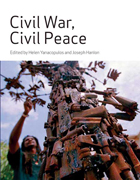
When a cease-fire is arranged, aid workers, military personnel, diplomats, and others pour in from the United States, Europe, and international agencies. Outside help is essential after a war, but too often, well-intentioned interveners do more harm than good. A half of civil wars have resumed after failed peace agreements.
Each war is different, and there can be no intervention handbook or best practices guide. Aimed at practitioners and policy makers, and essential reading for students of war, humanitarian intervention, peace building, and development, Civil War, Civil Peace provides a comprehensive examination of how interventions can be improved through a better understanding of the roots of war and of the grievances and interests that fueled the war.

Gary Gallagher's foreword traces the development of Civil War bibliographies and declares that Eicher's annotation exceeds that of any previous comprehensive volume. The Civil War in Books, Gallagher believes, is "precisely the type of guide" that has been needed. The first full-scale, fully-annotated bibliography on the Civil War to appear in more than thirty years, Eicher's The Civil War in Books is a remarkable compendium of the best reading available about the worst conflict ever to strike the United States. The bibliography, the most valuable reference book on the subject since The Civil War Day by Day, will be essential for college and university libraries, dealers in rare and secondhand books, and Civil War buffs.
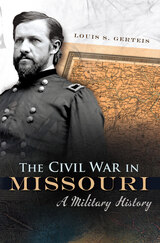
Both the Union and the Confederacy had a vested interest in Missouri throughout the war. The state offered control of both the lower Mississippi valley and the Missouri River, strategic areas that could greatly factor into either side’s success or failure. Control of St. Louis and mid-Missouri were vital for controlling the West, and rail lines leading across the state offered an important connection between eastern states and the communities out west. The Confederacy sought to maintain the Ozark Mountains as a northern border, which allowed concentrations of rebel troops to build in the Mississippi valley. With such valuable stock at risk, Lincoln registered the importance of keeping rebel troops out of Missouri, and so began the conventional battles investigated by Gerteis.
The first book-length examination of its kind, The Civil War in Missouri: A Military History dares to challenge the prevailing opinion that Missouri battles made only minor contributions to the war. Gerteis specifically focuses not only on the principal conventional battles in the state but also on the effects these battles had on both sides’ national aspirations. This work broadens the scope of traditional Civil War studies to include the losses and wins of Missouri, in turn creating a more accurate and encompassing narrative of the nation’s history.

A border county in a border state, Barbour County, West Virginia felt the full terror and tragedy of the Civil War. The wounds of the Civil War cut most bitterly in the border states, that strip of America from Maryland to Kansas, where conflicting loyalties and traditions ripped apart communities, institutions, and families. Barbour County, in the mountainous Northwest of (West) Virginia, is a telling microcosm of the deep divisions which both caused the war and were caused by it. By examining and interpreting long-ignored documents of the times and the personal accounts of the people who were there, Clash of Loyalties offers a startling new view of America's most bitter hour. Nearly half of the military-age men in the county served in the armed forces, almost perfectly divided between the Union and the Confederacy. After West Virginia split with Virginia to rejoin the Union, Confederate soldiers from the regions could not safely visit their homes on furlough, or even send letters to their families. The county's two leading political figures, Samuel Woods and Spencer Dayton, became leaders of the fight for and against secession, dissolved their close personal friendship, and never spoke to one another again. The two factions launched campaigns of terror and intimidation, leading to the burning of several homes, the kidnapping of a sheriff, the murder of a pacifist minister, and the self-imposed exile of many of the county's influential families. The conflicting loyalties crossed nearly all social and economic lines; even the county's slave owners were evenly divided between Union and Confederate sympathies. With a meticulous examination of census and military records, geneologies, period newspapers, tax rolls, eyewitness accounts, and other relevant documents, Clash of Loyalties presents a compelling account of the passion and violence which tore apart Barbour County and the nation.
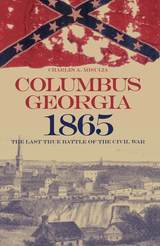
Columbus, Georgia, 1865 is a comprehensive study of the Easter Sunday, April 16, 1865, conflict, which occurred in the dark of night and extended over a mile and half through a series of forts and earthworks and was finally decided in an encounter on a bridge a thousand feet in length. This volume offers the first complete account of this battle, examining and recounting in depth not only the composition and actions of the contending forces, which numbered some three thousand men on each side, but meticulously detailing the effect of the engagement on the city of Columbus and its environs.
Misulia’s study fills in an omission in the grand account of our cataclysmic national struggle and adds a significant chapter to the history of an important regional city. In addition, Misulia takes on the long-vexing question of which encounter should be recognized as the last battle of the Civil War and argues persuasively that Columbus, Georgia, qualifies for this distinction on a number of counts.
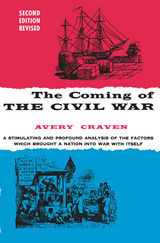
". . . those who would examine the democratic process during a period of progressive breakdown, in order to understand the dangers it embodies within itself, will find The Coming of the Civil War a classic analysis."—Louis D. Rubin, Jr., Sewanee Review
"The book has always been recognized, even by its most severe critics, as a work of consummate scholarship."—T. Harry Williams, Baton Rouge Morning Advocate
Confederate Daughters: Coming of Age during the Civil War explores gender, age, and Confederate identity by examining the lives of teenage daughters of Southern slaveholding, secessionist families. These young women clung tenaciously to the gender ideals that upheld marriage and motherhood as the fulfillment of female duty and to the racial order of the slaveholding South, an institution that defined their status and afforded them material privileges. Author Victoria E. Ott discusses how the loyalty of young Southern women to the fledgling nation, born out of a conservative movement to preserve the status quo, brought them into new areas of work, new types of civic activism, and new rituals of courtship during the Civil War.
Social norms for daughters of the elite, their preparation for their roles as Southern women, and their material and emotional connections to the slaveholding class changed drastically during the Civil War. When differences between the North and South proved irreconcilable, Southern daughters demonstrated extraordinary agency in seeking to protect their futures as wives, mothers, and slaveholders.
From a position of young womanhood and privilege, they threw their support behind the movement to create a Confederate identity, which was in turn shaped by their participation in the secession movement and the war effort. Their political engagement is evident from their knowledge of military battles, and was expressed through their clothing, social activities, relationships with peers, and interactions with Union soldiers.
Confederate Daughters also reveals how these young women, in an effort to sustain their families throughout the war, adjusted to new domestic duties, confronting the loss of slaves and other financial hardships by seeking paid work outside their homes.
Drawing on their personal and published recollections of the war, slavery, and the Old South, Ott argues that young women created a unique female identity different from that of older Southern women, the Confederate bellehood. This transformative female identity was an important aspect of the Lost Cause mythology—the version of the conflict that focused on Southern nationalism—and bridged the cultural gap between the antebellum and postbellum periods.
Augmented by twelve illustrations, this book offers a generational understanding of the transitional nature of wartime and its effects on women’s self-perceptions. Confederate Daughters identifies the experiences of these teenage daughters as making a significant contribution to the new woman in the New South.
Drawing from a wealth of historic documents and personal papers, William Warren Rogers, Jr., provides a fascinating and detailed political, economic, social, and commercial history of Montgomery from 1860 to 1865. His account begins with an examination of daily life in the city before the war began-how slaves outnumbered whites, how an unvarnished frontier atmosphere prevailed on the streets despite citizens' claims to refinement, how lush crops of corn and cotton grew in fields right up to the city limits, and how class divisions were distinct and immovable.
Rogers arranges his material topically, covering the events that led to the decision for secession and Montgomery's heady days as the Confederacy's first capital; the industrialization of the city's war effort as it became a hub of activity and served as a military post; the city's business patterns and administration as it attempted to promote the Confederacy and defend itself from federal forces; and the plight of the small group of Unionists who inhabited Montgomery through the war. Rogers concludes with chapters examining the situation in Montgomery as the Confederacy unraveled and the city fell to Union troops.
The Montgomery experience offers a microcosm of life on the Confederate home front and demonstrates that citizens generally experienced the same hopes, deprivations, and tragedies that other Southerners did at this time. Rogers's well-written, comprehensive history of the wartime city makes an original contribution to Civil War homefront and community studies that should appeal to general readers and scholars alike.
Author George S. Burkhardt details a fascinating case that the Confederates followed a consistent pattern of murder against the black soldiers who served in Northern armies after Lincoln’s 1863 Emancipation Proclamation. He shows subsequent retaliation by black soldiers and further escalation by the Confederates, including the execution of some captured white Federal soldiers, those proscribed as cavalry raiders, foragers, or house-burners, and even some captured in traditional battles.
Further disproving the notion of Confederates as victims who were merely trying to defend their homes, Burkhardt explores the motivations behind the soldiers’ actions and shows the Confederates’ rage at the sight of former slaves—still considered property, not men—fighting them as equals on the battlefield.
Burkhardt’s narrative approach recovers important dimensions of the war that until now have not been fully explored by historians, effectively describing the systemic pattern that pushed the conflict toward a black flag, take-no-prisoners struggle.
READERS
Browse our collection.
PUBLISHERS
See BiblioVault's publisher services.
STUDENT SERVICES
Files for college accessibility offices.
RECENTLY PUBLISHED



UChicago Accessibility Resources
home | accessibility | search | about | contact us
BiblioVault ® 2001 - 2026
The University of Chicago Press