
 A SCHOLARLY BOOK REPOSITORY
8 start with C start with C
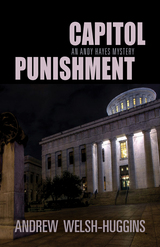
The job seems simple enough: Reporter Lee Hershey needs protection for a couple of weeks as he pursues the biggest story of his career with all eyes on swing state Ohio in the midst of a presidential election. Columbus private eye Andy Hayes, broke as usual, doesn’t have much choice but to sign on, even with his girlfriend falling for the charming journalist.
Then murder strikes at the Statehouse and Andy finds himself partly responsible for the death. With an innocent man behind bars, a mysterious vehicle following Andy around the city, and more lives in danger, the detective has his hands full trying to solve a killing in a poisonous political environment where everyone has a motive for murder and anyone could be the next target.
Winner of the 2004 New Jersey Studies Academic Alliance Book Award for Scholarly Non-Fiction | Named a 2005 Honor Book by the New Jersey Council for the Humanities
Essential reading for anyone interested in the most famous American crime of the twentieth century
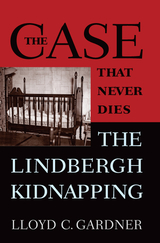
Since its original publication in 2004, The Case That Never Dies has become the standard account of the Lindbergh kidnapping. Now, in a new afterword, historian Lloyd C. Gardner presents a surprise conclusion based on recently uncovered pieces of evidence that were missing from the initial investigation as well as an evaluation of Charles Lindbergh’s role in the search for the kidnappers. Out of the controversies surrounding the actions of Colonel Lindbergh, Norman Schwarzkopf, commander of the New Jersey State Police, and FBI director J. Edgar Hoover, Gardner presents a well-reasoned argument for what happened on the night of March 1, 1932.
The Case That NeverDies places the Lindbergh kidnapping, investigation, and trial in the context of the Depression, when many feared the country was on the edge of anarchy. Gardner delves deeply into the aspects of the case that remain confusing to this day, including Lindbergh’s dealings with crime baron Owney Madden, Al Capone’s New York counterpart, as well as the inexplicable exploits of John Condon, a retired schoolteacher who became the prosecution’s best witness. The initial investigation was hampered by Colonel Lindbergh, who insisted that the police not attempt to find the perpetrator because he feared the investigation would endanger his son’s life. He relented only when the child was found dead.
After two years of fruitless searching, Bruno Richard Hauptmann, a German immigrant, was discovered to have some of the ransom money in his possession. Hauptmann was arrested, tried, and sentenced to death. Throughout the book, Gardner pays special attention to the evidence of the case and how it was used and misused in the trial. Whether Hauptmann was guilty or not, Gardner concludes that there was insufficient evidence to convict him of first-degree murder.
Set in historical context, the book offers not only a compelling read, but a powerful vantage point from which to observe the United States in the 1930s as well as contemporary arguments over capital punishment.

Francie returns to Enchantment Lake looking for answers, only to get dragged into a murder mystery she might not survive
Francie’s brother Theo has secrets—secrets Francie thinks she wants to know. But what if one of those secrets is that Theo is a murderer? To avoid considering that possibility, Francie plunges into her senior year at a small-town high school near Enchantment Lake in northern Minnesota. It’s a radical change from her private school in New York, but she hopes to keep an eye on her great aunts and maybe finally learn more about the mother she never knew. A small silver box seems to hold the answers, and she is determined to get her hands on it.
But when her long-lost brother turns up, so does a dead body, and once again Francie is drawn into a mystery. A long list of suspects, with Theo at the top, keeps her head spinning. When Francie herself becomes a suspect she starts to feel like she is walking on thin ice, but it isn’t until she is literally walking on thin ice that the pieces start to come together—and by then it may be too late.
In her previous adventure Enchantment Lake, Francie was thrown into northern Minnesota lake living: fishing, berry picking, lost kayaks and scary boat rides, poisoned hotdishes, exploding bulldozers, a forest fire . . . and murder. But if she thinks things have settled down, she’s in for a surprise. A new school with new friends (and a few enemies), a lead role in a play, an encounter with a giant muskie, archaeological twists, secret tunnels, thin ice, and a strangely sticky murder are all coming her way in The Clue in the Trees.
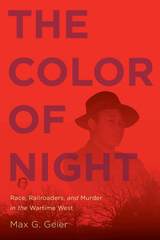
In this deeply researched and detailed account, Geier explores how race, gender, and class affected the attitudes of local town-folk, law officers, and courtroom jurors toward Black trainmen on the West Coast, at a time when militarization skewed perceptions of virtue, status, and authority. He delves into the working conditions and experiences of unionized Black trainmen in their “home and away” lives in Los Angeles and Portland, while illuminating the different ways that they, and other residents of Oregon and southern California, responded to news of “Oregon’s murdered war bride.” Reporters, civil rights activists, and curiosity seekers transformed the trial and appeals process into a public melodrama.
The investigation, trial, and conviction of Robert Folkes galvanized civil rights activists, labor organizers, and community leaders into challenging the flawed judicial process and ultimately the death penalty in Oregon, serving as a catalyst for civil rights activism that bridged rural and urban divides. The Color of Night will appeal to “true crime” aficionados, and to anyone interested in the history of race and labor relations, working conditions, community priorities, and attitudes toward the death penalty in the first half of the 20th century.
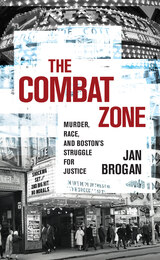
At the end of the 1976 football season, more than forty Harvard athletes went to Boston's Combat Zone to celebrate. In the city's adult entertainment district, drugs and prostitution ran rampant, violent crime was commonplace, and corrupt police turned the other way. At the end of the night, Italian American star athlete Andy Puopolo, raised in the city's North End, was murdered in a stabbing. Three African American men were accused of the crime. His murder made national news and led to the eventual demise of the city's red-light district.
Starting with this brutal murder, The Combat Zone tells the story of the Puopolo family's struggle with both a devastating loss and a criminal justice system that produced two trials with opposing verdicts, all within the context of a racially divided Boston. Brogan traces the contentious relationship between Boston’s segregated neighborhoods during the busing crisis; shines a light on a court system that allowed lawyers to strike potential jurors based purely on their racial or ethnic identity; and lays bare the deep-seated corruption within the police department and throughout the Combat Zone. What emerges is a fascinating snapshot of the city at a transitional moment in its recent past.
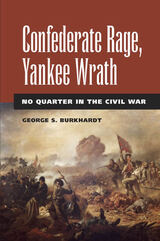
Author George S. Burkhardt details a fascinating case that the Confederates followed a consistent pattern of murder against the black soldiers who served in Northern armies after Lincoln’s 1863 Emancipation Proclamation. He shows subsequent retaliation by black soldiers and further escalation by the Confederates, including the execution of some captured white Federal soldiers, those proscribed as cavalry raiders, foragers, or house-burners, and even some captured in traditional battles.
Further disproving the notion of Confederates as victims who were merely trying to defend their homes, Burkhardt explores the motivations behind the soldiers’ actions and shows the Confederates’ rage at the sight of former slaves—still considered property, not men—fighting them as equals on the battlefield.
Burkhardt’s narrative approach recovers important dimensions of the war that until now have not been fully explored by historians, effectively describing the systemic pattern that pushed the conflict toward a black flag, take-no-prisoners struggle.
READERS
Browse our collection.
PUBLISHERS
See BiblioVault's publisher services.
STUDENT SERVICES
Files for college accessibility offices.
RECENTLY PUBLISHED






UChicago Accessibility Resources
home | accessibility | search | about | contact us
BiblioVault ® 2001 - 2025
The University of Chicago Press