
 A SCHOLARLY BOOK REPOSITORY
5 start with C start with C
This book is also freely available online as an open access digital edition. The open access publication was financially supported by the Social Science Research Master and partly also by the Health, Care and the Body Programme Group of the Department of Anthropology, both at the Amsterdam Institute of Social Science Research, University of Amsterdam.
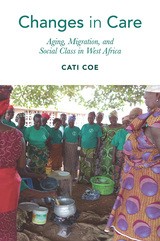
There is a short film that accompanies the book, “Making Happiness: Older People Organize Themselves” (2020), an 11-minute film by Cati Coe. Available at: https://doi.org/doi:10.7282/t3-thke-hp15

You are old, ill, in pain, and your doctor asks you what you want to do about it. You may be uncertain but you're definitely not alone. By the year 2020, some 50 million Americans will be over sixty-five, and as the nation ages we must all ask what we ought to do about the health and medical care of our elderly. Our response will have profound consequences, not just for individuals and families, but for society as a whole. This book helps us start to form an answer.
To make decisions about medical care in old age, we need to know more about the reality of being elderly and sick, and Choosing Medical Care in Old Age gives us the opportunity. Muriel Gillick, a noted physician who specializes in the care of the elderly and in medical ethics, presents a panoply of stories drawn from her clinical experience. These encounters, with the robust and the frail, the demented and the dying, capture the texture of the experience of being old and faced with critical medical questions. From the stories of older people struggling to make choices in the face of acute illness, stories that are often poignant and sometimes tragic, Gillick develops broad guidelines for medical decision–making for the elderly. Within this framework, she confronts particular concerns and questions. When are certain procedures too burdensome to be justified? What are unacceptable risks? Should family members serve as exclusive spokespersons for relatives who can no longer speak for themselves? Gillick's bold and personal prescription for medical care for the elderly calls for a change in the way medicine is understood and practiced, as well as for changes in the institutions that serve the elderly, such as hospitals and nursing homes. An intelligent and deeply compassionate inquiry into the difficult issues and real–life dilemmas raised by current practices, her book offers a first step toward those changes.

In previous decades, when younger Americans far outnumbered older ones, retirees could depend on financial support through taxes from the population at large. But as "Boomers" retire and the work force begins to shrink, there will be a disproportionately large population of retirees to workers. With such a big jump in the percentage of older Americans in the population, fewer workers will be able to to transfer funds, through taxes, to retirees. Moreover, other traditionally reliable sources of financial assistance—Social Security, Medicare, and Medicaid—have faced serious financial difficulties in recent years. Who will the aged turn to for assistance?
The Coming Health Crisis suggests that as funds from all quarters dwindle, older Americans will have to look to alternative programs for financial assistance. Wolfe urges immediate action to develop new saving programs and increase existing transfer schemes to head off an imminent crisis. Although tax increases might provide some resources, he demonstrates that it is more important to accumulate capital to create solid reserves for the future. Wolfe also explores two roles for government: prefunding new or existing social insurance programs and promoting private insurance options. By exempting insurance fund income from corporate taxation and permitting people at all income levels to defer income tax on accounts earmarked for long-term care, he shows how government could greatly encourage and expand personal saving.
Finally, this work assesses the value of other recent health and long-term-care innovations: social/health maintenance organizations, long-term-care individual retirement accounts, and reverse annuity mortgages, in addition to vouchers, care rationing, mandatory public insurance, and expanded private coverage. Through this wide-ranging survey, Wolfe demonstrates that, through a combination of these programs, we can care for the aging "Baby Boom" generation by anticipating their needs and saving now.

READERS
Browse our collection.
PUBLISHERS
See BiblioVault's publisher services.
STUDENT SERVICES
Files for college accessibility offices.
RECENTLY PUBLISHED




UChicago Accessibility Resources
home | accessibility | search | about | contact us
BiblioVault ® 2001 - 2025
The University of Chicago Press