
 A SCHOLARLY BOOK REPOSITORY
13 start with C start with C



The advent of chemical or pharmacological therapies has had an enormous impact on the treatment of psychiatric illness. For the chemotherapy to be effective, however, the clinician must take into account many factors in addition to recognition of a syndrome and selection of an appropriate agent and dose. In this extensively revised and expanded edition of a widely used book, Ross Baldessarini concentrates on providing rational, scientific underpinnings for the treatment of patients. In doing so, he bridges the gap between biology, psychology, and clinical practice.
To provide the most up-to-date coverage of the actions and use of psychotropic agents, Professor Baldessarini has enlarged the text to nearly twice its original length and has added sixty-three new tables. More basic preclinical pharmacology is included to guide the thoughtful use of medication. In addition to summarizing this basic knowledge, the text reviews the indications for each drug, the kinds of patients most likely to respond, and side effects and contraindications, and provides summaries of clinical research findings on which rational clinical practice rests.
A chapter is devoted to each of the principal classes of psychotropic drugs: antipsychotic agents, lithium salts and other antimanic agents, antidepressant agents, and antianxiety drugs. Within each chapter is a new section that surveys the future of the field and examines new procedures, theories, and agents. A final chapter covers more general topics such as psychosocial, ethical, and legal aspects of practice in the administration of drugs, as well as the emerging topics of geriatric and pediatric psychopharmacology--material not readily available elsewhere.

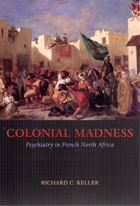
Nineteenth-century French writers and travelers imagined Muslim colonies in North Africa to be realms of savage violence, lurid sexuality, and primitive madness. Colonial Madness traces the genealogy and development of this idea from the beginnings of colonial expansion to the present, revealing the ways in which psychiatry has been at once a weapon in the arsenal of colonial racism, an innovative branch of medical science, and a mechanism for negotiating the meaning of difference for republican citizenship.
Drawing from extensive archival research and fieldwork in France and North Africa, Richard Keller offers much more than a history of colonial psychology. Colonial Madness explores the notion of what French thinkers saw as an inherent mental, intellectual, and behavioral rift marked by the Mediterranean, as well as the idea of the colonies as an experimental space freed from the limitations of metropolitan society and reason. These ideas have modern relevance, Keller argues, reflected in French thought about race and debates over immigration and France’s postcolonial legacy.


"Goldstein has raised our understanding of the politics of psychiatric professionalization on to a new plane."—Roy Porter, Times Higher Education Supplement
"[A]n historiographical tour de force, quite simply the most insightful work on the subject in English or any other language. . . . [A] work of distinctive originality. . . . It is written with lucidity and elegance, even a certain confident scholarly panache, that make it a pleasure to read."—Toby Gelfand, Social History
"Exhaustively researched, elegantly written, and persuasively argued, Console and Classify is an excellent example of the . . . sociologically informed intellectual history, stimulated by Kuhn and Foucault."—Robert Alun Jones, American Journal of Sociology
The young psychiatrist from Budapest had studied medicine in Vienna, he had read The Interpretation of Dreams, and now he was about to meet its author. Seventeen years Sigmund Freud's junior, Sándor Ferenczi (1873-1933) sent off a note anticipating the pleasure of the older man's acquaintance--thus beginning a correspondence that would flourish over the next twenty-five years, and that today provides a living record of some of the most important insights and developments of psychoanalysis, worked out through the course of a deep and profoundly complicated friendship.
This volume opens in January of 1908 and closes on the eve of World War I. Letter by letter, a "fellowship of life, thoughts, and interests" as Freud came to describe it, unfolds here as a passionate exchange of ideas and theories. Ferenczi's contribution to psychoanalysis was, Freud said, "pure gold," and many of the younger man's notions and concepts, proposed in these letters, later made their way into Freud's works on homosexuality, paranoia, trauma, transference, and other topics. To the two men's mutual scientific interests others were soon added, and their correspondence expanded in richness and complexity as Ferenczi attempted to work out his personal and professional conflicts under the direction of his devoted and sometimes critical elder colleague.
Here is Ferenczi's love for Elma, his analysand and the daughter of his mistress, his anguish over his matrimonial intentions, his soliciting of Freud's help in sorting out this emotional tangle--a situation that would eventually lead to Ferenczi's own analysis with Freud. Here is Freud's unraveling relationship with Jung, documented through a heated discussion of the events leading up to the final break. Amid these weighty matters of heart and mind, among the psychoanalytic theorizing and playful speculation, we also find the lighter stuff of life, the talk of travel plans and antiquities, gossip about friends and family. Unparalleled in their wealth of personal and scientific detail, these letters give us an intimate picture of psychoanalytic theory being made in the midst of an extraordinary friendship.
"Thought-provoking and important. . .Drawing on and consolidating the ideas of a range of authors, Horwitz challenges the existing use of the term mental illness and the psychiatric ideas and practices on which this usage is based. . . . Horwitz enters this controversial territory with confidence, conviction, and clarity."—Joan Busfield, American Journal of Sociology
"Horwitz properly identifies the financial incentives that urge therapists and drug companies to proliferate psychiatric diagnostic categories. He correctly identifies the stranglehold that psychiatric diagnosis has on research funding in mental health. Above all, he provides a sorely needed counterpoint to the most strident advocates of disease-model psychiatry."—Mark Sullivan, Journal of the American Medical Association
"Horwitz makes at least two major contributions to our understanding of mental disorders. First, he eloquently draws on evidence from the biological and social sciences to create a balanced, integrative approach to the study of mental disorders. Second, in accomplishing the first contribution, he provides a fascinating history of the study and treatment of mental disorders. . . from early asylum work to the rise of modern biological psychiatry."—Debra Umberson, Quarterly Review of Biology

David Healy follows his widely praised study, The Antidepressant Era, with an even more ambitious and dramatic story: the discovery and development of antipsychotic medication. Healy argues that the discovery of chlorpromazine (more generally known as Thorazine) is as significant in the history of medicine as the discovery of penicillin, reminding readers of the worldwide prevalence of insanity within living memory.
But Healy tells not of the triumph of science but of a stream of fruitful accidents, of technological discovery leading neuroscientific research, of fierce professional competition and the backlash of the antipsychiatry movement of the 1960s. A chemical treatment was developed for one purpose, and as long as some theoretical rationale could be found, doctors administered it to the insane patients in their care to see if it would help. Sometimes it did, dramatically. Why these treatments worked, Healy argues provocatively, was, and often still is, a mystery. Nonetheless, such discoveries made and unmade academic reputations and inspired intense politicking for the Nobel Prize.
Once pharmaceutical companies recognized the commercial potential of antipsychotic medications, financial as well as clinical pressures drove the development of ever more aggressively marketed medications. With verve and immense learning, Healy tells a story with surprising implications in a book that will become the leading scholarly work on its compelling subject.

French historian Alexis de Tocqueville observed that the conflict between the ideals of individualism and community defines American culture. In this groundbreaking new work, anthropologist Charles Nuckolls discovers that every culture consists of such paradoxes, thus making culture a problem that cannot be solved. He does, however, find much creative tension in these unresolvable opposites.
Nuckolls presents three fascinating case studies that demonstrate how values often are expressed in the organization of social roles. First he treats the Micronesian Ifaluks’ opposition between cooperation and self-gratification by examining the nature versus nurture debate. Nuckolls then shifts to the values of community and individual adventure by looking at the conflicts in the identities of public figures in Oklahoma. Finally, he investigates the cultural significance in the diagnostic system and practices of psychiatry in the United States. Nuckolls asserts that psychiatry treats genders differently, assigning dependence to women and independence to men and, in some cases, diagnoses the extreme forms of these values as disorders.
Nuckolls elaborates on the theory of culture that he introduced in his previous book, The Cultural Dialectics of Knowledge and Desire, which proposed that the desire to resolve conflicts is central to cultural knowledge. In Culture: A Problem that Cannot Be Solved, Nuckolls restores the neglected social science concept of values, which addresses both knowledge and motivation. As a result, he brings together cognition and psychoanalysis, as well as sociology and psychology, in his study of cultural processes.
READERS
Browse our collection.
PUBLISHERS
See BiblioVault's publisher services.
STUDENT SERVICES
Files for college accessibility offices.
RECENTLY PUBLISHED







UChicago Accessibility Resources
home | accessibility | search | about | contact us
BiblioVault ® 2001 - 2026
The University of Chicago Press