
 A SCHOLARLY BOOK REPOSITORY
10 start with D start with D
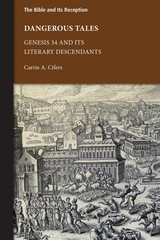
The biblical narrative of Israel’s only daughter Dinah is steeped in deception and violence, vengeance and destruction, and a silence that has posed interpretive problems for readers for more than two millennia. Carrie A. Cifers takes up the retellings of Genesis 34 in Josephus’s Jewish Antiquities, the book of Jubilees, and Joseph and Aseneth to explore how later authors tried to clarify the assumedly implicit ethical message of Dinah’s story. Through narrative ethics and socionarratology, Cifers demonstrates that biblical stories are a space of encounter where texts make claims on readers and where readers have an ethical responsibility as witnesses to the text. Dangerous Tales is a call for contemporary readers to engage biblical narratives in ways that mitigate interpretive violence and maximize each text’s ethical potential.
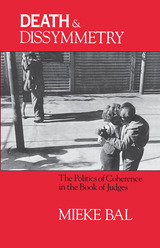
Counter to standard readings of Judges, Bal's interpretation demonstrates that the book has a political and ideological coherence in which the treatment of women plays a pivotal role. Bal concentrates here not on the assassinations and battles that rage through Judges but on the violence in the domestic lives of individual characters, particularly sexual violence directed at women. Her skillful reading reveals that murder, in this text, relates to gender and reflects a social structure that is inherently contradictory. By foregrounding the stories of women and subjecting them to subtle narrative analysis, she is able to expose a set of preoccupations that are essential to the sense of these stories but are not articulated in them. Bal thereby develops a "countercoherence" in conflict with the apparent emphases of Judges—the politics, wars, and historiography that have been the constant focus of commentators on the book.
Death and Dissymmetry makes an important contribution to the development of a feminist method of interpreting ancient texts, with consequences for religious studies, ancient history, literary theory, and gender studies.
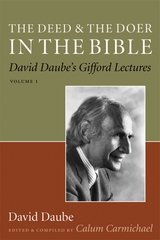
David Daube (1909–1999) was a world-renowned biblical law scholar. He was a fellow at All Souls College at Oxford, an emeritus professor of law at Oxford, and an emeritus professor of law at the University of California, Berkeley. Scholars have hailed his essential research on Roman law, biblical law, Hebraic Law, and ethics throughout his life and today.
Daube produced dozens of books and published over 150 articles in scholarly journals. Now, for the first time, his twenty Gifford Lectures, delivered in 1962 and 1964, will be available to the public. His first ten Gifford Lectures have been collected in The Deed and the Doer in the Bible: David Daube's Gifford Lectures, Volume 1.
The theme of Daube's Gifford Lectures is law and wisdom in the Bible. His wide-ranging deliberations reveal how complicated and profound the biblical text is. He analyzes deeds described in the Bible and considers, for example, what causes people to act in a certain way, the role of intent, why unintended deeds are sometimes punishable, and how the origin of a deed is determined. His lectures are aimed at professionals in biblical criticism, biblical history, ethics, and the history of law concerning its roots in Old Testament traditions. Daube is a recognized master in these fields, and there are substantial applications to current ethical and legal issues.

Explore how the past came to address the present and the future and why it became important for emerging Jewish identity.
Experts explore the themes and topics that made Deuteronomy and the Former Prophets appealing to ancient readers leading ultimately to those texts becoming authoritative for Persian and Hellenistic readers. This unique collection of essays focuses on what larger impact these texts might have had on primary and secondary audiences as part of emerging Torah. Contributors include Klaus-Peter Adam, Yairah Amit, Thomas M. Bolin, Philip R. Davies, Serge Frolov, Susanne Gilmayr-Bucher, E. Axel Knauf, Christoph Levin, James R. Linville, and Thomas Römer, and Diana V. Edelman.
Features:
- Essays focused on why texts became authoritative instead of when they were written or their historicity
- Two scholars examine each book providing a range of views
- Coverage of the socio-religious function of emerging Torah in the Persian and early Hellenistic periods

This latest edition of Discovering the Qur'an includes a new preface by the author. Used by students around the world as a reliable guide to reading a translation of the Qur'an, it shows how the Qur'an is experienced by Muslims, describing the rhythmic and rhyme scheme structures, the context in which it is heard, the part played by learning by heart, and the importance of calligraphy. It is also about the Qur'an and its relationship to Muhammed, as well as helping to divine the ordering of the surahs or chapters. In an English-speaking world newly sensitized to Islam and its believers, Discovering the Qur'an will be an invaluable tool to greater understanding.
A fresh literary analysis of political polemic in the Bible
The Book of Judges ends with a bizarre narrative of sex and violence that starts with a domestic tiff and ends with the decimation of a tribe that is restored by means of abduction and rape. Cynthia Edenburg applies a fresh literary analysis, recent understandings of historical linguistics, and historical geography in her exploration of the origin of the anti-Benjamin polemic found in Judges 19–21, the growth and provenance of the book of Judges, and the shape of the Deuteronomistic History. Her study exposes how Judges 19–21 function as political polemic reflecting not the pre-monarchic period but instead the historical realities of the settlement of Benjamin during the Babylonian and Persian period.
Features:
- Methodological discussions that open each chapter
- Charts and tables
- Engagement with current research produced by scholars from around the world
This volume brings together scholars from New Testament studies and classics, whose fields of study have much in common but are not often in in conversation. The contributors explore how the ancient works they study can be resources for thinking critically and creatively about issues that matter today. The essays address our obligation to take positive moral stands on divisive issues of both the past and the present, including empire, racial/ethnic and religious difference, economic inequality, gender and sexuality, slavery, and disability. Contributors include Douglas Boin, Denise Kimber Buell, Gay L. Byron, Allen Dwight Callahan, Joy Connolly, Jennifer A. Glancy, Shelley P. Haley, Caroline Johnson Hodge, Katherine Lu Hsu, Timothy Joseph, Tat-siong Benny Liew, Yii-Jan Lin, Dominic Machado, Joseph A. Marchal, Thomas R. Martin, Candida R. Moss, Laura Salah Nasrallah, Jorunn Økland, and Abraham Smith.
READERS
Browse our collection.
PUBLISHERS
See BiblioVault's publisher services.
STUDENT SERVICES
Files for college accessibility offices.
RECENTLY PUBLISHED



UChicago Accessibility Resources
home | accessibility | search | about | contact us
BiblioVault ® 2001 - 2026
The University of Chicago Press