
 A SCHOLARLY BOOK REPOSITORY
12 start with D start with D

Latin America’s economic performance is mediocre at best, despite abundant natural resources and flourishing neighbors to the north. The perplexing question of how some of the wealthiest nations in the world in the nineteenth century are now the most crisis-prone has long puzzled economists and historians. The Decline of Latin American Economies examines the reality behind the struggling economies of Argentina, Chile, and Mexico.
A distinguished panel of experts argues here that slow growth, rampant protectionism, and rising inflation plagued Latin America for years, where corrupt institutions and political unrest undermined the financial outlook of already besieged economies. Tracing Latin America’s growth and decline through two centuries, this volume illustrates how a once-prosperous continent now lags behind. Of interest to scholars and policymakers alike, it offers new insight into the relationship between political systems and economic development.
The NIRA is generally viewed as a monolithic program, its dramatic and sweeping effects best measurable through a macroeconomic lens. In this pioneering book, however, Jason E. Taylor examines the act instead using microeconomic tools, probing the uneven implementation of the act’s codes and the radical heterogeneity of its impact across industries and time. Deconstructing the Monolith employs a mixture of archival and empirical research to enrich our understanding of how the program affected the behavior and well-being of workers and firms during the two years NIRA existed as well as in the period immediately following its demise.
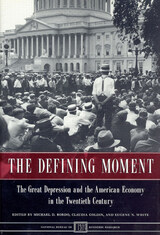
The essays consider whether New Deal-style legislation continues to operate today as originally envisioned, whether it altered government and the economy as substantially as did policies inaugurated during World War II, the 1950s, and the 1960s, and whether the legislation had important precedents before the Depression, specifically during World War I. Some chapters find that, surprisingly, in certain areas such as labor organization, the 1930s responses to the Depression contributed less to lasting change in the economy than a traditional view of the time would suggest. On the whole, however, these essays offer testimony to the Depression's legacy as a "defining moment." The large role of today's government and its methods of intervention—from the pursuit of a more active monetary policy to the maintenance and extension of a wide range of insurance for labor and business—derive from the crisis years of the 1930s.


Essays by the top scholars in the Weld span the breadth of the issue, from Uganda's growth out of poverty to development at the grass roots level. Developing Uganda replaces the myth and misinformation the last decade has witnessed with a realistic scrutiny by those who have studied it with care and caution.


This book applies a systematic communication theory to the 30-plus years of development experience in India.
Never before has development been treated from a communication perspective. This perspective demonstrates that the role of communication in development is not limited to the technology of satellites or to the economics of mass media; it is a way of thinking about the interaction among all agents involved.
The empirical data describe patterns of social realities, actions, and communication networks among planners, contact agents, and the masses in two Indian communities. The result is an analytical review of development theories and practice in India.
This study is practical as well as theoretical. The authors show how the theory of the “coordinated management of meaning” applies to large-scale social interactions. They also offer specific recommendations for Indian development planners.
P. T. Bauer is a pioneer: from the outset his studies and reflections about economic development led him to conclusions that diverge from the mainstream. The Development Frontier illustrates his characteristic approach, in which economic analysis is allied with careful observation of the economic scene and economic processes in the less developed world. The book is further enriched by his understanding of the interplay between social and political factors and forces conventionally regarded as falling within the purview of economics.
One of Bauer's central themes is the crucial importance of traders in transforming subsistence and near-subsistence economies into exchange economies. In contrast to the conventional view that traders are parasitic, Bauer views them as productive: they encourage new wants, convey information about new opportunities, and help producers take advantage of these opportunities. Other major topics include internal trade in less developed countries, occupational distribution and economic advance, Third World debt, price and income stabilization of primary producers, and official resource transfers (foreign aid).
Bauer presents arresting insights and graphic illustrations. He challenges the preconceptions and attitudes of nonspecialists and specialists alike, whether he is writing about the role of traders, the population explosion, Hong Kong, or the views of the late Sir John Hicks on economic history.

Contributors include Julio Carranza, Anicia Garcia, Hiram Marquetti, Lazaro Pena, Omar Everleny Perez, and Julio Diaz Vazquez (University of Havana, Cuba), Claes Brundenius (Centre for Development Research, Copenhagen, Denmark), David Dapice (Tufts University and Harvard University, USA), Francisco Leon (United Nations Economic Commission for Latin America and the Caribbean), and Mauricio de Miranda (Pontificia Universidad Javeriana, Colombia).
READERS
Browse our collection.
PUBLISHERS
See BiblioVault's publisher services.
STUDENT SERVICES
Files for college accessibility offices.
RECENTLY PUBLISHED







UChicago Accessibility Resources
home | accessibility | search | about | contact us
BiblioVault ® 2001 - 2026
The University of Chicago Press