
 A SCHOLARLY BOOK REPOSITORY
9 start with D start with D

Eric Anderson and Alfred A. Moss, Jr., offer a new examination of the impact of northern philanthropy on southern black education, giving special attention to the "Ogden movement," the General Education Board, the Rosenwald Fund, and the Episcopal American Church Institute for Negroes. Anderson and Moss present significant reinterpretations of key figures in African American education, including Booker T. Washington, William H. Baldwin, Jr., George Foster Peabody, and Thomas Jesse Jones.
Dangerous Donations explores both the great influence of the philanthropic foundations and the important limitations on their power. White racial radicals were suspicious that the northern agencies sought to undermine the southern system of race relations, "training negroes in the vain hope of social equality with whites." This criticism forced the philanthropists and their agents to move cautiously, seeking white southern cooperation whenever possible. Despite repeated compromises, northern philanthropists maintained a vision of race relations and black potential significantly different from that held by the South’s white majority.
Blacks challenged the foundations, expressing their own educational agendas in a variety of ways, including demands for black teachers, resistance to any distinctive racial curricula, and, in some cases, support for independent black schools. The millions of dollars in self-help philanthropy contributed by African Americans also indicated their refusal to give complete control of their schools to either the white South or distant philanthropists in the North.
No other scholars, according to Louis R. Harlan, "have examined the controversial role of philanthropy with the same coolness, analytical skill, and persistent search for the truth as Eric Anderson and Alfred Moss... [they] have made an outstanding contribution to the history of education for both races in the segregated South of 1900 to 1930."

For his landmark Debt, Investment, Slaves, Louisiana attorney Richard Holcombe Kilbourne Jr. performed a thorough survey of parish mortgage records and other manuscripts to create a rich map of antebellum credit relationships in the region. He demonstrates that most credit relationships, collateralized and uncollateralized, were grounded in slave property and not, as a contemporary reader would assume, land or other forms of wealth. Antebellum slavery was thus not only an arrangement of labor, but also an arrangement of finance and economics that shaped all of Southern life and politics. For this reason, defeat in the Civil War and emancipation not only freed enslaved people to work and earn wages, it occasioned a monumental credit implosion from which the Southern economy did not recover for the remainder of the nineteenth century.
To understand the antebellum South, it is necessary to set aside assumptions shared by modern Americans about the nature of borrowing, lending, banking, and investing. Kilbourne's seminal work reminds readers of the absence of banks outside of major cities like Charleston, New Orleans, and Mobile. He explains the defined and ad hoc roles that regional banks, intermediary lenders, and flexible agents ("factors") played in the absence of a robust banking system. He persuasively shows that this network of borrowers and lenders was based to an extent not well understood today on bondage. He then demonstrates how this fragile and improvised financial system had no ability to respond to the shocks and disruptions of war.
Setting out to write a book of local history, Kilbourne achieved an enduring work that illuminated aspects of Southern life that are indispensable to understanding American history.
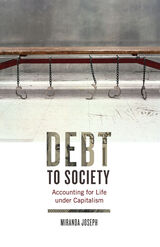
It is commonplace to say that criminals pay their debt to society by spending time in prison, but what is a “debt to society”? How is crime understood as a debt? How has time become the equivalent for crime? And how does criminal debt relate to the kind of debt held by consumers and university students?
In Debt to Society, Miranda Joseph explores modes of accounting as they are used to create, sustain, or transform social relations. Envisioning accounting broadly to include financial accounting, managerial accounting of costs and performance, and the calculation of “debts to society” owed by criminals, Joseph argues that accounting technologies have a powerful effect on social dynamics by attributing credits and debts. From sovereign bonds and securitized credit card debt to student debt and mortgages, there is no doubt that debt and accounting structure our lives.
Exploring central components of neoliberalism (and neoliberalism in crisis) from incarceration to personal finance and university management, Debt to Society exposes the uneven distribution of accountability within our society. Joseph demonstrates how ubiquitous the forces of accounting have become in shaping all aspects of our lives, proposing that we appropriate accounting and offer alternative accounts to turn the present toward a more widely shared well-being.
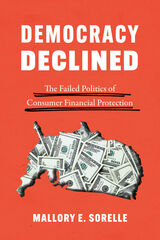
In Democracy Declined, Mallory E. SoRelle argues that the failure of federal policy makers to curb risky practices can be explained by the evolution of consumer finance policies aimed at encouraging easy credit in part by foregoing more stringent regulation. Furthermore, SoRelle explains how angry borrowers’ experiences with these policies teach them to focus their attention primarily on banks and lenders instead of demanding that lawmakers address predatory behavior. As a result, advocacy groups have been mostly unsuccessful in mobilizing borrowers in support of stronger consumer financial protections. The absence of safeguards on consumer financing is particularly dangerous because the consequences extend well beyond harm to individuals—they threaten the stability of entire economies. SoRelle identifies pathways to mitigate these potentially disastrous consequences through greater public participation.
To answer that question, the contributors to this book draw upon their deep backgrounds in finance, social science, art, and the humanities to create a new way of understanding derivative finance that does justice to its social and cultural dimensions. They offer a two-pronged analysis. First, they develop a social understanding of the derivative that casts it in the light of anthropological concepts such as the gift, ritual, play, dividuality, and performativity. Second, they develop a derivative understanding of the social, using financial concepts such as risk, hedging, optionality, and arbitrage to uncover new dimensions of contemporary social reality. In doing so, they construct a necessary, renewed vision of derivative finance as a deeply embedded aspect not just of our economics but our culture.
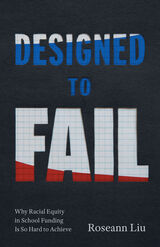
For people who care about urban school districts like Philadelphia’s, addressing the challenges that these schools face often boils down to the need for more money. But why are urban districts that serve Black and Brown students still so perennially underfunded compared to majority-white ones? Why is racial equity in school funding so hard to achieve?
In Designed to Fail, Roseann Liu provides an inside look at the Pennsylvania state legislature and campaigns for fair funding to show how those responsible for the distribution of school funding work to maintain the privileges of majority-white school districts. Liu analyzes how colorblind policies, political structures, and the maintenance of the status quo by people in power perpetuate wide and deepening racial disparities in education funding. Taking a lesson from community organizers fighting for a racially equitable school funding system, Liu’s work is a bold call to address structural racism at the root and organize from a place of abundant justice.

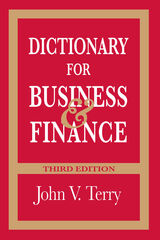
This revised and expanded edition of the Dictionary for Business & Finance defines terms from every field of business, as well as economics, statistics, and management and many words and expressions from other fields which have been adopted for special use by the business community. In this new edition, John V. Terry has added more than two hundred terms that help define the rapidly changing global economy of the late 1990s—terms like “European Currency Unit,” “Datsu-sara,” and “Keiretsu.” Of particular value to the student and business person alike are appendices for ratios, equations, formulas, abbreviations, and general financial and investment information.
In a clear, easy-to-follow style, Dictionary for Business & Finance goes directly to the business usage of a word or term, making it unnecessary to wade through irrelevant definitions.

As this volume suggests, the distributional consequences of these proposals are substantially different and may disproportionately affect those groups who depend on social security to avoid poverty in old age. Together, these studies persuasively show that appropriately designed investment-based social security reforms can effectively reduce the long-term burden of an aging society on future taxpayers, increase the expected future income of retirees, and mitigate poverty rates among the elderly.
READERS
Browse our collection.
PUBLISHERS
See BiblioVault's publisher services.
STUDENT SERVICES
Files for college accessibility offices.
RECENTLY PUBLISHED







UChicago Accessibility Resources
home | accessibility | search | about | contact us
BiblioVault ® 2001 - 2025
The University of Chicago Press