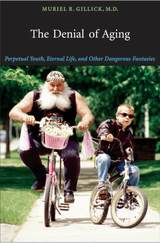
front cover of The Denial of Aging
The Denial of Aging
Perpetual Youth, Eternal Life, and Other Dangerous Fantasies
Muriel R. Gillick M.D.
Harvard University Press, 2006

You’ve argued politics with your aunt since high school, but failing eyesight now prevents her from keeping current with the newspaper. Your mother fractured her hip last year and is confined to a wheelchair. Your father has Alzheimer’s and only occasionally recognizes you. Someday, as Muriel Gillick points out in this important yet unsettling book, you too will be old. And no matter what vitamin regimen you’re on now, you will likely one day find yourself sick or frail. How do you prepare? What will you need?

With passion and compassion, Gillick chronicles the stories of elders who have struggled with housing options, with medical care decisions, and with finding meaning in life. Skillfully incorporating insights from medicine, health policy, and economics, she lays out action plans for individuals and for communities. In addition to doing all we can to maintain our health, we must vote and organize—for housing choices that consider autonomy as well as safety, for employment that utilizes the skills and wisdom of the elderly, and for better management of disability and chronic disease.

Most provocatively, Gillick argues against desperate attempts to cure the incurable. Care should focus on quality of life, not whether it can be prolonged at any cost. “A good old age,” writes Gillick, “is within our grasp.” But we must reach in the right direction.


[more]

logo for Rutgers University Press
Determined Survivors
Janice A. Smithers
Rutgers University Press, 1985

Community Life Among the Urban Elderly

[more]

front cover of Developments in the Economics of Aging
Developments in the Economics of Aging
Edited by David A. Wise
University of Chicago Press, 2009

The number of Americans eligible to receive Social Security benefits will increase from forty-five million to nearly eighty million in the next twenty years. Retirement systems must therefore adapt to meet the demands of the largest aging population in our nation’s history. In Developments in the Economics of Aging, David A. Wise and a distinguished group of analysts examine the economic issues that will confront policy makers as they seek to design policies to protect the economic and physical health of these older Americans.

The volume looks at such topics as factors influencing work and retirement decisions at older ages, changes in life satisfaction associated with retirement, and the shift in responsibility for managing retirement assets from professional money managers of traditional pension plans to individual account holders of 401(k)s. Developments in the Economics of Aging also addresses the complicated relationship between health and economic status, including why health behaviors vary across populations and how socioeconomic measures correlate with health outcomes.

[more]

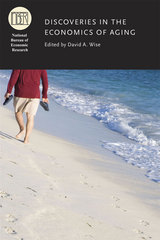
front cover of Discoveries in the Economics of Aging
Discoveries in the Economics of Aging
Edited by David A. Wise
University of Chicago Press, 2014
The oldest members of the Baby-Boomer generation are now crossing the threshold of eligibility for Social Security and Medicare with extensive and significant implications for these programs’ overall spending and fiscal sustainability. Yet the aging of the Baby Boomers is just one part of the rapidly changing landscape of aging in the United States and around the world.

The latest volume in the NBER’s Economics of Aging series, Discoveries in the Economics of Aging assembles incisive analyses of the most recent research in this expanding field of study. A substantive focus of the volume is the well-documented relationship between health and financial well-being, especially as people age. The contributors explore this issue from a variety of perspectives within the context of the changing demographic landscape. The first part of the volume explores recent trends in health measurement, including the use of alternative measurement indices. Later contributions explore, among other topics, alternate determinants of health, including retirement, marital status, and cohabitation with family, and the potential for innovations, interventions, and public policy to improve health and financial well-being.
[more]

front cover of Don't Send Me Flowers When I'm Dead
Don't Send Me Flowers When I'm Dead
Voices of Rural Elderly
Eva J. Salber
Duke University Press, 1983
"This extraordinary book is yet another example of a growing tradition—a literature of compelling and edifying oral history. Dr. Salber has worked for years in one of North Carolina's rural areas, and doing so, has come to know certain elderly people rather well. She has attended their physical complaints, but she has also wanted to know how they live, what they hope for, and what they worry about. She has asked them to speak on the record, to declare to others what occurs to them in the waning hours of their particular lives. The result is a series of American voices reminding us what it has been like for relatively vulnerable, if not defenseless, southern country folk in this rapidly disappearing 20th century.
"They are men and women, blacks and whites, Dr. Salber's teachers. The North Carolinians in this book have no trouble giving us a good measure of open-eyed social comment, not to mention intelligent self-scrutiny and astute moral reflection. These pages glow with all that. . . . This book represents an intense and unyielding ethical as well as medical and literary commitment by a most impressive physician."—Robert Coles
[more]


Send via email Share on Facebook Share on Twitter