logo for Duke University Press
Dance Cadaverous
Antiblackness of the Social World and Social Theory
Moon-Kie Jung and João H. Costa Vargas
Duke University Press, 2027
In Dance Cadaverous, Moon-Kie Jung and João H. Costa Vargas argue that the modern social world and modern social theory are foundationally antiblack. Antiblackness, the ontological exclusion inaugurated by racial slavery, persists while social theorists reproduce the exclusion, missing and misrecognizing this profoundly antisocial predicament at the heart of modernity. Across three historical moments—antebellum, Jim Crow, and contemporary—Jung and Vargas offer fundamental critiques of antiblackness, putting under scrutiny humanist and posthumanist social theories, science and technology studies, agency, genocide, racism, people-of-color intersectionality, and environmental justice. Drawing on radical Black study, freedom struggles, and jazz improvisation, they propose antisociology and abolitionist antipolitics as paths forward to provincialize and leave behind the modern social world.
[more]

front cover of Darwin's Conjecture
Darwin's Conjecture
The Search for General Principles of Social and Economic Evolution
Geoffrey M. Hodgson and Thorbjørn Knudsen
University of Chicago Press, 2010

Of paramount importance to the natural sciences, the principles of Darwinism, which involve variation, inheritance, and selection, are increasingly of interest to social scientists as well. But no one has provided a truly rigorous account of how the principles apply to the evolution of human society—until now.

In Darwin’s Conjecture, Geoffrey Hodgson and Thorbjørn Knudsen reveal how the British naturalist’s core concepts apply to a wide range of phenomena, including business practices, legal systems, technology, and even science itself. They also critique some prominent objections to applying Darwin to social science, arguing that ultimately Darwinism functions as a general theoretical framework for stimulating further inquiry. Social scientists who adopt a Darwinian approach, they contend, can then use it to frame and help develop new explanatory theories and predictive models.

This truly pathbreaking workat long last makes the powerful conceptual tools of Darwin available to the social sciences and will be welcomed by scholars and students from a range of disciplines.


[more]

logo for Assoc of College & Research Libraries
Databrarianship
The Academic Data Librarian in Theory and Practice
Lynda Kellam
Assoc of College & Research Libraries, 2016

front cover of The Death of Homo Economicus
The Death of Homo Economicus
Work, Debt and the Myth of Endless Accumulation
Peter Fleming
Pluto Press, 2017
For neoclassical economists, Homo economicus, or economic human, represents the ideal employee: an energetic worker bee that is a rational yet competitive decision-maker. Alternatively, one could view the concept as a cold and selfish workaholic endlessly seeking the accumulation of money and advancement—a chilling representation of capitalism. Or perhaps, as Peter Fleming argues, Homo economicus does not actually exist at all.
 
In The Death of Homo Economicus, Fleming presents this controversial claim with the same fierce logic and perception that launched his Guardian column into popularity. Fleming argues that as an invented model of a human being, Homo economicus is, in reality, a tool used by economists and capitalists to manage our social world through the state, business, and even family. As workers, we are barraged with constant reminders that we should always strive toward this ideal persona. It’s implied—and sometimes directly stated—that if we don’t then we are failures. Ironically, the people most often encouraged to emulate this model are those most predisposed to fail due to their socioeconomic circumstances: the poor, the unemployed, students, and prisoners.
 
Fleming illuminates why a peculiar proactive negativity now marks everyday life in capitalist societies, and he explores how this warped, unattainable model for workers would cause chaos if enacted to the letter. Timely and revelatory, The Death of Homo Economicus offers a sharp, scathing critique of who we are supposed to be in the workplace and beyond.

 
[more]

front cover of Deberlinization
Deberlinization
Refabulating the World, a Theory of Praxis
Edited by Bonaventure Soh Bejeng Ndikung, Ibou Coulibaly Diop, and Franck Hermann Ekra
Diaphanes, 2025
A multidisciplinary volume reflecting on the epistemological legacy of the colonial partitioning of Africa.

In 1884, the Chancellor of the German Empire, Otto von Bismarck, convened a conference in Berlin to organize the division of the African continent among the industrial and military powers of the time. The result was a profound dismemberment of Africa’s original political structures, which, driven by nationalism and a barbaric ethos of rule, had a lasting impact on the continent’s political, socioeconomic, cultural, and spiritual development. One hundred and forty years after the Berlin Conference, it seems more than urgent to disentangle this complex of colonial appropriation, identify its after-effects, and question its epistemological legacy—all the more so as Europe searches for a new positioning in the changing geopolitical balance of power.

This multidisciplinary anthology takes up the idea of a transnational performative utopia to explore the possibilities of refabulating the world order and its future. Between creative action and resistance, memory and foresight, Deberlinization opens up perspectives on trans-African cohesion and outlines a new poetics of sovereignty.
 
[more]

front cover of Development Theory and the Economics of Growth
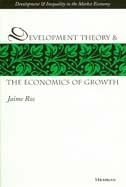
Development Theory and the Economics of Growth
Jaime Ros
University of Michigan Press, 2000
Why are some countries richer than others? Why do some economies grow so much faster than others do? Do economies tend to converge at similar levels of per capita income? Or is catching up simply impossible? These questions have vast implications for human welfare. After a period of lack of interest in growth theory, they are back on the research agenda of mainstream economics. They have also been at the heart of development economics since its inception some decades ago. This book endeavors to answer such questions by blending classical contributions to development theory with recent developments in the economics of growth.
The unifying theme is that early theoretical insights and accumulated empirical knowledge of development economics have much to offer to research in the theory and empirics of economic growth. With the help of a number of recent contributions, the ideas and insights of the classical literature in development economics can be given simple and rigorous formulations. Together, they amount to an approach to growth theory that can overcome the long-recognized empirical shortcomings of neoclassical growth economics, while being free from the objections that can be raised against the new brand of endogenous growth theory.
In addition to an original thesis on the contribution that early development theory can make to the research program of modern growth economics, the book provides professional and research economists and graduate students with an evaluation of the strengths and limitations of the different strands of inquiry in the modern economics of growth. In addition it presents findings on comparative growth performance across countries.
Jaime Ros is Professor of Economics and Faculty Fellow of the Helen Kellogg Institute of International Studies, University of Notre Dame.
[more]

front cover of Dialogue Across Difference
Dialogue Across Difference
Practice, Theory, and Research on Intergroup Dialogue
Patricia Gurin
Russell Sage Foundation, 2013
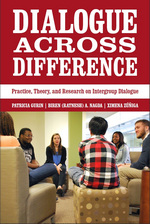
Due to continuing immigration and increasing racial and ethnic inclusiveness, higher education institutions in the United States are likely to grow ever more diverse in the 21st century. This shift holds both promise and peril: Increased inter-ethnic contact could lead to a more fruitful learning environment that encourages collaboration. On the other hand, social identity and on-campus diversity remain hotly contested issues that often raise intergroup tensions and inhibit discussion. How can we help diverse students learn from each other and gain the competencies they will need in an increasingly multicultural America? Dialogue Across Difference synthesizes three years’ worth of research from an innovative field experiment focused on improving intergroup understanding, relationships and collaboration. The result is a fascinating study of the potential of intergroup dialogue to improve relations across race and gender. First developed in the late 1980s, intergroup dialogues bring together an equal number of students from two different groups – such as people of color and white people, or women and men – to share their perspectives and learn from each other. To test the possible impact of such courses and to develop a standard of best practice, the authors of Dialogue Across Difference incorporated various theories of social psychology, higher education, communication studies and social work to design and implement a uniform curriculum in nine universities across the country. Unlike most studies on intergroup dialogue, this project employed random assignment to enroll more than 1,450 students in experimental and control groups, including in 26 dialogue courses and control groups on race and gender each. Students admitted to the dialogue courses learned about racial and gender inequalities through readings, role-play activities and personal reflections. The authors tracked students’ progress using a mixed-method approach, including longitudinal surveys, content analyses of student papers, interviews of students, and videotapes of sessions. The results are heartening: Over the course of a term, students who participated in intergroup dialogues developed more insight into how members of other groups perceive the world. They also became more thoughtful about the structural underpinnings of inequality, increased their motivation to bridge differences and intergroup empathy, and placed a greater value on diversity and collaborative action. The authors also note that the effects of such courses were evident on nearly all measures. While students did report an initial increase in negative emotions – a possible indication of the difficulty of openly addressing race and gender – that effect was no longer present a year after the course. Overall, the results are remarkably consistent and point to an optimistic conclusion: intergroup dialogue is more than mere talk. It fosters productive communication about and across differences in the service of greater collaboration for equity and justice. Ambitious and timely, Dialogue Across Difference presents a persuasive practical, theoretical and empirical account of the benefits of intergroup dialogue. The data and research presented in this volume offer a useful model for improving relations among different groups not just in the college setting but in the United States as well.
[more]

front cover of Digital Rhetoric
Digital Rhetoric
Theory, Method, Practice
Douglas Eyman
University of Michigan Press, 2015
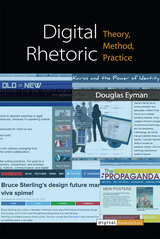
What is “digital rhetoric”? This book aims to answer that question by looking at a number of interrelated histories, as well as evaluating a wide range of methods and practices from fields in the humanities, social sciences, and information sciences to determine what might constitute the work and the world of digital rhetoric. The advent of digital and networked communication technologies prompts renewed interest in basic questions such as What counts as a text? and Can traditional rhetoric operate in digital spheres or will it need to be revised? Or will we need to invent new rhetorical practices altogether?

Through examples and consideration of digital rhetoric theories, methods for both researching and making in digital rhetoric fields, and examples of digital rhetoric pedagogy, scholarship, and public performance, this book delivers a broad overview of digital rhetoric. In addition, Douglas Eyman provides historical context by investigating the histories and boundaries that arise from mapping this emerging field and by focusing on the theories that have been taken up and revised by digital rhetoric scholars and practitioners. Both traditional and new methods are examined for the tools they provide that can be used to both study digital rhetoric and to potentially make new forms that draw on digital rhetoric for their persuasive power.

[more]

logo for Intellect Books
Digital Visual Culture
Theory and Practice
Edited by Anna Bentkowska-Kafel, Trish Cashen, Hazel Gardiner
Intellect Books, 2009

Digital Visual Culture presents the latest research into the relationship between theory and practice across digital media and technology in the visual arts and investigates the challenges of contemporary research and art curation, particularly in regard to new media artworks. The contributors to this volume discuss the impact of technological advances on visual art and the new art practices that are developing as a result. Many aspects of new interdisciplinary and collaborative practices are considered, such as net art and global locative environments, , and installations that are themselves performance, or games that often take place simultaneously online and in reality. Digital Visual Culture is an important addition to the ongoing discussion surrounding postmodern art practice in art and digital media.
[more]

front cover of The Dignity of Commerce
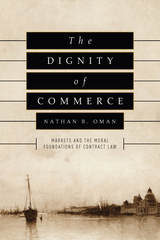
The Dignity of Commerce
Markets and the Moral Foundations of Contract Law
Nathan B. Oman
University of Chicago Press, 2016
Why should the law care about enforcing contracts? We tend to think of a contract as the legal embodiment of a moral obligation to keep a promise. When two parties enter into a transaction, they are obligated as moral beings to play out the transaction in the way that both parties expect. But this overlooks a broader understanding of the moral possibilities of the market. Just as Shakespeare’s Shylock can stand on his contract with Antonio not because Antonio is bound by honor but because the enforcement of contracts is seen as important to maintaining a kind of social arrangement, today’s contracts serve a fundamental role in the functioning of society.

With The Dignity of Commerce, Nathan B. Oman argues persuasively that well-functioning markets are morally desirable in and of themselves and thus a fit object of protection through contract law. Markets, Oman shows, are about more than simple economic efficiency. To do business with others, we must demonstrate understanding of and satisfy their needs. This ability to see the world from another’s point of view inculcates key virtues that support a liberal society. Markets also provide a context in which people can peacefully cooperate in the absence of political, religious, or ideological agreement. Finally, the material prosperity generated by commerce has an ameliorative effect on a host of social ills, from racial discrimination to environmental destruction.

The first book to place the moral status of the market at the center of the justification for contract law, The Dignity of Commerce is sure to elicit serious discussion about this central area of legal studies.

 
[more]

front cover of Doing What Comes Naturally
Doing What Comes Naturally
Change, Rhetoric, and the Practice of Theory in Literary & Legal Studies
Stanley Fish
Duke University Press, 1989
In literary theory, the philosophy of law, and the sociology of knowledge, no issue has been more central to current debate than the status of our interpretations. Do they rest on a ground of rationality or are they subjective impositions of a merely personal point of view? In Doing What Comes Naturally, Stanley Fish refuses the dilemma posed by this question and argues that while we can never separate our judgments from the contexts in which they are made, those judgments are nevertheless authoritative and even, in the only way that matters, objective. He thus rejects both the demand for an ahistorical foundation, and the conclusion that in the absence of such a foundation we reside in an indeterminate world. In a succession of provocative and wide-ranging chapters, Fish explores the implications of his position for our understanding of legal, literary, and psychoanalytic interpretation, the nature of professional and institutional culture, and the place of reason in a world that is rhetorical through and through.
[more]

logo for Intellect Books
Drive in Cinema
Essays on Film, Theory and Politics
Marc James Léger
Intellect Books, 2015
In Drive in Cinema, Marc James Léger presents Žižek-influenced studies of films made by some of the most influential filmmakers of our time, including Jean-Luc Godard, Pier Paolo Pasolini, Werner Herzog, Alexander Kluge, William Klein, Jim Jarmusch, Hal Hartley, Harmony Korine, and more. Working with radical theory and Lacanian ethics, Léger draws surprising connections between art, film, and politics, taking his analysis beyond the academic obsession with cultural representation and filmic technique and instead revealing film’s potential as an emancipatory force.
[more]

front cover of Dynamism and Its Enemies
Dynamism and Its Enemies
Proceedings from the 2024 Austin Symposium
Edited by Ryan Streeter
University of Texas Press, 2025

Papers presented and discussed at the inaugural Civitas symposium on economic dynamism.

If we want more people in more places building and creating more good things, what should we do? This volume, edited by Ryan Streeter, presents perspectives on key issues of economic and societal dynamism by Ryan Decker (Federal Reserve), Ed Glaeser (Harvard University), Deirdre McCloskey (University of Illinois at Chicago), Edmund Phelps (Columbia University), Dan Shoag (Case Western Reserve University), and Cass Sunstein (Harvard Law School).

The chapters in Dynamism and Its Enemies began as presentations at the 2024 Austin Symposium, a one-day seminar on dynamism in America hosted by the Civitas Institute at the University of Texas at Austin. This first annual event, held in one of America’s most dynamic cities, was designed to bring various leading scholars of dynamism’s various aspects into one place in order to think together about how to foster a more dynamic future.
[more]

front cover of The Dysfunctional Workplace
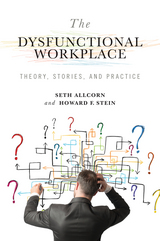
The Dysfunctional Workplace
Theory, Stories, and Practice
Seth Allcorn and Howard F. Stein
University of Missouri Press, 2015

This book explores an aspect of organizational life that is at times difficult to acknowledge and often painful to recall. Stories invite reflection and the development of greater understanding of organizational dynamics. This fresh scholarship provides a theoretical framework for discussion. Throughout this book, Allcorn and Stein utilize a psychoanalytically informed perspective to help readers understand why a leader, colleague or friend behaves in ways that are destructive of others and the organization and provides a basis for organizations to survive and thrive in a dysfunctional workplace.

[more]


Send via email Share on Facebook Share on Twitter