
 A SCHOLARLY BOOK REPOSITORY
138 start with E start with E
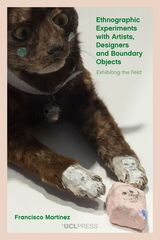
Richly illustrated, Ethnographic Experiments with Artists, Designers and Boundary Objects reflects on the experimental skills and practices shared by ethnographers and curators. Francisco Martínez highlights relationships between contemporary art, design, and anthropology and imagines creative ways to develop new infrastructure that supports vital interdisciplinary work. Attentive to the experimental nature of exhibitions, Martínez models a new approach to both ethnography and objecthood across disciplinary boundaries.
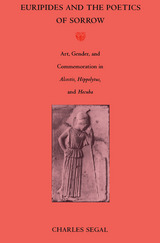
Alcestis, Hippolytus, and Hecuba, the three early plays interpreted here, are linked by common themes of violence, death, lamentation and mourning, and by their implicit definitions of male and female roles. Segal shows how these plays draw on ancient traditions of poetic and ritual commemoration, particularly epic song, and at the same time refashion these traditions into new forms. In place of the epic muse of martial glory, Euripides, Segal argues, evokes a muse of sorrows who transforms the suffering of individuals into a "common grief for all the citizens," a community of shared feeling in the theater.
Like his predecessors in tragedy, Euripides believes death, more than any other event, exposes the deepest truth of human nature. Segal examines the revealing final moments in Alcestis, Hippolytus, and Hecuba, and discusses the playwright's use of these deaths--especially those of women--to question traditional values and the familiar definitions of male heroism. Focusing on gender, the affective dimension of tragedy, and ritual mourning and commemoration, Segal develops and extends his earlier work on Greek drama. The result deepens our understanding of Euripides' art and of tragedy itself.

Europe and Love in Cinema explores the relationship between love and Europeanness in a wide range of films from the 1920s to the present. A critical look at the manner in which love—in its broadest sense—is portrayed in cinema from across Europe and the United States, this volume exposes constructed notions of "Europeanness" that both set Europe apart and define some parts of it as more "European" than others. Through the international distribution process, these films in turn engage with ideas of Europe from both outside and within, while some, treated extensively in this volume, even offer alternative models of love. A bracing collection of essays from top film scholars, Europe and Love in Cinema demonstrates the centrality of desire to film narrative and explores multiple models of love within Europe's frontiers.

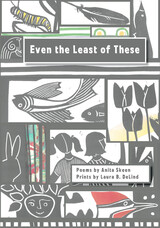

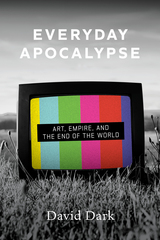
This revised edition of the book includes a foreword by Hanif Abdurraqib, an extensive afterword, updates in light of the passage of time since its publication, and new insights from the author, whose outspokenness has placed him outside of circles in which he was once supported and celebrated.
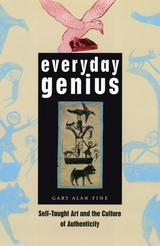
Fine considers the differences among folk art, outsider art, and self-taught art, explaining the economics of this distinctive art market and exploring the dimensions of its artistic production and distribution. Interviewing dealers, collectors, curators, and critics and venturing into the backwoods and inner-city homes of numerous self-taught artists, Fine describes how authenticity is central to the system in which artists—often poor, elderly, members of a minority group, or mentally ill—are seen as having an unfettered form of expression highly valued in the art world. Respected dealers, he shows, have a hand in burnishing biographies of the artists, and both dealers and collectors trade in identities as much as objects.
Revealing the inner workings of an elaborate and prestigious world in which money, personalities, and values affect one another, Fine speaks eloquently to both experts and general readers, and provides rare access to a world of creative invention-both by self-taught artists and by those who profit from their work.
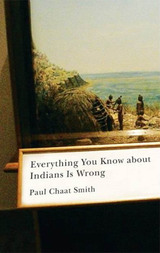
Raised in suburban Maryland and Oklahoma, Smith dove head first into the political radicalism of the 1970s, working with the American Indian Movement until it dissolved into dysfunction and infighting. Afterward he lived in New York, the city of choice for political exiles, and eventually arrived in Washington, D.C., at the newly minted National Museum of the American Indian (“a bad idea whose time has come”) as a curator. In his journey from fighting activist to federal employee, Smith tells us he has discovered at least two things: there is no one true representation of the American Indian experience, and even the best of intentions sometimes ends in catastrophe. Everything You Know about Indians Is Wrong is a highly entertaining and, at times, searing critique of the deeply disputed role of American Indians in the United States. In “A Place Called Irony,” Smith whizzes through his early life, showing us the ironic pop culture signposts that marked this Native American’s coming of age in suburbia: “We would order Chinese food and slap a favorite video into the machine—the Grammy Awards or a Reagan press conference—and argue about Cyndi Lauper or who should coach the Knicks.” In “Lost in Translation,” Smith explores why American Indians are so often misunderstood and misrepresented in today’s media: “We’re lousy television.” In “Every Picture Tells a Story,” Smith remembers his Comanche grandfather as he muses on the images of American Indians as “a half-remembered presence, both comforting and dangerous, lurking just below the surface.”
Smith walks this tightrope between comforting and dangerous, offering unrepentant skepticism and, ultimately, empathy. “This book is called Everything You Know about Indians Is Wrong, but it’s a book title, folks, not to be taken literally. Of course I don’t mean everything, just most things. And ‘you’ really means we, as in all of us.”

Evil by Design documents the search for the origins of the iconic “femme fatale.” Depicted as a dangerous, depraved, and deadly woman, this image was found frequently in Salon paintings from 1885 to 1910.
Elizabeth K. Menon’s study is the first to use popular sources to make the critical link between the femme fatale and the rise of feminism. In addition to the Salon paintings, Menon sifts through a variety of popular sources, including French illustrated journals, literature, posters, and decorative arts. Over 120 images depict women with serpents, evil flowers, and even miniature men having their hearts cooked. She argues that the evolution of the femme fatale, with both literary and visual links to the biblical Eve figure, came as a response to increasing feminism and the desire by men to halt its spread.
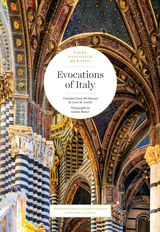
In 1907, Pavel Muratov, a budding littérateur and art connoisseur from Moscow, set off for Italy with his wife, three friends, and a dozen books on the Italian Renaissance. This journey, the first of over a dozen he would make in a decade, inspired an obsession with the country’s art and culture that would produce, in the words of Clive James, “one of the most dazzling books of its type ever written.” First published in Russian between 1911 and 1924, Evocations of Italy(Obrazy Italii) chronicles Muratov’s encounters with the art, myth, and land of Italy. A classic of the Silver Age, it built on the tradition of Italian travelogues by Goethe, Stendhal, John Ruskin, and Henry James and defined the idea of Italy for generations of Russian artists and writers. Finally available in English, this three-volume collector's edition illuminates the personalities, conditions, and dreams that gave us the Italian Renaissance. At once intimate and authoritative, and here richly illustrated with photographs that echo Muratov’s shimmering juxtapositions of image and sensation, Evocations of Italy is as timely and compelling a guide today as it was a hundred years ago.
The contributors to this comparative study examine ex votos across a range of locations and time periods, including the classical Mediterranean world, medieval Europe, the period of the Catholic Reform, and on to Mexico, Shinto and Buddhist Japan, and Muslim Iran. Voluminous and diverse, Ex Voto will appeal in a wide range of fields, including history, religion, and anthropology.
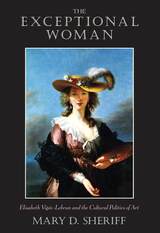
In The Exceptional Woman, Mary D. Sheriff uses Vigée-Lebrun's career to explore the contradictory position of "woman-artist" in the moral, philosophical, professional, and medical debates about women in eighteenth-century France. Paying particular attention to painted and textual self-portraits, Sheriff shows how Vigée-Lebrun's images and memoirs undermined the assumptions about "woman" and the strictures imposed on women.
Engaging ancien-régime philosophy, as well as modern feminism, psychoanalysis, literary theory, and art criticism, Sheriff's interpretations of Vigée-Lebrun's paintings challenge us to rethink the work and the world of this controversial woman artist.
Today, nearly any group or nation with violence in its past has constructed or is planning a memorial museum as a mechanism for confronting past trauma, often together with truth commissions, trials, and/or other symbolic or material reparations. Exhibiting Atrocity documents the emergence of the memorial museum as a new cultural form of commemoration, and analyzes its use in efforts to come to terms with past political violence and to promote democracy and human rights.
Through a global comparative approach, Amy Sodaro uses in-depth case studies of five exemplary memorial museums that commemorate a range of violent pasts and allow for a chronological and global examination of the trend: the U.S. Holocaust Memorial Museum in Washington, DC; the House of Terror in Budapest, Hungary; the Kigali Genocide Memorial Centre in Rwanda; the Museum of Memory and Human Rights in Santiago, Chile; and the National September 11 Memorial Museum in New York. Together, these case studies illustrate the historical emergence and global spread of the memorial museum and show how this new cultural form of commemoration is intended to be used in contemporary societies around the world.
Download open access ebook.
In Exhibiting Blackness, art historian Bridget R. Cooks analyzes the curatorial strategies, challenges, and critical receptions of the most significant museum exhibitions of African American art. Tracing two dominant methodologies used to exhibit art by African Americans—an ethnographic approach that focuses more on artists than their art, and a recovery narrative aimed at correcting past omissions—Cooks exposes the issues involved in exhibiting cultural difference that continue to challenge art history, historiography, and American museum exhibition practices. By further examining the unequal and often contested relationship between African American artists, curators, and visitors, she provides insight into the complex role of art museums and their accountability to the cultures they represent.

András Koerner is the author of a number of critically acclaimed, award-winning CEU Press titles on the cultural history of Hungarian Jews and Jewish cuisine. This volume continues that tradition by discussing the phenomenon of exhibits on Jewish culinary culture in museums and galleries around the world.
The first part of the book provides an overview of the cultural history of "foodism" and the proliferation of Jewish museums. In addition, it examines the role of cuisine in Jewish identity. It offers an analysis of the history and recent examples of exhibitions on Jewish culinary culture, a subject that has not received scholarly attention until now.
The second part complements this by offering a detailed case study of the book’s subject. It showcases a 2022 exhibition in Budapest on the History of Hungarian Jewish Culinary Culture. András Koerner was the co-curator of the show, thus he is able to offer an insider’s account of its implementation – concept, scope, goals, audience, and design. He also openly discusses the compromises made and mistakes committed in the exhibition’s preparatory work.
This subjective account, quite different from the dry objectivity of catalogues, offers an unusual, behind-the-scenes look at how a complex exhibition like this is prepared. At the same time, the book’s appendix includes images of the display boards and some of the exhibited objects – thus it can also stand for a valuable ex-post catalogue.
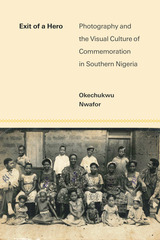
In Exit of a Hero, Okechukwu Nwafor explores the cultural, political, and socioeconomic implications of photography in commemorative practices in southern Nigeria from the nineteenth century to the present. Focusing on obituary and commemorative photographs of late nineteenth and early twentieth-century Lagos to contemporary funeral posters, booklets, and social media posts, Nwafor tracks the historical evolution of the iconic and heroic image. He argues that the quest to produce an ideal memorial body is not just a personal aesthetic choice but a deliberate photographic project that resonates with the Igbo aspirations for heroic achievement.
Exit of a Hero asserts that the visual canonization transforms the deceased from a fallible being to an unimpeachable character who transcends underachievement, imperfection, and failed social performance to emerge as a saintly icon of the Igbo public sphere. In seeking an alternative, hyper-visible public self, social media reclaims the lost hero image of the deceased, reconstituting the contested Igbo public space as a lived reality where heroes and icons are actively and eternally commemorated. Nwafor unveils the creative imaginations of colonial subjects and postcolonial citizens as memorialization has become entangled within the intersecting discursive spaces of print culture and the public sphere.
The fourth volume in the Terra Foundation Essays series, Experience considers the possibility of immediacy, or the idea that we can directly relate to the past by way of an artifact or work of art. Without discounting the matrix of codes involved in both the production and reception of art, contributors to Experience emphasize the sensibility of the interpreter; the techniques of art historical writing, including its affinity with fiction and its powers of description; the emotional charge—the punctum—that certain representations can deliver. These and other topics are examined through seven essays, addressing different periods in American art.

In the years of rapid economic growth following the protest movements of the 1960s, artists and intellectuals in Japan searched for a means of direct impact on the whirlwind of historical and cultural transformations of their time. Yet while the artists often called for such “direct” encounter, their works complicate this ideal with practices of interruption, self-reflexive mimesis, and temporal discontinuity. In an era known for idealism and activism, some of the most cherished ideals—intimacy between subjects, authenticity, a sense of home—are limitlessly desired yet always just out of reach.
In this book, Miryam Sas explores the theoretical and cultural implications of experimental arts in a range of media. Casting light on important moments in the arts from the 1960s to the early 1980s, this study focuses first on underground (post-shingeki) theater and then on related works of experimental film and video, buto dance, and photography. Emphasizing the complex and sophisticated theoretical grounding of these artists through their works, practices, and writings, this book also locates Japanese experimental arts in an extensive, sustained dialogue with key issues of contemporary critical theory.
A compelling study of unofficial postwar Soviet art, The Experimental Group takes as its point of departure a subject of strange fascination: the life and work of renowned professional illustrator and conceptual artist Ilya Kabakov.
Kabakov’s art—iconoclastic installations, paintings, illustrations, and texts—delicately experiments with such issues as history, mortality, and disappearance, and here exemplifies a much larger narrative about the work of the artists who rose to prominence just as the Soviet Union began to disintegrate. By placing Kabakov and his conceptualist peers in line with our own contemporary perspective, Matthew Jesse Jackson suggests that the art that emerged in the wake of Stalin belongs neither entirely to its lost communist past nor to a future free from socialist nostalgia. Instead, these artists and their work produced a critical and controversial chapter in the as yet unwritten history of global contemporary art.
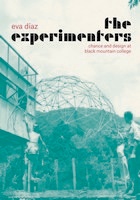
Díaz’s focus is on experimentation. Albers, Cage, and Fuller, she shows, taught new models of art making that favored testing procedures rather than personal expression. These methodologies represented incipient directions for postwar art practice, elements of which would be sampled, and often wholly adopted, by Black Mountain students and subsequent practitioners. The resulting works, which interrelate art and life in a way that imbues these projects with crucial relevance, not only reconfigured the relationships among chance, order, and design—they helped redefine what artistic practice was, and could be, for future generations.
Offering a bold, compelling new angle on some of the most widely studied creative figures of modern times, The Experimenters does nothing less than rewrite the story of art in the mid-twentieth century.
In Experimenting the Human, G Douglas Barrett argues that experimental music speaks to the contemporary posthuman, a condition in which science and technology decenter human agency amid the uneven temporality of postwar global capitalism. Time moves forward for some during this period, while it seems to stand still or even move backward for others. Some say we’re already posthuman, while others endure the extended consequences of never having been considered fully human in the first place. Experimental music reflects on this state, Barrett contends, through its interdisciplinary involvements in postwar science, technology, and art movements.
Rather than pursuing the human's beyond, experimental music addresses the social and technological conditions that support such a pursuit. Barrett locates this tendency of experimentalism throughout its historical entanglements with cybernetics, and in his intimate analysis of Alvin Lucier’s neurofeedback music, Pamela Z’s BodySynth performances, Nam June Paik’s musical robotics, Pauline Oliveros’s experiments with radio astronomy, and work by Laetitia Sonami, Yasunao Tone, and Jerry Hunt. Through a unique meeting of music studies, media theory, and art history, Experimenting the Human provides fresh insights into what it means to be human.
In Austin, Texas, in 2002, a group of artists, activists, and academics led by performance studies scholar Omi Osun Joni L. Jones formed the Austin Project (tAP), which meets annually in order to provide a space for women of color and their allies to build relationships based on trust, creativity, and commitment to social justice by working together to write and perform work in the jazz aesthetic.
Inspired by this experience, this book is both an anthology of new writing and a sourcebook for those who would like to use creative writing and performance to energize their artistic, scholarly, and activist practices. Theoretical and historical essays by Omi Osun Joni L. Jones describe and define the African American tradition of art-making known as the jazz aesthetic, and explain how her own work in this tradition inspired her to start tAP.
Key artists in the tradition, from Bessie Award–winning choreographer Laurie Carlos and writer/performer Robbie McCauley to playwrights Daniel Alexander Jones and Carl Hancock Rux, worked with the women of tAP as mentors and teachers. This book brings together never-before-published, must-read materials by these nationally known artists and the transformative writing of tAP participants. A handbook for workshop leaders by Lambda Literary Award–winning writer Sharon Bridgforth, tAP's inaugural anchor artist, offers readers the tools for starting similar projects in their own communities. A full-length script of the 2005 tAP performance is an original documentation of the collaborative, breath-based, body work of the jazz aesthetic in theatre, and provides both a script for use by theatre artists and an invaluable documentation of a major transformative movement in contemporary performance.
Jones explores the human impulse to create, the necessity for having aesthetically satisfying experiences, and the craving for tradition. He also considers topics such as making chairs, remodeling houses, using and preserving soda-fountain slang, preparing and eating food, and sculpting lifelike figures out of cement.
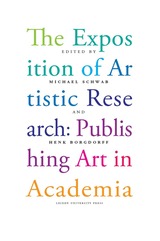
The Exposition of Artistic Research: Publishing Art in Academia introduces the pioneering concept of ‘expositions’ in the context of art and design research, where practice needs to be exposed as research to enter academic discourse. It brings together reflective and methodological approaches to exposition writing from a variety of artistic disciplines including fine art, music and design, which it links to questions of publication and the use of technology. The book proposes a novel relationship to knowledge, where the form in which this knowledge emerges and the mode in which it is communicated makes a difference to what is known.
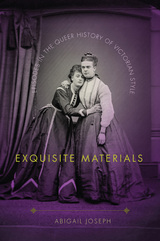
Published by University of Delaware Press. Distributed worldwide by Rutgers University Press.
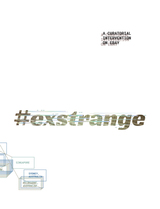
Over 80 contemporary artists and designers created “artworks as auctions” for #exstrange between January 15 and April 15, 2017, each using the elements of the auction listing—descriptive text, images, pricing, and categories—as tools of production.
Works include artist Lucy Pawlak’s collaboration with the Beat Officer to sell a series of clay objects as missing evidence from unexplained events in Mexico; IOCOSE’s sale of instant protests in the category “Specialty Services” where buyers chose the protest mantras, and outsourced performers demonstrated; and Susanne Cockrell & Ted Purves’ offering of a stick-gun with the memory of their son’s play in “Entertainment Memorabilia.”
Featured artists:
10.000 • Lanfranco Aceti • AILADI • Aysha Al Moayyed • Nasser Alzayani • Mary Ayling • Georgia Banks • Ann Bartges • Yogesh Barve • Kim Beck • Ajit Bhadoriya • Natalie Boterman • Sophia Brueckner • Carmel Buckley • Renee Carmichael • Alessio Chierico • Mia Cinelli • Susanne Cockrell • ConnX • Da Burn Gallery • Julia del Río • Tyler Denmead • César Escudero • Nihaal Faizal • FICTILIS • Eryn Foster • John D. Freyer • Elisa Giardina Papa • Angela Glanzmann • Maximilian Goldfarb • Archana Hande • Abhishek Hazra • Adam Hewins • Megan Hildebrandt • Joey Holder • Masimba Hwati • Regin Igloria • IOCOSE • JODI • Geraldine Juárez • KairUs Art+Research • Katerina Kamprani • Kamilia Kard • Tara Kelton • Matt Kenyon • Stephanie LaFreniere • Eno Laget • Nicolás Lamas • Martin Lang • Taekyeom Lee • LEXX Exhibitor Space • Lloyd Corporation • Silvio Lorusso • Breda Lynch • Garrett Lynch • Eva and Franco Mattes • Kembrew McLeod • Kathleen Meaney • Maria Miranda • Crisia Miroiu • Joana Moll • Martín Nadal • Norie Neumark • Xi Jie Ng • Maeve O'Neill • Chiara Passa • Lucy Pawlak • Sreshta Rit Premnath • Niko Princen • Ted Purves • Renuka Rajiv • Luis Romero • Armando Rosales • Robert Sakrowski • Alessandro Sambini • Sarah Ancelle Schönfeld • Anke Schüttler • Guido Segni • Chinar Shah • Jenine Sharabi • Yastika Prakash Shetty • Anupam Singh • Gagan Singh • Ishan Srivstava • Isabella Streffen • Surabhi Vaya • Wang Yue • Wu Jiaru • Yashaswini • Laura Yuile • Carlo Zanni • Huaqian Zhang
Guest curators:
Latifa Al Khalifa • Bani Brusadin • Peter Dykhuis • Fred Feinberg & Lu Zhang • Harrell Fletcher • Tamara Ibarra • João Laia • Nora O Murchú • Domenico Quaranta • Gaia Tedone • TSAO Yidi

Contributors. Elissa Auther, Anthea Black, Betty Bright, Nicole Burisch, Maria Elena Buszek, Jo Dahn, M. Anna Fariello, Betsy Greer, Andrew Jackson, Janis Jefferies, Louise Mazanti, Paula Owen, Karin E. Peterson, Lacey Jane Roberts, Kirsty Robertson, Dennis Stevens, Margaret Wertheim
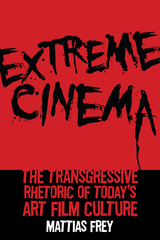
From Shortbus to Shame and from Oldboy to Irreversible, film festival premieres regularly make international headlines for their shockingly graphic depictions of sex and violence. Film critics and scholars alike often regard these movies as the work of visionary auteurs, hailing directors like Michael Haneke and Lars von Trier as heirs to a tradition of transgressive art. In this provocative new book, Mattias Frey offers a very different perspective on these films, exposing how they are also calculated products, designed to achieve global notoriety in a competitive marketplace.
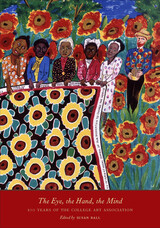
The Eye, the Hand, the Mind is a collaborative journey, filled with pictorial mementoes and enlivening stories and anecdotes. Its pages unfold along a path-an architectural framework-that connects the organization's sixteen goals and tells its rich, sometimes controversial, story. Readers will discover the important role the CAA played in major issues in higher education such as curriculum development, preservation of world monuments, workforce issues and market equity, intellectual property and free speech, capturing conflicts and reconciliations inherent among artists and art historians, pedagogical approaches and critical interpretations/interventions as played out in association publications, annual conferences, advocacy efforts, and governance.
Celebrating the centennial of CAA members and milestones, Susan Ball and renowned contributors honor the organization's complex history which, in part, also represents many learned societies and the humanities over the last one hundred years.
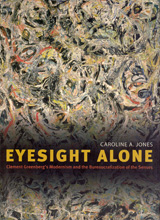
Caroline Jones's magisterial study widens Greenberg's fundamental tenet of "opticality"-the idea that modernist art is apprehended through "eyesight alone"-to a broader arena, examining how the critic's emphasis on the specular resonated with a society increasingly invested in positivist approaches to the world. Greenberg's modernist discourse, Jones argues, developed in relation to the rationalized procedures that gained wide currency in the United States at midcentury, in fields ranging from the sense-data protocols theorized by scientific philosophy to the development of cultural forms, such as hi-fi, that targeted specific senses, one by one. Greenberg's attempt to isolate and celebrate the visual was one manifestation of a large-scale segmentation-or bureaucratization-of the body's senses. Working through these historical developments, Jones brings Greenberg's theories into contemporary philosophical debates about agency and subjectivity.
Eyesight Alone offers artists, art historians, philosophers, and all those interested in the arts a critical history of this generative figure, bringing his work fully into dialogue with the ideas that shape contemporary critical discourse and shedding light not only on Clement Greenberg but also on the contested history of modernism itself.
READERS
Browse our collection.
PUBLISHERS
See BiblioVault's publisher services.
STUDENT SERVICES
Files for college accessibility offices.
RECENTLY PUBLISHED


UChicago Accessibility Resources
home | accessibility | search | about | contact us
BiblioVault ® 2001 - 2026
The University of Chicago Press