
 A SCHOLARLY BOOK REPOSITORY
109 start with E start with E
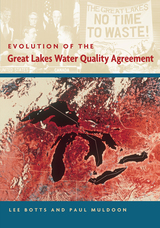
Water quality concerns are not new to the Great Lakes. They emerged early in the 20th century, in 1909, and matured in 1972 and 1978. They remain a prominent part of today’s conflicted politics and advancing industrial growth. The Great Lakes Water Quality Agreement, under the Boundary Waters Treaty of 1909, became a model to the world for environmental management across an international boundary. Evolution of the Great Lakes Water Quality Agreement recounts this historic binational relationship, an agreement intended to protect the fragile Great Lakes.
One strength of the agreement is its flexibility, which includes a requirement for periodic review that allows modification as problems are solved, conditions change, or scientific research reveals new problems. The first progress was made in the 1970s in the area of eutrophication, the process by which lakes gradually age, which normally takes thousands of years to progress, but is accelerated by modern water pollution. The binational agreement led to the successful lowering of phosphorus levels that saved Lake Erie and prevented accelerated eutrophication in the rest of the Great Lakes ecosystem. Another major success at the time was the identification and lowering of the levels of toxic contaminants that cause major threats to human and wildlife health, from accumulating PCBs and other persistent organic pollutants

"Excellence for all" might, at first glance, appear to be nothing more than a rhetorical flourish. Who, after all, would oppose the idea of a great education for every student? Yet it is hardly a throwaway phrase. Rather, it represents a surprising fusion of educational policy approaches that had been in tense opposition throughout the twentieth centurythose on the right favoring social efficiency, and those on the left supporting social justice.
This book seeks to understand why the "excellence for all" vision took hold at the time it did, unpacks the particular beliefs and assumptions embedded in it, and details the often informal coalition building that produced this period of consensus. Examining the nation's largest urban school districts (Los Angeles, Chicago, and New York), the author details three major reform efforts in chapters titled "The Right Space: The Small Schools Movement"; "The Right Teachers: Teach for America"; and "The Right Curriculum: Expanding Advanced Placement."

That question is at the heart of Executing Freedom, a powerful, wide-ranging examination of the place of the death penalty in American culture and how it has changed over the years. Drawing on an array of sources, including congressional hearings and campaign speeches, true crime classics like In Cold Blood, and films like Dead Man Walking, Daniel LaChance shows how attitudes toward the death penalty have reflected broader shifts in Americans’ thinking about the relationship between the individual and the state. Emerging from the height of 1970s disillusion, the simplicity and moral power of the death penalty became a potent symbol for many Americans of what government could do—and LaChance argues, fascinatingly, that it’s the very failure of capital punishment to live up to that mythology that could prove its eventual undoing in the United States.
State fragility is a much-debated yet underinvestigated concept in the development and international security worlds. Based on years of research as part of the Country Indicators for Foreign Policy project at Carleton University, Exiting the Fragility Trap marks a major step toward remedying the lack of research into the so-called fragility trap. In examining the nature and dynamics of state transitions in fragile contexts, with a special emphasis on states that are trapped in fragility, David Carment and Yiagadeesen Samy ask three questions: Why do some states remain stuck in a fragility trap? What lessons can we learn from those states that have successfully transitioned from fragility to stability and resilience? And how can third-party interventions support fragile state transitions toward resilience?
Carment and Samy consider fragility’s evolution in three state types: countries that are trapped, countries that move in and out of fragility, and countries that have exited fragility. Large-sample empirical analysis and six comparative case studies—Pakistan and Yemen (trapped countries), Mali and Laos (in-and-out countries), and Bangladesh and Mozambique (exited countries)—drive their investigation, which breaks ground toward a new understanding of why some countries fail to see sustained progress over time.

Economic reasoning has thus far dominated the field of public policy analysis. This new introduction to the field posits that policy analysis should have both a broader interdisciplinary base—including criteria from such fields as political science, sociology, law, and philosophy, as well as economics—and also a broader audience in order to foster democratic debate.
To achieve these goals, MacRae and Whittington have organized their textbook around the construction of decision matrices using multiple criteria, exploring the uses of the decision matrix formulation more fully than other texts. They describe how to set up the matrix, fill in cells and combine criteria, and use it as an aid for decision making. They show how ethical assessment of the affects that alternatives have on various parties differs from political analysis, and then they extend the use of the decision matrix to consider alternatives by affected parties, periods of time, or combined factors.
The authors also thoughtfully address the role of expert advice in the policy process, widening the scope of the field to describe a complex system for the creation and use of knowledge in a democracy.
An extended case study of HIV/AIDS policy follows each chapter (in installments), immediately illustrating the application of the material. The book also contains a glossary.
Expert Advice for Policy Choice provides a new basis for graduate education in public policy analysis and can also serve as a text in planning, evaluation research, or public administration. In addition, it will be of interest to students and professionals wishing to aid policy choice who work in such fields as sociology, political science, psychology, public health, and social work.
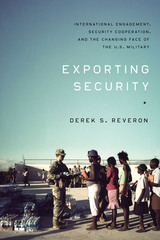
Given U.S. focus on the continuing wars in Iraq and Afghanistan, it is easy to miss that the military does much more than engage in combat. On any given day, military engineers dig wells in East Africa, medical personnel provide vaccinations in Latin America, and special forces mentor militaries in southeast Asia.
To address today's security challenges, the military partners with civilian agencies, NGOs, and the private sector both at home and abroad. By doing so, the United States seeks to improve its international image, strengthen the state sovereignty system by training and equipping partners’ security forces, prevent localized violence from escalating into regional crises, and protect U.S. national security by addressing underlying conditions that inspire and sustain violent extremism.
In Exporting Security, Derek Reveron provides a comprehensive analysis of the shift in U.S. foreign policy from coercive diplomacy to cooperative military engagement, examines how and why the U.S. military is an effective tool of foreign policy, and explores the methods used to reduce security deficits around the world.

Social media compile data on users, retailers mine information on consumers, Internet giants create dossiers of who we know and what we do, and intelligence agencies collect all this plus billions of communications daily. Exploiting our boundless desire to access everything all the time, digital technology is breaking down whatever boundaries still exist between the state, the market, and the private realm. Exposed offers a powerful critique of our new virtual transparence, revealing just how unfree we are becoming and how little we seem to care.
Bernard Harcourt guides us through our new digital landscape, one that makes it so easy for others to monitor, profile, and shape our every desire. We are building what he calls the expository society—a platform for unprecedented levels of exhibition, watching, and influence that is reconfiguring our political relations and reshaping our notions of what it means to be an individual.
We are not scandalized by this. To the contrary: we crave exposure and knowingly surrender our privacy and anonymity in order to tap into social networks and consumer convenience—or we give in ambivalently, despite our reservations. But we have arrived at a moment of reckoning. If we do not wish to be trapped in a steel mesh of wireless digits, we have a responsibility to do whatever we can to resist. Disobedience to a regime that relies on massive data mining can take many forms, from aggressively encrypting personal information to leaking government secrets, but all will require conviction and courage.

In Extra/ordinary Johannesburg, urbanist Lindsay Blair Howe argues that Johannesburg, part of the highly urbanized Gauteng City-Region and often labeled as an “apartheid city,” is an “ordinary” space where spatial changes both marginalize and create opportunities for people in their everyday lives. Structured around the concepts of urbanization and peripheralization and drawing on Henri Lefebvre’s theory of spatial dialectics, the book uses empirical research methods like smartphone applications and volunteered geographic information to draw theoretical conclusions, providing exciting new insights into urban denizens’ daily lives and how urbanization in the Gauteng region relates to the decolonial project. One central premise is that understanding how people navigate the urban fabric of centralities, peripheries, and the spaces in between is crucial for reimagining effective ways to address poverty and inequality in urban Africa.
READERS
Browse our collection.
PUBLISHERS
See BiblioVault's publisher services.
STUDENT SERVICES
Files for college accessibility offices.
RECENTLY PUBLISHED






UChicago Accessibility Resources
home | accessibility | search | about | contact us
BiblioVault ® 2001 - 2026
The University of Chicago Press