
 A SCHOLARLY BOOK REPOSITORY
117 books about Diseases & Conditions and 4
start with E
117 books about Diseases & Conditions and 4
117 books about Diseases & Conditions
4 start with E start with E
4 start with E start with E

The Elephant in the Room
How to Stop Making Ourselves and Other Animals Sick
Liz Kalaugher
University of Chicago Press, 2025
A healthier future starts with seeing the human causes of wildlife diseases.
When new diseases spread, news reports often focus on wildlife culprits—rodents, monkeys and mpox; bats and COVID-19; waterfowl and avian flu; or mosquitoes and Zika. But, in this urgent and engaging book, we see it often works the other way around—humans have caused diseases in other animals countless times, through travel and transport, the changes we impose on our environment, and global warming. With science journalist Liz Kalaugher as our guide, we meet the wildlife we have harmed and the experts now studying the crosscurrents between humans, other animals, and health.
Herds of buffalo in Kenya, cloned ferrets in Colorado, and frogs shipped worldwide as living pregnancy tests for humans, all help Kalaugher dive into the murky backstories behind wildlife epidemics past and present. We learn that military conflict likely contributed to the spread of rinderpest, or cattle plague, throughout Africa, devastating pastoral communities. That crowded poultry farms may create virulent new forms of bird flu that spill back into the wild. And that West Nile virus—which affects not only birds and humans, but other animals, including horses, skunks, and squirrels—is spreading as global temperatures rise.
Expanding today’s discussions of environmental protection to include illness and its impact, Kalaugher both sounds the alarm and explores ways to stop the emergence and spread of wildlife diseases. These solutions start with a simple lesson: when we protect other animals, we protect ourselves.
When new diseases spread, news reports often focus on wildlife culprits—rodents, monkeys and mpox; bats and COVID-19; waterfowl and avian flu; or mosquitoes and Zika. But, in this urgent and engaging book, we see it often works the other way around—humans have caused diseases in other animals countless times, through travel and transport, the changes we impose on our environment, and global warming. With science journalist Liz Kalaugher as our guide, we meet the wildlife we have harmed and the experts now studying the crosscurrents between humans, other animals, and health.
Herds of buffalo in Kenya, cloned ferrets in Colorado, and frogs shipped worldwide as living pregnancy tests for humans, all help Kalaugher dive into the murky backstories behind wildlife epidemics past and present. We learn that military conflict likely contributed to the spread of rinderpest, or cattle plague, throughout Africa, devastating pastoral communities. That crowded poultry farms may create virulent new forms of bird flu that spill back into the wild. And that West Nile virus—which affects not only birds and humans, but other animals, including horses, skunks, and squirrels—is spreading as global temperatures rise.
Expanding today’s discussions of environmental protection to include illness and its impact, Kalaugher both sounds the alarm and explores ways to stop the emergence and spread of wildlife diseases. These solutions start with a simple lesson: when we protect other animals, we protect ourselves.
[more]
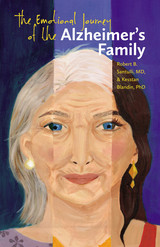
The Emotional Journey of the Alzheimer's Family
Robert B. Santulli and Kesstan Blandin
Dartmouth College Press, 2015
Alzheimer’s disease is a growing public health crisis. According to the Alzheimer’s Association, there are 5.4 million victims of this disease; by 2050, there will be close to 15 million people who suffer from this debilitating disorder of memory, thinking, personality, and functioning. The disease profoundly affects immediate family members, close friends, and neighbors. These people—the Alzheimer’s family—undergo tremendous psychological and emotional change as they witness the cruel and relentless progression of the disease in their loved one. Incorporating over thirty years of experience with Alzheimer’s patients and their families with current medical knowledge, the authors chart the complex emotional journey of the Alzheimer’s family from the onset of the disease through the death of the loved one. They discuss the anger that rises in the face of discordant views of the disease, the defenses that emerge when family members are unwilling to accept a dementia diagnosis, and the common emotions of anxiety, guilt, anger, and shame. They focus especially on grief as the core response to losing a loved one to dementia, and describe the difficult processes of adaptation and acceptance, which lead to personal growth. Final chapters emphasize the importance of establishing a care community and how to understand and cope with personal stress. This volume will be useful to medical professionals and ordinary people close to or caring for a person with dementia.
[more]
An Epidemic of Uncertainty
Navigating HIV and Young Adulthood in Malawi
Jenny Trinitapoli
University of Chicago Press, 2023
A decade-long study of young adulthood in Malawi that demonstrates the impact of widespread HIV status uncertainty, laying bare the sociological implications of what is not known.
An Epidemic of Uncertainty advances a new framework for studying social life by emphasizing something social scientists routinely omit from their theories, models, and measures–what people know they don’t know. Taking Malawi’s ongoing AIDS epidemic as an entry point, Jenny Trinitapoli shows that despite admirable declines in new HIV infections and AIDS-related mortality, an epidemic of uncertainty persists; at any given point in time, fully half of Malawian young adults don’t know their HIV status. Reckoning with the impact of this uncertainty within the bustling trading town of Balaka, Trinitapoli argues that HIV-related uncertainty is measurable, pervasive, and impervious to biomedical solutions, with consequences that expand into multiple domains of life, including relationship stability, fertility, and health. Over the duration of a groundbreaking decade-long longitudinal study, rich survey data and poignant ethnographic vignettes vividly depict how individual lives and population patterns unfold against the backdrop of an ever-evolving epidemic. Even as HIV is transformed from a progressive, fatal disease to a chronic and manageable condition, the accompanying epidemic of uncertainty remains fundamental to understanding social life in this part of the world.
Insisting that known unknowns can and should be integrated into social-scientific models of human behavior, An Epidemic of Uncertainty treats uncertainty as an enduring aspect, a central feature, and a powerful force in everyday life.
An Epidemic of Uncertainty advances a new framework for studying social life by emphasizing something social scientists routinely omit from their theories, models, and measures–what people know they don’t know. Taking Malawi’s ongoing AIDS epidemic as an entry point, Jenny Trinitapoli shows that despite admirable declines in new HIV infections and AIDS-related mortality, an epidemic of uncertainty persists; at any given point in time, fully half of Malawian young adults don’t know their HIV status. Reckoning with the impact of this uncertainty within the bustling trading town of Balaka, Trinitapoli argues that HIV-related uncertainty is measurable, pervasive, and impervious to biomedical solutions, with consequences that expand into multiple domains of life, including relationship stability, fertility, and health. Over the duration of a groundbreaking decade-long longitudinal study, rich survey data and poignant ethnographic vignettes vividly depict how individual lives and population patterns unfold against the backdrop of an ever-evolving epidemic. Even as HIV is transformed from a progressive, fatal disease to a chronic and manageable condition, the accompanying epidemic of uncertainty remains fundamental to understanding social life in this part of the world.
Insisting that known unknowns can and should be integrated into social-scientific models of human behavior, An Epidemic of Uncertainty treats uncertainty as an enduring aspect, a central feature, and a powerful force in everyday life.
[more]

Esophageal Cancer
Real life stories from patients and families
Edited by Ellen R. Abramson
Michigan Publishing Services, 2015
This book presents the stories of eleven patients and family members who received the diagnosis of esophageal cancer. The stories, provided by esophageal cancer survivors, illustrate some of the setbacks and some of the triumphs, that these individuals and their families encountered. All of these patients underwent a remarkable surgical procedure known as an esophagectomy. During this operation, the majority of the esophagus is removed. In order to restore swallowing, the stomach is reconfigured into a tube that is repositioned in the chest and neck and sutured to the remaining esophagus. The stories convey courage and strength in the face of a major life-changing event and its consequences. The authors describe in detail what the experience was like for themselves and their loved ones. Their stories are inspiring and offer hope to others facing this illness. Book sales support patient and family education in the Thoracic Surgery section of the University of Michigan Health System.
[more]
READERS
Browse our collection.
PUBLISHERS
See BiblioVault's publisher services.
STUDENT SERVICES
Files for college accessibility offices.
RECENTLY PUBLISHED







UChicago Accessibility Resources
home | accessibility | search | about | contact us
BiblioVault ® 2001 - 2026
The University of Chicago Press