
 A SCHOLARLY BOOK REPOSITORY
8 start with E start with E
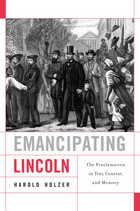
Emancipating Lincoln seeks a new approach to the Emancipation Proclamation, a foundational text of American liberty that in recent years has been subject to woeful misinterpretation. These seventeen hundred words are Lincoln’s most important piece of writing, responsible both for his being hailed as the Great Emancipator and for his being pilloried by those who consider his once-radical effort at emancipation insufficient and half-hearted.
Harold Holzer, an award-winning Lincoln scholar, invites us to examine the impact of Lincoln’s momentous announcement at the moment of its creation, and then as its meaning has changed over time. Using neglected original sources, Holzer uncovers Lincoln’s very modern manipulation of the media—from his promulgation of disinformation to the ways he variously withheld, leaked, and promoted the Proclamation—in order to make his society-altering announcement palatable to America. Examining his agonizing revisions, we learn why a peerless prose writer executed what he regarded as his “greatest act” in leaden language. Turning from word to image, we see the complex responses in American sculpture, painting, and illustration across the past century and a half, as artists sought to criticize, lionize, and profit from Lincoln’s endeavor.
Holzer shows the faults in applying our own standards to Lincoln’s efforts, but also demonstrates how Lincoln’s obfuscations made it nearly impossible to discern his true motives. As we approach the 150th anniversary of the Proclamation, this concise volume is a vivid depiction of the painfully slow march of all Americans—white and black, leaders and constituents—toward freedom.

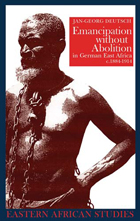
This study examines the complex history of slavery in East Africa, focusing on the area that came under German colonial rule. In contrast to the policy pursued at the time by other colonial powers in Africa, the German authorities did not legally abolish slavery in their colonial territories. However, despite government efforts to keep the institution of slavery alive, it significantly declined in Tanganyika in the period concerned. The book highlights the crucial role played by the slaves in the process of emancipation.
Author Jan-Georg Deutsch explores the rise of slavery in Tanganyika in the second half of the nineteenth century, when the region became more fully integrated into the world economy.
An analysis of German colonial policy reveals that the authorities believed that abolition should be avoided at all costs since it would undermine the power and prosperity of the local slave-owning elites whose effective collaboration was thought to be indispensable to the functioning of colonial rule.
The author demonstrates how slaves by their own initiative brought the ”evil institution“ to an end, making the best of limited choices and opportunities available to them.
The study, of interest to historians of East Africa, makes a contribution to the more general debate about the demise of slavery on the continent.
Arguing for equality as the necessary foundation of liberty
During Ralph Waldo Emerson’s lifetime, the idea of universal human equality was under intensive assault. Repeatedly—in contexts ranging from slavery, to marriage, to politics and workers’ rights—Americans of the time were being told that equality was an obsolete ideal and that the future would belong to those who accepted the hard truth that liberty lies not in egalitarian values but in hierarchies of domination and submission. Greg Garvey’s Emerson and the Defense of Equality focuses on Emerson as a real-time defender of equality during the antebellum culture wars.
In contrast to studies that treat individual liberty as Emerson’s primary concern, Garvey argues that Emerson’s works define a broad and sustained defense of equality as the necessary foundation of liberty. When read as part of a debate about equality, Emerson’s Nature is a treatise on individuality and the common weal; his anti-slavery speeches and English Traits advance evolutionary theories to rebut polygenesist arguments for white supremacy; the essays “Love” and “Domestic Life” challenge gender spheres and explore equality in marriage, friendship, and citizenship. As Emerson speculates on the future, “Politics” and “The Young American” anticipate a “beneficent socialism” in which human rights will always have priority over property rights. In his career-long effort to defend a threatened ideal, Emerson develops an aspirational vision of society that understands equality to be a fundamental aspect of liberty.

An exploration of the resilient lives and legacies of enslaved Africans in Africa
Unlike narratives focused on enslaved people in the Americas, Europe, or the Middle East, this edited collection highlights the lives of African slaves and their descendants who remained in Africa. The contributors chronicle lives spanning the continent, from Sierra Leone, Burkina Faso, Nigeria, Chad, and Cameroon to Egypt, Ethiopia, Tanzania, and South Africa.
The collection explores various forms of slavery and diverse personal trajectories, with many stories beginning in childhood enslavement and evolving into adulthood with limited chances for education or personal advancement. Notably, the accounts include figures who managed to achieve prominent roles, such as a slave who became a general and administrator, a female slave who rose to be a village chief, and a woman who became a successful obstetrician in Muslim Africa.
The narratives underscore the resilience and agency of the enslaved individuals, many of whom created meaningful lives despite the constraints and stigma of both slavery and post-slavery. Some, like a medical missionary in Tanganyika and a slave convert who helped grow the Catholic Church in Burkina Faso, contributed significantly to their communities and religious institutions.
Accessing these stories required rigorous research due to limited documentation, social silence surrounding slavery, and stigma associated with slave ancestry. The contributors’ extensive research brings together fragmented knowledge and oral histories to provide an invaluable perspective and insight into the complex identities, struggles, and achievements of African slaves and their descendants.
Contributors:
Richard Anderson
Dadda Astabarka
Abdourahman Halirou
Martin A. Klein
George Michael La Rue
Adam Mahamat
Ricardo Marquez Garcia
Stephen J. Rockel
Ute Röschenthaler
Mohammed Bashir Salau
Moris Samen
Sandra Rowoldt Shell
Joseph Jules Sinang
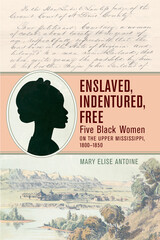
Focusing on these five women, Mary Elise Antoine explores the history of slavery in the Upper Mississippi River Valley, relying on legal documents, military records, court transcripts, and personal correspondence. Whether through perseverance, self-purchase, or freedom suits—including one suit that was used as precedent in Dred and Harriet Scott’s freedom suits years later—each of these women ultimately secured her freedom, thanks in part to the bonds they forged with one another.
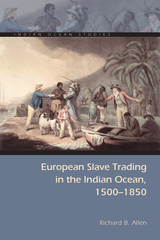
Between 1500 and 1850, European traders shipped hundreds of thousands of African, Indian, Malagasy, and Southeast Asian slaves to ports throughout the Indian Ocean world. The activities of the British, Dutch, French, and Portuguese traders who operated in the Indian Ocean demonstrate that European slave trading was not confined largely to the Atlantic but must now be viewed as a truly global phenomenon. European slave trading and abolitionism in the Indian Ocean also led to the development of an increasingly integrated movement of slave, convict, and indentured labor during the late eighteenth and early nineteenth centuries, the consequences of which resonated well into the twentieth century.
Richard B. Allen’s magisterial work dramatically expands our understanding of the movement of free and forced labor around the world. Drawing upon extensive archival research and a thorough command of published scholarship, Allen challenges the modern tendency to view the Indian and Atlantic oceans as self-contained units of historical analysis and the attendant failure to understand the ways in which the Indian Ocean and Atlantic worlds have interacted with one another. In so doing, he offers tantalizing new insights into the origins and dynamics of global labor migration in the modern world.
READERS
Browse our collection.
PUBLISHERS
See BiblioVault's publisher services.
STUDENT SERVICES
Files for college accessibility offices.
RECENTLY PUBLISHED





UChicago Accessibility Resources
home | accessibility | search | about | contact us
BiblioVault ® 2001 - 2026
The University of Chicago Press