front cover of Emily Dickinson's Herbarium
Emily Dickinson's Herbarium
A Facsimile Edition
Emily Dickinson
Harvard University Press, 2006

In a letter from 1845, the 14-year-old Emily Dickinson asked her friend Abiah Root if she had started collecting flowers and plants for a herbarium: "it would be such a treasure to you; 'most all the girls are making one." Emily's own album of more than 400 pressed flowers and plants, carefully preserved, has long been a treasure of Harvard's Houghton Library. This beautifully produced, slipcased volume now makes it available to all readers interested in the life and writings of Emily Dickinson.

The care that Emily put into her herbarium, as Richard Sewall points out, goes far beyond what one might expect of a botany student her age: "Take Emily's herbarium far enough, and you have her." The close observation of nature was a lifelong passion, and Emily used her garden flowers as emblems in her poetry and her correspondence. Each page of the album is reproduced in full color at full size, accompanied by a transcription of Dickinson's handwritten labels. Introduced by a substantial literary and biographical essay, and including a complete botanical catalog and index, this volume will delight scholars, gardeners, and all readers of Emily Dickinson's poetry.


[more]

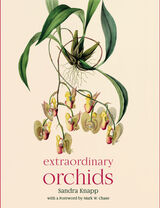
front cover of Extraordinary Orchids
Extraordinary Orchids
Sandra Knapp
University of Chicago Press, 2021
Perching on tropical trees, partnering with fungi to reproduce, or deceiving birds and amorous insects to promote pollination, orchids fascinate. In the exquisitely illustrated Extraordinary Orchids, award-winning botanist and writer Sandra Knapp tells the stories behind some of the bizarre lifestyles and interactions that scientists have uncovered among many species of the orchid family.

Orchids deserve such a visual celebration: parts of the orchid flower have shapes unlike any other flowering plant, and the sheer number of species means they have a seemingly endless ability to create ever more fantastical forms. In fact, many orchid common names refer to the shape-shifting forms of their flowers—the “man-orchids” or “monkey-orchids” are so called because of their resemblance to the primate form. Orchids lend themselves to depiction, and botanical artworks of them abound. Who could resist painting or drawing such odd shapes?

Illustrated with stunning artwork, much from the archives of the Natural History Museum in London and never before published, Extraordinary Orchids includes depictions from celebrated botanical artists such as Ferdinand and Franz Bauer, Arthur Harry Church, and Sydney Parkinson, revealing the weird and wonderful lives of this most diverse of plant families.
[more]


Send via email Share on Facebook Share on Twitter