
 A SCHOLARLY BOOK REPOSITORY
6 start with E start with E

Winner of the Association of Jewish Libraries' 2022 Judaica Bibliography Award.
The seven essays in this volume focus such previously unexplored subjects as the world’s first cookbook printed in Hebrew letters, published in 1854, and a wonderful 19th-century Jewish cookbook, which in addition to its Hungarian edition was also published in Dutch in Rotterdam. The author entertainingly reconstructs the history of bólesz, a legendary yeast pastry that was the specialty of a famous, but long defunct Jewish coffeehouse in Pest, and includes the modernized recipe of this distant relative of cinnamon rolls. Koerner also tells the history of the first Jewish bookstore in Hungary (founded as early as in 1765!) and examines the influence of Jewish cuisine on non-Jewish food.
In this volume András Koerner explores key issues of Hungarian Jewish culinary culture in greater detail and more scholarly manner than what space restrictions permitted in his previous work Jewish Cuisine in Hungary: A Cultural History, also published by CEU Press, which received the prestigious National Jewish Book Award in 2020. The current essays confirm the extent to which Hungarian Jewry was part of the Jewish life and culture of the Central European region before their almost total language shift by the turn of the 20th century.

In an exploration of the life and customs of the Hungarian nobility, this book compares historical reality and legal literature on the example of one noble family--the Elefánthy kindred from northern Hungary (present-day Slovakia). The author begins by outlining the customary law regarding noble status, inheritance and marriage, as summarized in the famous code of Stephen Werbőczy (1514). He then compares these norms with the documentary evidence and establishes the fact that the legal literature differs in regard to social mobility and kindred solidarity.
With this frame of reference in mind, the fate of the Elefánthy family is traced through several generations, enabling the author to make some general statistical statements on inheritance, the rise and fall of various branches, marriage strategies, and the "survival skills" of the kindred. In his summary, the author outlines some of the major avenues for further research, including the peculiar Hungarian form of retainership (familiaritas), and the relationships between noble families and between the nobility and local communities.

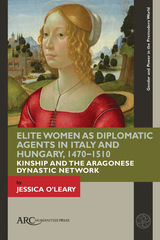
This book explores the diplomatic role of women in early modern European dynastic networks through the study of Aragonese marriage alliances in late fifteenth-century Italy and Hungary. It challenges the frequent erasure of dynastic wives from diplomatic and political narratives to show how elite women were diplomatically active agents for two dynasties.
Chapters analyze the lives of Eleonora (1450-1493) and Beatrice d'Aragona (1457-1508), daughters of King Ferrante of Naples (1423-1494), and how they negotiated their natal and marital relationships to achieve diplomatic outcomes. While Ferrante expected his daughters to follow paternal imperatives and to remain engaged in collective dynastic strategy, the extent of his kinswomen's continued participation in familial projects was dependent on the nature of their marital relationships. The book traces the access to these relationships that enabled courtly women to re-enter the diplomatic space after marriage, not as objects, but as agents, with their own strategies, politics, and schemes.
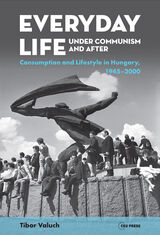
By providing a survey of consumption and lifestyle in Hungary during the second half of the twentieth century, this book shows how common people lived during and after tumultuous regime changes. After an introduction covering the late 1930s, the study centers on the communist era, and goes on to describe changes in the post-communist period with its legacy of state socialism.
Tibor Valuch poses a series of questions. Who could be called rich or poor and how did they live in the various periods? How did living, furnishings, clothing, income, and consumption mirror the structure of the society and its transformations? How could people accommodate their lifestyles to the political and social system? How specific to the regime was consumption after the communist takeover, and how did consumption habits change after the demise of state socialism? The answers, based on micro-histories, statistical data, population censuses and surveys help to understand the complexities of daily life, not only in Hungary, but also in other communist regimes in east-central Europe, with insights on their antecedents and afterlives.
With the collapse of the state socialist regimes in East-Central Europe, it was widely expected that collectivized agriculture would quickly be remade in the glowing image of China--a patchwork of small, privately run farms yielding rapid increases in output and incomes. However, the European experience has been quite different; while socialist collective farms have disappeared, collective forms of organization have persisted, and private farming has been slow to emerge. Meurs argues that an understanding of the causes of the slow emergence of private farming is essential to effective policy intervention in agriculture. This book contributes to such an understanding through analyzing variations in farm organization and rural market development and comparing agricultural restructuring in Hungary and Bulgaria.
The Evolution of Agrarian Institutions is unique in its combination of original survey data, published data on land use, and published historical data. It also tests two institutionalist explanations for the pace and direction of change in agricultural organization. This book will be of interest to economists, political scientists, sociologists, scholars working in the area of rural development in emerging countries, and anyone with an interest in transitional economics.
Mieke Meurs is Associate Professor of Economics, American University.
READERS
Browse our collection.
PUBLISHERS
See BiblioVault's publisher services.
STUDENT SERVICES
Files for college accessibility offices.
RECENTLY PUBLISHED




UChicago Accessibility Resources
home | accessibility | search | about | contact us
BiblioVault ® 2001 - 2026
The University of Chicago Press