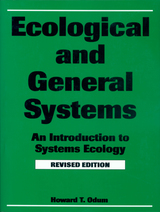
front cover of Ecological and General Systems
Ecological and General Systems
An Introduction to Systems Ecology, Revised Edition
Howard T. Odum
University Press of Colorado, 1994
Using an energy systems language that combines energetics, kinetics, information, cybernetics, and simulation, Ecological and General Systems compares models of many fields of science, helping to derive general systems principles.

First published as Systems Ecology in 1983, Ecological and General Systems proposes principles of self-organization and the designs that prevail by maximizing power and efficiency. Comparisons to fifty other systems languages are provided. Innovative presentations are given on earth homeostasis (Gaia); the inadequacy of presenting equations without network relationships and energy constraints; the alternative interpretation of high entropy complexity as adaptive structure; basic equations of ecological economics; and the energy basis of scientific hierarchy.

Part I introduces energetics, hierarchy, and systems modeling. Part II features design elements: intersections, autocatalytic modules, loops, series, parallel elements, and webs. Part III includes embodied energy, spectra of energy quality, temperature, complexity, spatial distribution, and diversity. Part IV discusses production, consumption, ecosystems, succession, economic systems, anthropological models, urban and regional models, global biogeochemistry, and the universe.


[more]

front cover of English Syntax
English Syntax
An Introduction
Jon-Bok Kim and Peter Sells
CSLI, 2008
Focusing on the descriptive facts of English, this volume provides a systematic introduction to English syntax for students with no prior knowledge of English grammar or syntactic analysis. English Syntax aims to help students appreciate the various sentence patterns available in the language, understand insights into core data of its syntax, develop analytic abilities to further explore the patterns of English, and learn precise ways of formalizing syntactic analysis for a variety of English data and major constructions such as agreement, raising and control, the auxiliary system, passive, wh- questions, relative clauses, extrapolation, and clefts.


[more]

front cover of Ezekiel 1–24
Ezekiel 1–24
Introduction and Commentary
Dale F. Launderville
SBL Press, 2026
In volume 1 of his cutting-edge two-volume commentary, Dale F. Launderville relies on the Hebrew, Old Greek, Aramaic, Syriac, and Latin texts of Ezekiel to produce a fresh translation of the first twenty-four chapters. Each passage is followed by interpretive sections that emphasize the history of reception, explaining how the text of Ezekiel has sparked the imagination of subsequent thinkers, writers, and artists. Each chapter concludes with a section of commentary dedicated to a historical-critical examination of the canonical text. Readers will become more equipped to interpret Ezekiel and more confident in their understanding of Old Testament prophecy and its relevance to contemporary issues in church and society. This is an essential resource for ministers, seminary students, and teachers of biblical studies courses.
[more]


Send via email Share on Facebook Share on Twitter